Key Takeaways
- AB 1482 is the statewide floor — but local rent control ordinances override it whenever they are stricter
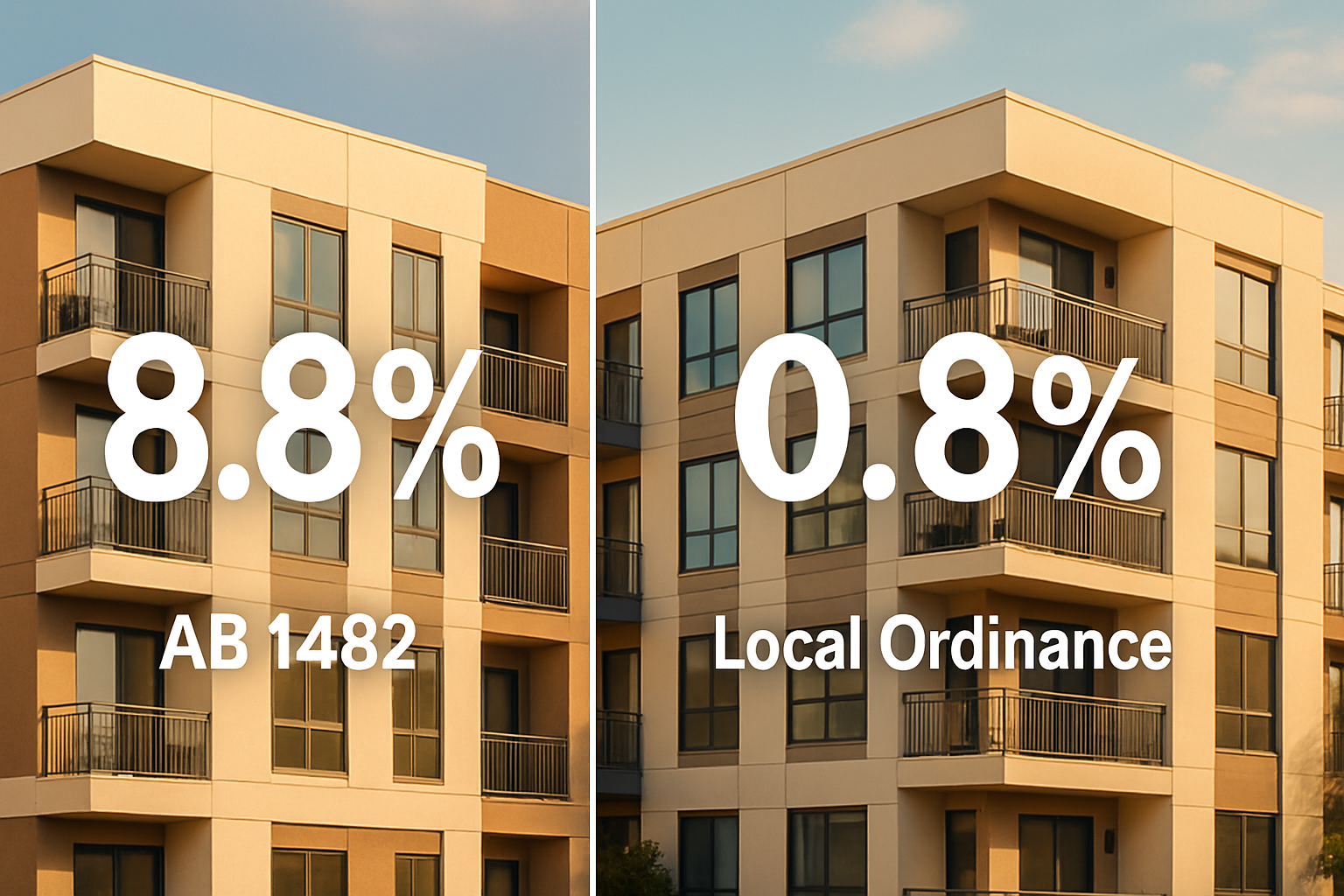
- In cities like Oakland (0.8%), Berkeley (1.0%), and San Francisco (1.7%), tenants are protected well below the ~8% AB 1482 cap
- Local ordinances often add just cause protections from day one, mandatory registration, relocation assistance, and rent banking restrictions that AB 1482 does not require
- Construction year cutoffs vary widely — from 1978 (LA, SF) to no cutoff at all (East Palo Alto, Pomona)
- If your city has no local ordinance, AB 1482 applies by default — and that still means a hard cap and just cause rules after 12 months
AB 1482: The Statewide Baseline
Assembly Bill 1482, the California Tenant Protection Act of 2019, caps annual rent increases at 5% + local CPI (maximum 10%) and requires just cause for evictions after 12 months of tenancy. It applies to most residential rental properties statewide and was extended through January 1, 2035 by AB 12 (2024).
But AB 1482 was never intended to be the final word. The law explicitly defers to local ordinances when they are stricter. If you own property in a city with its own rent control program, the local rules almost certainly govern your property — not AB 1482. Understanding which law applies, and where the differences lie, is the single most important compliance question for California landlords with properties in multiple jurisdictions.
For a full breakdown of AB 1482 on its own — CPI rates, exemptions, notice requirements, and penalties — see our AB 1482 Rent Cap Calculator and California Landlord Compliance Checklist.
The Stricter-Rule-Applies Principle
California’s approach to overlapping rent control is straightforward: the stricter rule wins. This principle is codified in Civil Code §1946.2(g), which states that AB 1482’s provisions do not supersede any local ordinance that is “more protective” of tenants.
In practice, this means:
- If your city caps rent increases at 3% and AB 1482 allows 8.7%, the 3% cap applies
- If your city requires just cause eviction from day one (not after 12 months), the day-one requirement applies
- If your city requires relocation assistance of two months’ rent (vs. AB 1482’s one month), the two-month requirement applies
- If your city covers properties built before 1995 (narrower than AB 1482’s 15-year rolling window), AB 1482 may still cover newer properties that fall outside the local ordinance
This last point is critical. The two laws can apply to different units within the same city. A building constructed in 1990 in San Francisco is covered by the local ordinance. A building constructed in 2005 in San Francisco falls outside the local ordinance (which only covers pre-1979 construction) but is covered by AB 1482 — as long as it is more than 15 years old.
Rent Cap Comparison: Every Major California Jurisdiction
The following table compares current local rent caps against the AB 1482 statewide cap for all major rent-controlled jurisdictions in California. Local caps shown are the most recently published allowable annual increase as of mid-2026. AB 1482 caps vary by CPI region.
| City | Local Cap | AB 1482 Cap (Regional) | Which Applies |
|---|---|---|---|
| Oakland | 0.8% | ~8.5% | Local (0.8%) |
| Berkeley | 1.0% | ~8.5% | Local (1.0%) |
| San Francisco | 1.7% | ~8.5% | Local (1.7%) |
| LA County (Unincorporated) | 1.93% | ~8.8% | Local (1.93%) |
| East Palo Alto | 2.2% | ~8.5% | Local (2.2%) |
| West Hollywood | 2.25% | ~8.8% | Local (2.25%) |
| Pasadena | 2.25% | ~8.8% | Local (2.25%) |
| Santa Monica | 2.3% | ~8.8% | Local (2.3%) |
| Santa Ana | 2.42% | ~8.8% | Local (2.42%) |
| Mountain View | 2.7% | ~8.5% | Local (2.7%) |
| Los Angeles | 3.0% | ~8.8% | Local (3.0%) |
| Beverly Hills | 3.0% | ~8.8% | Local (3.0%) |
| San Jose | 5.0% | ~8.5% | Local (5.0%) |
Note: Local caps shown are the most recent published rates. These change annually based on each city’s formula (typically CPI-based). The AB 1482 “regional” column reflects the approximate 5% + CPI cap for each city’s BLS region. In every case above, the local cap is significantly stricter than AB 1482.
Want to calculate the exact cap for your property? Use our city-specific calculators: Los Angeles, San Francisco, Oakland, Berkeley, or San Jose. For AB 1482 statewide calculations, use the AB 1482 Calculator.
Beyond Rent Caps: Where Local Ordinances Diverge from AB 1482
The rent cap comparison is the most visible difference, but it is far from the only one. Local rent control ordinances impose requirements that AB 1482 does not — and in some cases, the gap is enormous.
Just Cause Eviction: Day One vs. 12 Months
Under AB 1482, just cause eviction protections kick in after a tenant has occupied a unit for 12 months. During that first year, a landlord can terminate a month-to-month tenancy with proper notice and no stated reason.
Most local rent control ordinances do not give landlords that grace period. In San Francisco, Oakland, Berkeley, Los Angeles, Santa Monica, West Hollywood, and East Palo Alto, just cause protections apply from the first day of tenancy. You cannot terminate a tenancy without a legally recognized reason — not even during the first month.
This distinction catches landlords who move from AB 1482-only cities to local rent control jurisdictions. A practice that was perfectly legal in Sacramento (giving a 60-day no-cause notice to a month-to-month tenant in their eighth month) would be an illegal eviction in San Francisco.
Relocation Assistance
AB 1482 requires one month’s rent in relocation assistance for no-fault evictions (owner move-in, Ellis Act withdrawal, substantial remodel). Local ordinances often require significantly more:
- San Francisco: Relocation payments can exceed $7,000 per tenant, with additional amounts for elderly, disabled, and families with minor children
- Los Angeles: Relocation assistance ranges from approximately $8,000 to $22,000+ depending on unit size, tenant age, disability status, and length of tenancy
- Santa Monica: Relocation fees are among the highest in the state, with additional protections for long-term tenants
- Berkeley: Relocation assistance is required for most no-fault evictions, with amounts indexed to the rental market
If your property is in a city with local rent control, the local relocation assistance requirement applies — not AB 1482’s one-month figure.
Registration and Fee Requirements
AB 1482 does not require landlords to register their properties or pay any fees to the state. Many local ordinances do:
- Los Angeles (LAHD): Annual registration required; systematic code enforcement fee (SCEP) per unit
- San Francisco: Annual registration with the San Francisco Rent Board
- Oakland: Annual registration with the Rent Adjustment Program
- Berkeley: Annual registration with the Rent Stabilization Board
- San Jose: Annual registration with the Rent Stabilization Program
- Mountain View: Annual registration with the Community Stabilization and Fair Rent Act program
Failure to register can result in fines, inability to collect rent increases, and in some cities, a presumption that the tenant’s reported rent is accurate in any dispute.
Rent Banking Restrictions
“Rent banking” refers to the practice of accumulating unused allowable increases and applying them in a future year. For example, if you are allowed a 3% increase but only raise rent by 1%, can you apply the remaining 2% next year on top of next year’s allowable increase?
AB 1482 does not address rent banking — it simply caps each year’s increase independently. Local ordinances vary:
- Oakland: Rent banking is prohibited. You can only apply the current year’s allowable increase.
- San Francisco: Rent banking is allowed. Landlords can accumulate and apply unused increases.
- Berkeley: Rent banking is prohibited.
- Los Angeles: Rent banking is allowed, subject to certain limits.
- San Jose: Rent banking is allowed, with a cap on cumulative banked increases.
If you own properties in multiple cities, you need to track these rules individually. Applying a banked increase in Oakland is a violation; the same action in San Francisco is perfectly legal.
Construction Year Cutoffs: Which Buildings Are Covered
One of the most confusing aspects of California rent control is the patchwork of construction year cutoffs. These cutoffs determine which buildings fall under the local ordinance based on when they were built.
Why Construction Cutoffs Exist
The Costa-Hawkins Rental Housing Act (1995) prohibits local governments from applying rent control to buildings that received their certificate of occupancy after the date the local ordinance was adopted. This means older ordinances cover fewer buildings, while newer ordinances can cover more recent construction.
Cutoff Dates by City
| City | Construction Cutoff | Notes |
|---|---|---|
| Los Angeles | October 1, 1978 | Certificate of occupancy before this date |
| San Francisco | June 13, 1979 | Buildings with first certificate of occupancy before this date |
| San Jose | September 7, 1979 | Based on date of ordinance adoption |
| West Hollywood | July 1, 1979 | Based on date of city incorporation and ordinance |
| Hayward | July 1, 1979 | Rent stabilization ordinance adoption date |
| Berkeley | June 1980 | Based on original ordinance passage |
| Oakland | January 1, 1983 | Buildings with certificate of occupancy before this date |
| Richmond | December 31, 1995 | Newer ordinance allows broader coverage under Costa-Hawkins |
| Mountain View | December 31, 1995 | Community Stabilization and Fair Rent Act (2016) |
| East Palo Alto | No cutoff | Ordinance predates Costa-Hawkins; covers all rental housing |
| Pomona | No cutoff | Covers all multifamily rental housing regardless of build date |
What This Means for Your Property
If your building was constructed after the local cutoff date but is more than 15 years old, it falls outside the local ordinance but is still covered by AB 1482. This creates a middle tier of properties that are subject to the statewide cap (5% + CPI) but not the typically stricter local cap.
Example: A building in Los Angeles with a certificate of occupancy dated March 1985. It was built after the October 1978 cutoff, so it is not covered by the LA Rent Stabilization Ordinance. However, it is more than 15 years old, so it is covered by AB 1482. The landlord can raise rent up to 8.8% (AB 1482 cap for the LA region) rather than being limited to the 3% LA local cap.
A building in the same neighborhood with a certificate of occupancy dated June 1975 is covered by both the LA RSO and AB 1482 — and the stricter local 3% cap applies.
How to Determine Which Law Applies to Your Property
Follow this decision tree to determine the governing rent control law for your property:
Step 1: Is your property exempt from all rent control?
Check the AB 1482 exemptions first:
- Is the property a single-family home or condo owned by a natural person (not a corporation, REIT, or LLC with a corporate member) and have you provided the required exemption notice? → Exempt from AB 1482 (but check whether a local ordinance still applies — some local ordinances cover single-family homes)
- Was the property built within the last 15 years? → Exempt from AB 1482 and likely exempt from local ordinances (Costa-Hawkins)
- Is it an owner-occupied duplex? → Exempt from AB 1482 (check local ordinance for its own owner-occupied exemption)
Step 2: Does your city have a local rent control ordinance?
If your city is not on the list of rent-controlled jurisdictions, AB 1482 is the governing law. This includes Sacramento, San Diego, Fresno, Bakersfield, Stockton, Modesto, Riverside, and most other California cities.
Step 3: Was your property built before the local cutoff date?
If your city has local rent control, check whether your building’s certificate of occupancy date falls before the local cutoff. If it does, the local ordinance governs your property (with its stricter caps, registration requirements, and additional protections).
If your building was constructed after the local cutoff, it falls outside the local ordinance. In that case, check whether it is more than 15 years old — if so, AB 1482 applies. If it is fewer than 15 years old, neither law applies and there is no rent cap.
Step 4: Apply the stricter rule
For properties covered by a local ordinance, remember that both the local ordinance and AB 1482 can technically apply simultaneously. The stricter provision in each category wins:
- Rent cap: use the lower percentage
- Just cause: use the one that applies earlier (day one vs. 12 months)
- Relocation assistance: use the higher amount
- Notice requirements: use the longer notice period
When Your City Has No Local Rent Control
The majority of California cities do not have their own rent control ordinances. In these cities, AB 1482 is the only rent regulation that applies. This includes major cities and regions such as:
- Sacramento — The state capital has the Tenant Protection Program (TPP), which mirrors AB 1482’s formula (5% + CPI, max 10%) rather than imposing a stricter local cap
- San Diego — No local rent control; AB 1482 governs
- Fresno — No local rent control; AB 1482 governs
- Bakersfield, Stockton, Modesto — No local rent control
- Riverside, San Bernardino — No local rent control
- Most Central Valley and Inland Empire cities — No local rent control
If you own properties exclusively in these areas, your compliance obligation is simpler: follow AB 1482. Track the annual CPI for your region, calculate your maximum 5% + CPI increase (capped at 10%), serve proper notice, and comply with just cause requirements after 12 months of tenancy. Use the AB 1482 Calculator to stay current.
Sacramento’s Tenant Protection Program: Same Formula, Separate Law
Sacramento is a special case worth understanding. The city adopted its own Tenant Protection Program (TPP) in 2019, but it deliberately mirrors AB 1482’s rent cap formula: 5% + CPI, maximum 10%.
So why does it matter? Because the Sacramento TPP has its own enforcement mechanisms, its own administrative processes, and — critically — it could be amended independently of AB 1482. If the Sacramento City Council decides to lower the cap to 3% + CPI, that would be a local ordinance change that AB 1482 would defer to under the stricter-rule-applies principle.
For now, the practical effect is the same: Sacramento landlords follow the 5% + CPI formula regardless of whether they think of it as “AB 1482” or “the TPP.” But staying aware of local council activity is important — a change could come at any time.
Multi-City Landlords: Managing Compliance Across Jurisdictions
If you own properties in multiple California cities — say, one in Oakland, one in Sacramento, and one in San Jose — you are operating under three different regulatory frameworks simultaneously:
- Oakland: 0.8% annual cap, just cause from day one, no rent banking, mandatory registration with the Rent Adjustment Program, relocation assistance for no-fault evictions
- Sacramento: ~7.7% annual cap (5% + 2.7% CPI), just cause after 12 months, no separate registration
- San Jose: 5.0% flat cap, just cause from day one, rent banking allowed, mandatory registration with the Rent Stabilization Program
Treating all three properties the same is a compliance failure waiting to happen. Each property needs its own rent increase calendar, its own notice procedures, and its own documentation trail. This is one of the strongest arguments for using automated compliance tracking rather than spreadsheets — the rules are too varied and change too frequently for manual tracking to be reliable.
“The landlords who get into trouble aren’t the ones who ignore rent control entirely — it’s the ones who know about AB 1482 but don’t realize their city has a stricter local ordinance. They calculate 8% when the legal max is 1.7%. That’s the gap that creates real liability.”
— Rachid Abadli, Founder & CEO at LeaseBase, California landlord and compliance technology builder
Recent and Upcoming Changes to Watch
California’s rent control landscape is not static. Several developments are worth monitoring:
- AB 12 extension (2024): Extended AB 1482 through January 1, 2035, making it a long-term compliance requirement rather than a temporary measure
- New local ordinances: Cities like Pasadena, Pomona, and Santa Ana adopted rent stabilization ordinances in 2023–2024. More cities may follow as housing costs continue to rise.
- Costa-Hawkins reform attempts: Multiple ballot initiatives and legislative proposals have sought to repeal or amend the Costa-Hawkins Act, which would allow cities to apply rent control to newer buildings and single-family homes. While these have not passed as of 2026, they remain active policy discussions.
- CPI volatility: Inflation fluctuations directly affect both AB 1482 and local caps that use CPI-based formulas. The 2022–2023 inflation spike produced some of the highest allowable increases in years, while the subsequent cooldown has lowered caps in many regions.
Frequently Asked Questions
Does AB 1482 apply if my city has rent control?
AB 1482 applies statewide, but if your city has a local ordinance that is stricter, the local ordinance governs. In practice, this means the local rent cap, just cause rules, and other protections override AB 1482’s provisions. However, AB 1482 can still cover properties that fall outside the local ordinance’s scope — for example, buildings constructed after the local cutoff date but more than 15 years ago.
How do I know if my city has a local rent control ordinance?
The major rent-controlled cities in California include Los Angeles, San Francisco, Oakland, Berkeley, San Jose, Santa Monica, West Hollywood, Beverly Hills, East Palo Alto, Mountain View, Richmond, Hayward, Pasadena, Pomona, Santa Ana, and unincorporated LA County. Check your city’s housing department website or contact your local rent board. If your city is not on this list, AB 1482 is likely the governing law.
Can I use the AB 1482 rent cap if it is higher than my local cap?
No. The stricter-rule-applies principle means you must use whichever cap is lower. If your local ordinance caps increases at 1.7% and AB 1482 allows 8.5%, your legal maximum is 1.7%. Charging above the local cap — even if you are within AB 1482’s limit — is a violation of local law and exposes you to penalties, rent refunds, and potential legal action.
My property was built in 1985. Which law applies in Los Angeles?
The LA Rent Stabilization Ordinance (RSO) covers buildings with a certificate of occupancy before October 1, 1978. Since your building was constructed in 1985, it falls outside the RSO. However, it is more than 15 years old, so AB 1482 applies. You would follow the AB 1482 cap (~8.8% for the LA region) rather than the LA RSO’s 3% cap. You would also follow AB 1482’s just cause rules (12-month threshold) rather than the RSO’s day-one just cause requirement.
Do I need to register my property if I am only subject to AB 1482?
No. AB 1482 does not require any registration or fees. Registration requirements come exclusively from local rent control ordinances. If your property is subject only to AB 1482 (because your city has no local ordinance or your building falls outside the local ordinance’s scope), there is no registration obligation.
What is rent banking, and does AB 1482 allow it?
Rent banking is accumulating unused allowable rent increases to apply in future years. AB 1482 does not explicitly address rent banking — each year’s cap is calculated independently. Local ordinances vary: San Francisco and Los Angeles allow it (with limits), while Oakland and Berkeley prohibit it. Check your specific city’s rules.
What happens if I accidentally exceed the local rent cap?
The tenant can file a complaint with the local rent board (if one exists), demand a refund of excess rent paid, and potentially recover additional damages. In cities with administrative enforcement (LA, SF, Oakland, Berkeley), the rent board can order a rollback and impose penalties. Under AB 1482, tenants can also recover excess rent plus punitive damages and attorney’s fees through civil litigation.
Can a city adopt rent control that is less strict than AB 1482?
A city could adopt its own ordinance with a higher cap than AB 1482, but it would be irrelevant for most practical purposes — AB 1482 would still cap increases at the statewide level. The city’s ordinance would only matter if it contained provisions not addressed by AB 1482 (such as registration requirements or specific eviction procedures). The stricter rule always applies in each category.
Does Costa-Hawkins still limit local rent control?
Yes. The Costa-Hawkins Rental Housing Act still prohibits local governments from applying rent control to single-family homes, condos, and buildings constructed after the date the local ordinance was adopted. This is why construction cutoff dates exist. Efforts to repeal Costa-Hawkins (Proposition 10 in 2018, Proposition 21 in 2020) have failed at the ballot, but remain active policy discussions.
Stay Compliant Across Every Jurisdiction
Managing rent control compliance across multiple California jurisdictions is complex. The rules change annually, vary by city, and depend on your property’s construction date, ownership structure, and tenant tenure. Getting it wrong exposes you to rent refunds, penalties, and costly litigation.
LeaseBase tracks rent control compliance automatically for each of your properties — whether they fall under AB 1482, a local ordinance, or both. You see the correct maximum allowable increase for every unit, calculated against the right law, with the right CPI, every year. No spreadsheets, no guessing, no accidental violations.
Related Reading
- AB 1482 Rent Cap Calculator
- California Landlord Compliance Checklist
- Why More California Landlords Are Self-Managing
- California Security Deposit Laws 2026: Complete Landlord Guide
- California Rent Increase Notice Requirements 2026
- Common Rent Increase Mistakes & Penalties
Disclaimer: This article is for informational purposes only and does not constitute legal advice. Laws and regulations change frequently. Consult a licensed attorney for advice specific to your situation.