Key Takeaways
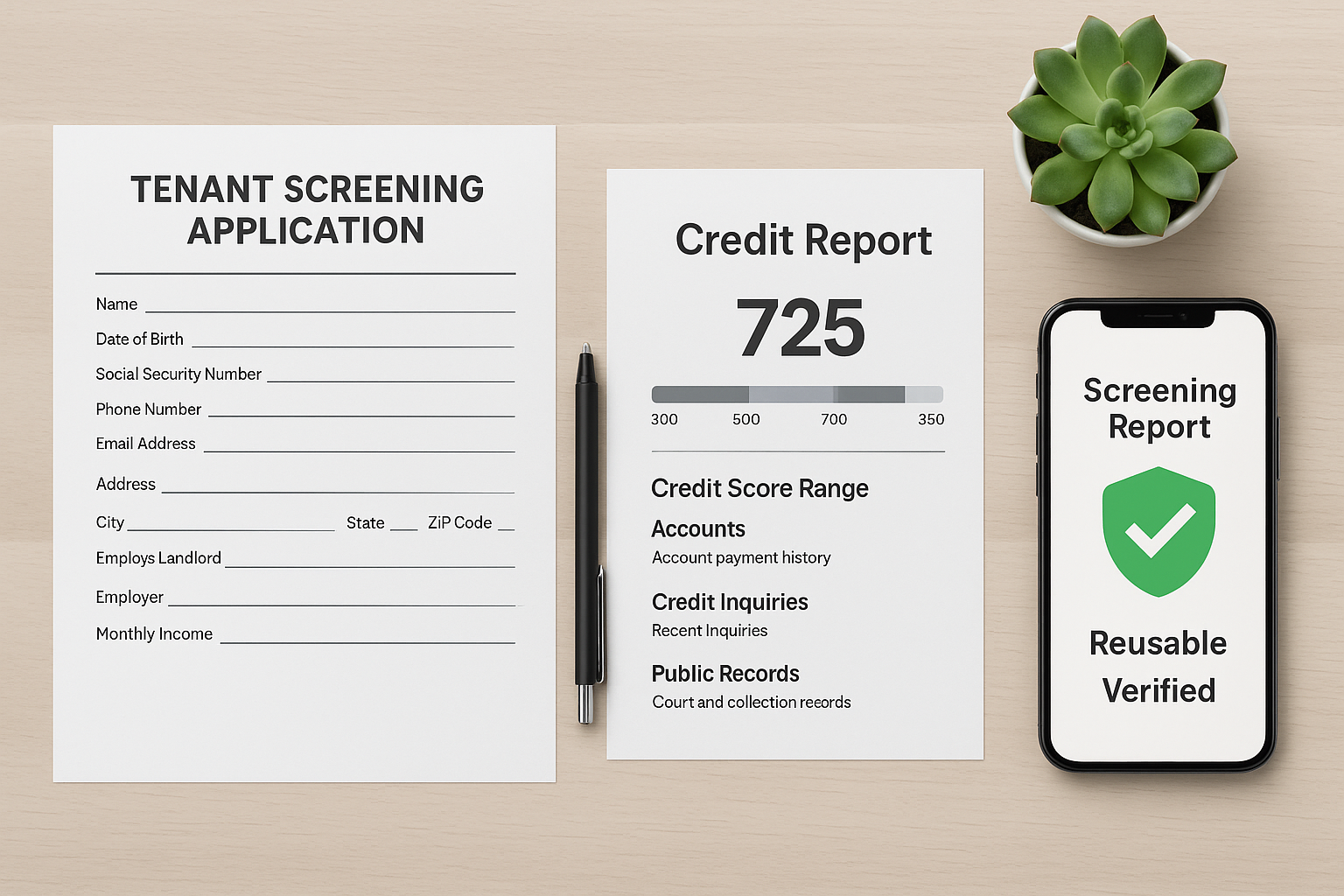
- AB 2559 (effective January 1, 2025) creates a reusable screening report system in California — tenants can purchase one consumer report from a qualifying provider and present it to multiple landlords instead of paying a separate screening fee for each application.
- You cannot refuse to accept a compliant reusable report — if a tenant presents a qualifying report that is no more than 30 days old, you must accept it and waive the screening fee. Refusing constitutes a violation of Civil Code §1950.6.
- The 30-day validity window is hard — a reusable screening report expires 30 days after it was generated. Reports older than 30 days may be refused, but you must notify the applicant and give them the opportunity to provide a current one.
- You can still run your own screening in limited circumstances — if the tenant does not provide a reusable report, or if the report does not meet the statutory requirements, you may charge up to the AB 2801 statutory cap (currently $65.34 for 2025, indexed annually to CPI).
- Itemized screening fee receipts are now required — if you collect a screening fee, Civil Code §1950.6 requires you to provide a written itemized receipt showing exactly how the fee was spent within 21 days of receiving the application.
- Violations expose you to actual damages, statutory damages, and attorney fees — non-compliance with the reusable report acceptance requirement or the receipt requirement is actionable by the tenant in civil court.
What AB 2559 Requires — The Plain-English Summary
California Assembly Bill 2559 was signed into law in September 2024 and took effect January 1, 2025. It amended Civil Code §1950.6, which already governed screening fees, to create a new mechanism for tenant screening called the “reusable tenant screening report.” The core policy goal is to reduce the financial burden on applicants who are competing for multiple units simultaneously — instead of paying $50–$65 per application, a tenant can buy one report once and present it everywhere they apply.
For self-managing landlords with 2–75 units, this law changes your screening workflow in three concrete ways:
- You may not collect a screening fee when a tenant presents a qualifying reusable report.
- You must accept qualifying reports from any third-party consumer reporting agency that meets the statutory criteria.
- You must issue an itemized receipt within 21 days when you do collect a screening fee, showing actual costs for each component of the check.
These requirements are not suggestions. Civil Code §1950.6 is enforceable in small claims court and civil court. Tenants who are wrongly charged a screening fee despite presenting a valid reusable report — or who are denied without an itemized accounting — can sue for actual damages plus attorney fees.
What Is a “Reusable Tenant Screening Report” Under AB 2559?
Not every background check qualifies. AB 2559 defines a reusable tenant screening report by both its source and its content. Under Civil Code §1950.6(h), a qualifying report must:
- Be prepared by a consumer reporting agency (CRA) as defined under the federal Fair Credit Reporting Act (15 U.S.C. §1681a) — this means it must come from a licensed CRA, not a tenant-prepared summary or a landlord’s previous screening report from another tenancy.
- Include a credit report — the reusable report must contain a full credit history check, not merely a credit score.
- Include criminal background information — the report must contain a criminal history search, subject to California’s fair chance housing restrictions (Gov. Code §12955 et seq.).
- Include an eviction history search — the report must reflect any unlawful detainer (eviction) judgments or filings in the applicant’s history.
- Be no more than 30 days old at the time it is presented to the landlord.
- Be provided directly by the applicant — the tenant must furnish the report themselves. You cannot request a reusable report from a third-party CRA on the tenant’s behalf and treat it as compliant.
A report that omits any of these components — for example, a credit report without criminal history, or a criminal check without an eviction search — does not qualify as a reusable screening report under the statute. In that case, you may still charge the statutory screening fee and run your own check. However, you must inform the applicant that the report they presented does not meet the statutory requirements and specify what is missing.
The 30-Day Validity Window: What It Means in Practice
The 30-day window creates a practical timing constraint that landlords and applicants both need to understand. Under Civil Code §1950.6(h)(1), the report’s date of generation — not the date the tenant purchased it — starts the clock. If a tenant had a screening report generated on January 5, 2025, that report is valid through February 4, 2025. If they present it to you on February 5, you are not obligated to accept it, and you may collect a screening fee to run a fresh check.
However, if you reject a report for being expired, you have specific obligations:
- Notify the applicant in writing (or via the same channel they submitted the application) that the report is expired.
- Offer a reasonable opportunity to provide a current report before collecting a fee — this does not mean indefinitely holding the unit, but you cannot charge a fee the same day you reject the old report without first giving the tenant a chance to source a new one.
- If you collect a fee after rejection, the itemized receipt requirement still applies in full.
The practical implication: a tenant who is actively apartment hunting should time their screening report purchase to their application window. A report generated at the start of a 30-day apartment search will still be valid for the last application in that search — barely. Encourage applicants to disclose the report date upfront so you can determine validity before any fee transaction occurs.
Landlord Obligations When a Tenant Presents a Reusable Report
Civil Code §1950.6(i) is unambiguous: “A landlord shall not charge an applicant a screening fee if the applicant provides a reusable tenant screening report.” The statute creates an affirmative prohibition — it is not a default you can opt out of, and it is not conditioned on whether you prefer to use your own screening service.
When a qualifying reusable report is presented, you must:
- Waive the screening fee entirely. You cannot charge a partial fee, a “processing fee,” or any administrative charge for reviewing the report. Charging any amount when a qualifying report has been provided violates §1950.6.
- Accept the report for screening purposes. You cannot require the applicant to undergo a separate screening through your preferred vendor as a condition of tenancy if their reusable report meets all statutory criteria.
- Evaluate the report using your standard screening criteria. The fact that you did not select the CRA does not give you grounds to discount the report’s findings. If you have written screening criteria (credit score minimums, income ratios, eviction history standards), apply them to the report as presented.
- Retain a copy or reference. If you deny the applicant based on information in the reusable report, your adverse action notice obligations under the federal Fair Credit Reporting Act (15 U.S.C. §1681m) still apply — the applicant is entitled to know which CRA provided the report, and you must furnish that information in your adverse action notice.
What you cannot do: require the applicant to also submit to your own screening in addition to providing the reusable report, charge a fee on the theory that the reusable report is “supplemented” by your check, or refuse to consider the report without a specific, documented basis for believing it fails the statutory criteria.
When You CAN Still Collect a Screening Fee
AB 2559 does not eliminate screening fees — it creates conditions under which you must forgo them. You may still charge the statutory maximum screening fee when:
| Scenario | May You Charge a Fee? | Statutory Basis |
|---|---|---|
| Applicant provides no reusable report | Yes — up to the statutory cap | Civil Code §1950.6(b) |
| Applicant provides a report older than 30 days | Yes — after notifying applicant and providing opportunity to source a current report | Civil Code §1950.6(h)(1) |
| Applicant’s report is missing a required component (no eviction search, no criminal history, or no credit report) | Yes — after notifying applicant in writing of the specific deficiency | Civil Code §1950.6(h)(2) |
| Applicant provides report from a source that is not a licensed CRA under the FCRA | Yes — a self-prepared summary or a non-FCRA report does not qualify | Civil Code §1950.6(h) |
| Applicant provides a qualifying reusable report | No — fee is prohibited | Civil Code §1950.6(i) |
| You run a screening in addition to the tenant’s qualifying report | No — you bear your own cost for duplicative checks | Civil Code §1950.6(i) |
The decision tree is straightforward: if the report is valid, you absorb the cost of any additional verification you choose to run. You cannot pass that cost to the applicant.
Screening Fee Caps Under AB 2801: The Dollar Context
AB 2559 operates alongside AB 2801 (Civil Code §1950.6(b)), which set a statutory cap on screening fees and made that cap subject to annual CPI indexing. The cap is adjusted each January 1 based on changes in the Consumer Price Index. For 2025, the maximum allowable screening fee is $65.34.
This ceiling applies when you do run your own screening. You cannot charge more than the CPI-indexed cap even if your chosen screening vendor charges you more — the difference is your business cost, not an applicant cost you can pass through. Specifically, Civil Code §1950.6(b) limits the fee to “the actual out-of-pocket costs of gathering information concerning the applicant” capped at the statutory maximum, whichever is less.
The interplay between AB 2801 and AB 2559 creates three scenarios:
- No reusable report submitted: You may charge up to $65.34 (2025 cap), must document actual costs, and must provide an itemized receipt within 21 days.
- Qualifying reusable report submitted: You charge nothing. Zero. No processing fee, no administrative fee, no “file opening” fee.
- Non-qualifying report submitted and you run your own check: You may charge the statutory cap, notify the applicant in writing of why their report did not qualify, and still must provide the itemized receipt.
Landlords who have historically used screening fees as a modest revenue line or offset to administrative costs need to recalibrate. With the reusable report system now in effect, a meaningful percentage of your applicants will arrive with their own reports. Your revenue from screening fees will decline proportionally.
The Itemized Receipt Requirement
The itemized receipt requirement predates AB 2559 but was strengthened by it and is now a compliance tripwire that landlords frequently miss. Civil Code §1950.6(c) requires that if you collect a screening fee, you must provide an itemized written statement of how the money was spent within 21 days of receiving the fee.
The receipt must show each discrete cost component:
- Cost of the credit report (name the bureau)
- Cost of the criminal background check (name the provider)
- Cost of the eviction/unlawful detainer search (name the provider)
- Any additional documented out-of-pocket costs
What is explicitly prohibited from appearing on the receipt:
- Administrative overhead or labor costs for your time reviewing the application
- A “profit margin” on top of the actual third-party cost
- Lump-sum fees described as “screening services” without itemization by component
If the applicant is not selected and you spend less than the screening fee you collected, Civil Code §1950.6(d) requires you to refund the unused portion within 21 days. This means if you charged $65.34 and your actual costs were $48.00, you owe the applicant a $17.34 refund. Document the actual costs contemporaneously — after-the-fact reconstruction of screening costs to match the fee charged is not compliant and creates audit risk.
When no unit is available: Civil Code §1950.6(a) prohibits collecting a screening fee when you know no unit is available at the time of application. This is a separate and pre-existing requirement, but it is worth reiterating because some landlords use application fees as a speculative revenue mechanism when their waitlist is long. Do not collect screening fees from applicants when you have no unit to offer.
How AB 2559 Interacts with AB 1482 (Tenant Protection Act)
AB 1482 (Civil Code §1946.2 and §1947.12) established California’s statewide rent cap and just-cause eviction requirements. It applies to properties that are not exempt under §1946.2(e) — single-family homes with proper notice served, condos sold separately, and buildings constructed within the last 15 years.
AB 2559 is a screening fee statute; it applies regardless of whether your property is covered by AB 1482. However, the two interact at the application stage in this way: under AB 1482, once a tenant occupies a covered unit for more than 12 months, you can only remove them for a just-cause reason. This means the screening decision at the front end — who you select as a tenant — is more consequential than it is for exempt properties, because removal is harder once the tenancy begins. The reusable screening report system does not reduce the quality of information available to you; it only changes who pays for it. A qualifying reusable report from a licensed CRA contains the same credit, criminal, and eviction data you would receive from your own-ordered report. Your substantive screening criteria (income ratio, credit score minimums, rental history standards) remain fully enforceable.
The practical guidance: do not relax screening criteria because the report comes from the applicant rather than your vendor. Apply your written screening standards uniformly, document the outcome, and issue the adverse action notice if you decline based on the report content.
Fair Housing Integration: What You Cannot Screen For, Regardless of Report Source
AB 2559 governs who pays for the report and what form is acceptable. It does not change what criteria you may legally use to evaluate that report. California fair housing law under FEHA (Gov. Code §12955) and the federal Fair Housing Act continue to prohibit using screening criteria that have a disparate impact on protected classes — even if those criteria are facially neutral.
Specific restrictions that apply when reviewing reusable screening reports:
- Criminal history restrictions: California does not permit blanket criminal history disqualification. Under Gov. Code §12955 and guidance from the California Department of Fair Employment and Housing (DFEH), you must conduct an individualized assessment of criminal history — considering the nature of the offense, time elapsed, and relationship to tenancy risks. A reusable report will contain criminal history. You cannot use it to automatically disqualify applicants with any criminal record.
- Eviction history restrictions: Certain cities (Los Angeles, San Francisco, Oakland) have additional restrictions on using eviction history in screening. A court-administered unlawful detainer that was ultimately decided in the tenant’s favor generally cannot be used against them. If your property is in a jurisdiction with enhanced eviction screening restrictions, apply those rules to the reusable report’s eviction history section.
- Source of income: California prohibits discrimination based on source of income (Gov. Code §12955(p)), which includes housing vouchers such as Section 8. A reusable report may reflect income in a way that signals voucher use — do not use that information as a basis to deny.
- Immigration status: Civil Code §1940.35 prohibits inquiring about or considering immigration status. A reusable report should not include immigration status data. If it does, do not use that information and consider whether the report’s source is a compliant CRA.
Updating Your Application Process: A Step-by-Step Compliance Guide
Step 1: Update Your Application Form and Instructions
Your application must now include a statement that applicants may provide a reusable tenant screening report in lieu of paying a screening fee. This is required under Civil Code §1950.6(i)(2) — you must affirmatively disclose to applicants that the option exists. The disclosure does not need to be lengthy, but it must be present. A compliant disclosure looks like this:
“California law (Civil Code §1950.6) permits you to provide a reusable tenant screening report from a consumer reporting agency in lieu of paying a screening fee. If you provide a qualifying report that is no more than 30 days old and includes a credit report, criminal background check, and eviction history search, no screening fee will be charged. If you do not provide a qualifying reusable report, a screening fee of up to $[your actual cap] will be charged.”
Step 2: Train Yourself and Any Staff on Report Verification
When an applicant presents a reusable report, you need to verify four things before waiving the fee:
- Source: Is it from a licensed CRA under the FCRA? Look for the CRA’s name and FCRA compliance statement on the report. Common qualifying CRAs include TransUnion SmartMove, Experian RentBureau, and other FCRA-registered tenant screening services.
- Date: When was it generated? Check the report header or footer for a generation date. Calculate the 30-day window from that date to today.
- Completeness: Does it contain all three required components — credit report (not just a score), criminal history search, and eviction/unlawful detainer search? Review the table of contents or section headers.
- Subject identity: Does the name, date of birth, and other identifying information on the report match the applicant presenting it? A reusable report is for the individual who generated it — it cannot be shared between co-applicants or between household members applying together. Each co-applicant must provide their own reusable report or pay their own screening fee.
If all four elements check out, waive the fee, note it in your screening file, and proceed with evaluation. If any element fails, notify the applicant in writing of the specific deficiency before collecting any fee.
Step 3: Update Your Screening Fee Receipt Template
If you are still charging fees when reusable reports are not provided, build a compliant itemized receipt template. The receipt must be ready to issue within 21 days of collecting the fee. A minimal compliant receipt structure:
| Screening Component | Provider | Actual Cost |
|---|---|---|
| Credit report (full history) | [CRA name] | $___ |
| Criminal background check | [Provider name] | $___ |
| Eviction/unlawful detainer search | [Provider name] | $___ |
| Total screening cost | $___ | |
| Fee collected from applicant | $___ | |
| Refund due (if any) | $___ |
Date the receipt, sign it, and deliver it to the applicant by the method they used to apply (email if they applied electronically, mail if they applied by paper). Retain a copy in your screening file for at least two years.
Step 4: Establish a Written Screening Policy Document
California fair housing law and the federal FCRA both benefit from landlords having a written, consistently applied screening policy. Your policy document should:
- State your minimum qualifying criteria (minimum income ratio, credit score floor, rental history standards, criminal history individualized assessment process)
- State that reusable reports meeting Civil Code §1950.6(h) requirements will be accepted and no fee will be charged
- State the process for notifying applicants when a reusable report does not qualify and why
- State the screening fee amount and itemized receipt process for applicants who do not provide a reusable report
- Reference your fair housing commitment and the criteria you will not use (protected class characteristics)
Apply this policy uniformly to every applicant. If you accept one applicant’s non-qualifying report without charging a fee, you create an argument that you must do the same for all subsequent applicants. Consistency is your compliance defense.
Impact on Landlord Screening Costs
The economic effect of AB 2559 on landlords is real but often overstated in landlord advocacy commentary. Here is the actual analysis:
Where you lose revenue: Applicants who previously paid you a screening fee and now present reusable reports. You absorb the cost of reviewing those reports (which is minimal — you’re reading the report, not ordering it). If you previously treated screening fees as a modest revenue line beyond actual costs, that delta disappears.
Where your costs don’t change: If you were already charging only actual costs as required by Civil Code §1950.6(b), your out-of-pocket screening costs don’t change. You just don’t receive a fee reimbursement when qualifying reports are presented.
Where you save time: A well-formatted reusable report from a national CRA is often easier to read than a patchwork of individual vendor reports. If the tenant’s report is comprehensive and current, you may process applications faster.
Where you need to adjust: If your workflow assumes a screening fee as part of every application, update your financial model. In competitive markets where multiple applicants apply simultaneously, you may receive several qualifying reports at once — none of which generate fee revenue. Budget accordingly.
For tenants: the cost of a reusable report typically ranges from $25–$45 depending on the CRA and coverage depth. A tenant who applies to five properties saves between $75–$200 compared to paying individual fees per application, depending on how many qualifying reports they can substitute.
Compliance Checklist
Review this checklist before accepting applications for any vacancy after January 1, 2025:
- ☑ Application form or instructions disclose that applicants may submit a reusable screening report in lieu of a screening fee (Civil Code §1950.6(i)(2)).
- ☑ Written verification checklist exists for evaluating whether a submitted report qualifies (licensed CRA, within 30 days, includes credit/criminal/eviction components, matches applicant identity).
- ☑ Screening fee waiver process is documented — staff or owner knows the steps to confirm qualification and zero out any fee when a valid report is presented.
- ☑ Itemized receipt template is ready to issue within 21 days when a fee is collected (itemized by component, named provider, actual cost, refund calculation if applicable).
- ☑ Screening fee cap verified against current CPI-indexed maximum ($65.34 for 2025); internal fee schedule updated.
- ☑ Written screening criteria document exists and is applied uniformly — minimum income, credit score floor, rental history standards, individualized criminal history assessment.
- ☑ Adverse action notice process confirmed: when denying based on report content, the notice identifies the CRA, states the applicant’s right to obtain a copy from the CRA, and provides the CRA’s contact information (FCRA §1681m).
- ☑ Screening fee not collected when no unit is available at the time of application (existing Civil Code §1950.6(a) requirement).
- ☑ Fair housing compliance review: criminal history individualized assessment process documented; no blanket criminal disqualification policy; source of income not used as denial basis.
- ☑ Screening files retained for at least two years: copy of report reviewed (or notation that applicant provided reusable report), screening decision record, receipt or fee waiver documentation.
Frequently Asked Questions
Q: Can I require applicants to use a specific CRA for their reusable report?
A: No. Civil Code §1950.6(h) does not give you the authority to require applicants to use a particular CRA or platform. Any licensed CRA under the FCRA qualifies. You can inform applicants of commonly used services, but you cannot condition acceptance of the report on using your preferred vendor. If you do so, you are effectively refusing to accept a qualifying reusable report — which violates §1950.6(i).
Q: I have two applicants applying together as co-tenants. Can they share one reusable screening report?
A: No. A reusable screening report is tied to an individual applicant. Each co-applicant must provide their own qualifying reusable report, or you may charge each a separate screening fee. You cannot require one co-applicant to pay a fee while waiving the fee for the other — the fee is per-person, and the waiver is per-person when a qualifying report is provided for each individual.
Q: What if the reusable report looks suspicious — can I run my own check to verify it?
A: You may run your own check, but you cannot charge the applicant for it. If you have a good-faith basis to suspect the report was altered or does not accurately reflect the applicant’s history, document your concern. You bear the cost of any additional verification you choose to run. If the report is from a licensed CRA and appears authentic, you generally must accept it. Consider calling the CRA to verify the report reference number if authenticity is genuinely in question.
Q: What if the applicant’s reusable report shows a bankruptcy or eviction that I want to verify further with a different service?
A: You may conduct additional verification, again at your own cost. The reusable report serves as the qualifying screen — you cannot require the applicant to pay for supplemental checks. However, additional verification you run independently at your expense is your prerogative. If additional data changes your screening decision, document the basis for your decision using your standard screening criteria, apply it consistently, and proceed with the adverse action process if denying.
Q: Does the 21-day receipt deadline apply even if the applicant is rejected the same day?
A: Yes. Civil Code §1950.6(c) requires the itemized receipt within 21 days of collecting the fee — not 21 days after a final decision. If you collect the fee, run the check, and reject the same day, you still owe a receipt within 21 days, and if your actual costs were less than what you charged, you owe a refund within that same period. The timeline is not triggered by the decision; it is triggered by the fee collection.
Q: I use an online property management platform for screening. Does the platform need to support reusable report acceptance?
A: Your compliance obligation is yours, not your vendor’s. If your platform does not have a workflow to accept reusable reports (e.g., a mechanism for applicants to upload a report instead of paying a platform screening fee), you need to supplement the platform process manually. Either configure a workaround within the platform or establish an offline process for applicants who present reusable reports. You cannot use platform limitations as a defense against a §1950.6 violation.
Q: Can I charge a “portal fee” or “application submission fee” separately from the screening fee when a reusable report is submitted?
A: No. Civil Code §1950.6 prohibits charging any fee in connection with screening when a qualifying reusable report is presented. An “application fee” or “portal fee” labeled differently but functionally serving as a screening charge would be a violation. The only permissible charge at the application stage is the actual screening fee, and that is waived when a qualifying report is presented. SB 611’s junk fee prohibition further reinforces this — fees not reasonably related to a documented cost of tenancy are prohibited.
Q: What are the penalties if I improperly charge a screening fee when a qualifying report was presented?
A: Under Civil Code §1950.6, the tenant can sue for actual damages (the improperly collected fee, plus any costs they incurred because of your non-compliance), statutory damages, and attorney fees. The attorney fee provision is significant — a tenant represented by a housing attorney can recover their fees even if the case resolves quickly. A single improper $65 screening fee can cost you $2,000–$5,000 in total liability once attorney fees are factored in. The deterrent is designed to be asymmetric.
Disclaimer: This guide is for informational purposes only and does not constitute legal advice. Consult a licensed California attorney for advice specific to your situation. Laws change, and enforcement practices vary by jurisdiction.