Key Takeaways
- AB 838 (effective January 1, 2022) lowered the trigger threshold for substandard building enforcement — a single qualifying condition can now force a mandatory city or county inspection within 15 business days of a verified complaint
- The expanded substandard conditions list under Health & Safety Code §17920.3 now includes dampness, mold, inadequate lighting, and pest infestations — conditions that many landlords previously treated as cosmetic now trigger mandatory code enforcement
- Tenants who file complaints are protected from retaliation under Civil Code §1942.5 — raising rent, reducing services, or threatening eviction within 180 days of a complaint creates a rebuttable presumption of retaliation, exposing landlords to punitive damages
- Civil penalties run up to $1,000 per violation per day — a multi-condition building with uninhabitable units can accumulate five-figure penalties within weeks of a notice of violation
- AB 838 intersects directly with Civil Code §1941–1942.5 — a substandard determination by a code enforcement officer strengthens a tenant’s warranty of habitability claim and can be introduced as evidence in civil litigation
- Relocation assistance may be mandatory — if a unit is declared uninhabitable and tenants must vacate, local ordinances (and in some cases state law) require you to pay temporary relocation costs
- Proactive maintenance is your best defense — the compliance checklist at the end of this guide walks you through a systematic annual inspection protocol designed to find problems before tenants or code officers do
What Is AB 838 and Why Does It Matter to Self-Managing Landlords?
Assembly Bill 838 was signed by Governor Gavin Newsom and took effect January 1, 2022. It made targeted but significant amendments to California’s Health and Safety Code, primarily to Section 17920.3, which defines what conditions make a residential building “substandard” under state law.
Before AB 838, local building and code enforcement departments had wide discretion over whether to investigate tenant habitability complaints and how quickly. The result was inconsistent enforcement — in some jurisdictions, complaints sat unaddressed for months, leaving tenants in genuinely dangerous conditions. AB 838 changed that by:
- Expanding the list of conditions that qualify a building as “substandard” under Health & Safety Code §17920.3
- Establishing a mandatory timeline within which local code enforcement must inspect a building after a qualifying complaint
- Strengthening the procedural link between tenant complaints and formal code enforcement action
For self-managing landlords with 2 to 75 units, AB 838 represents a material increase in regulatory exposure. Conditions you may have addressed at your own pace — minor mold, inadequate lighting in common areas, persistent dampness — can now trigger a formal notice of violation, civil penalties, and a paper trail that arms tenants for civil litigation. The law works in parallel with, and reinforces, the existing warranty of habitability framework under Civil Code §1941–1942.5.
What Health & Safety Code §17920.3 Now Defines as Substandard
Health and Safety Code §17920.3 establishes the state-level definition of a “substandard building.” AB 838 expanded the qualifying conditions. A building is substandard if it contains any of the following conditions to an extent that endangers the life, limb, health, property, safety, or welfare of the occupants or the public:
| Category | Qualifying Conditions | AB 838 Change |
|---|---|---|
| Structural Hazards | Deteriorated or inadequate foundations; defective or deteriorated flooring or floor supports; walls, partitions, or other vertical supports that split, lean, list, or buckle; faulty weather protection including roofing, walls, windows, and doors; deteriorated or ineffective waterproofing of exterior walls, roof, foundations, or floors | Pre-existing; retained |
| Dampness and Moisture | Visible dampness, moisture intrusion, or water damage in any habitable room, bathroom, kitchen, or common area — including leaking roofs, plumbing leaks, and ground moisture | Expanded under AB 838 — dampness alone now qualifies without requiring visible mold |
| Mold | Visible mold growth, as defined in Health & Safety Code §17920(a)(13), in any area where a reasonable person would not expect mold — including behind walls or under flooring where accessible | Clarified under AB 838 — mold is explicitly a standalone qualifying condition; no other condition required |
| Sanitation and Plumbing | Defective or lack of adequate sewer, septic, or drain facilities; lack of adequate garbage or rubbish storage and removal; inadequate or unsanitary plumbing; bathrooms or kitchen sinks not connected to an approved water system | Pre-existing; retained |
| Lighting and Ventilation | Lack of required electrical lighting in any room, hallway, stairwell, or common area; inadequate natural light or ventilation in violation of building code | Strengthened under AB 838 — inadequate lighting in common areas now explicitly enumerated as a qualifying condition |
| Pest Infestation | Infestation of insects, vermin, or rodents as determined by a health officer or building inspector | Pre-existing; retained and re-emphasized in AB 838 enforcement context |
| Heating and HVAC | Lack of heating facilities in violation of Health & Safety Code §17926; or heating facilities that are defective, inoperative, or hazardous in violation of §17926.1 | Pre-existing; retained |
| Electrical Hazards | Faulty, unsafe, or substandard electrical wiring, fixtures, or systems that present a fire or shock hazard | Pre-existing; retained |
| Fire Hazards | Lack of, or improper operation of, required means of egress; lack of required fire-resistive construction; missing or inoperative smoke detectors or carbon monoxide detectors | Pre-existing; retained |
| General Dilapidation | General dilapidation or improper maintenance in a manner that constitutes an attractive nuisance to children or a hazard to the public | Pre-existing; retained |
The critical point: Any single condition from this list, to the extent it endangers health or safety, is sufficient to trigger the substandard building classification. You do not need multiple failures. A chronic roof leak causing dampness — even without visible mold — can classify your building as substandard under the post-AB 838 standard.
How the Tenant Complaint Process Works Under AB 838
AB 838 formalized and accelerated the complaint-to-inspection pipeline. Here is exactly how a complaint escalates from a tenant concern to a formal code enforcement action:
Step 1: Tenant Files a Complaint
A tenant (or any third party with knowledge of conditions) files a habitability complaint with the local building department, code enforcement office, or, in some jurisdictions, the housing authority. Complaints can be filed in person, by phone, by email, or through online portals. Many jurisdictions now accept anonymous complaints, though anonymous complaints do not trigger the same mandatory timelines as identified complaints.
Tenants are also permitted to contact California’s Department of Housing and Community Development (HCD) for units covered by state building standards, and the Division of the State Architect for certain other structures. Most single-family rental and multifamily habitability complaints route to local code enforcement.
Step 2: Local Agency Receives and Verifies the Complaint
Under AB 838, once a local agency receives a complaint that a residential building may be substandard under Health & Safety Code §17920.3, the agency is required to inspect the property. The statute removes the discretionary “may inspect” language that existed prior to 2022 and replaces it with a mandatory obligation.
Step 3: Mandatory Inspection Timeline
AB 838 establishes the following inspection timelines after receipt of a verified complaint:
| Condition Type | Required Inspection Timeline |
|---|---|
| Complaint alleging conditions that pose an immediate threat to life or safety (gas leaks, structural collapse risk, sewage overflow, no heat in extreme cold) | As soon as possible — within 24 hours in most jurisdictions |
| Standard habitability complaints (mold, dampness, pest infestation, inadequate lighting, plumbing defects) | Within 15 business days of the agency verifying the complaint |
The 15-business-day window is the headline change under AB 838. Before the law took effect, complaints in many jurisdictions waited 60–90 days or were never scheduled at all. The mandatory timeline creates a hard deadline that local agencies must meet or face their own accountability mechanisms.
Step 4: Inspection Conducted
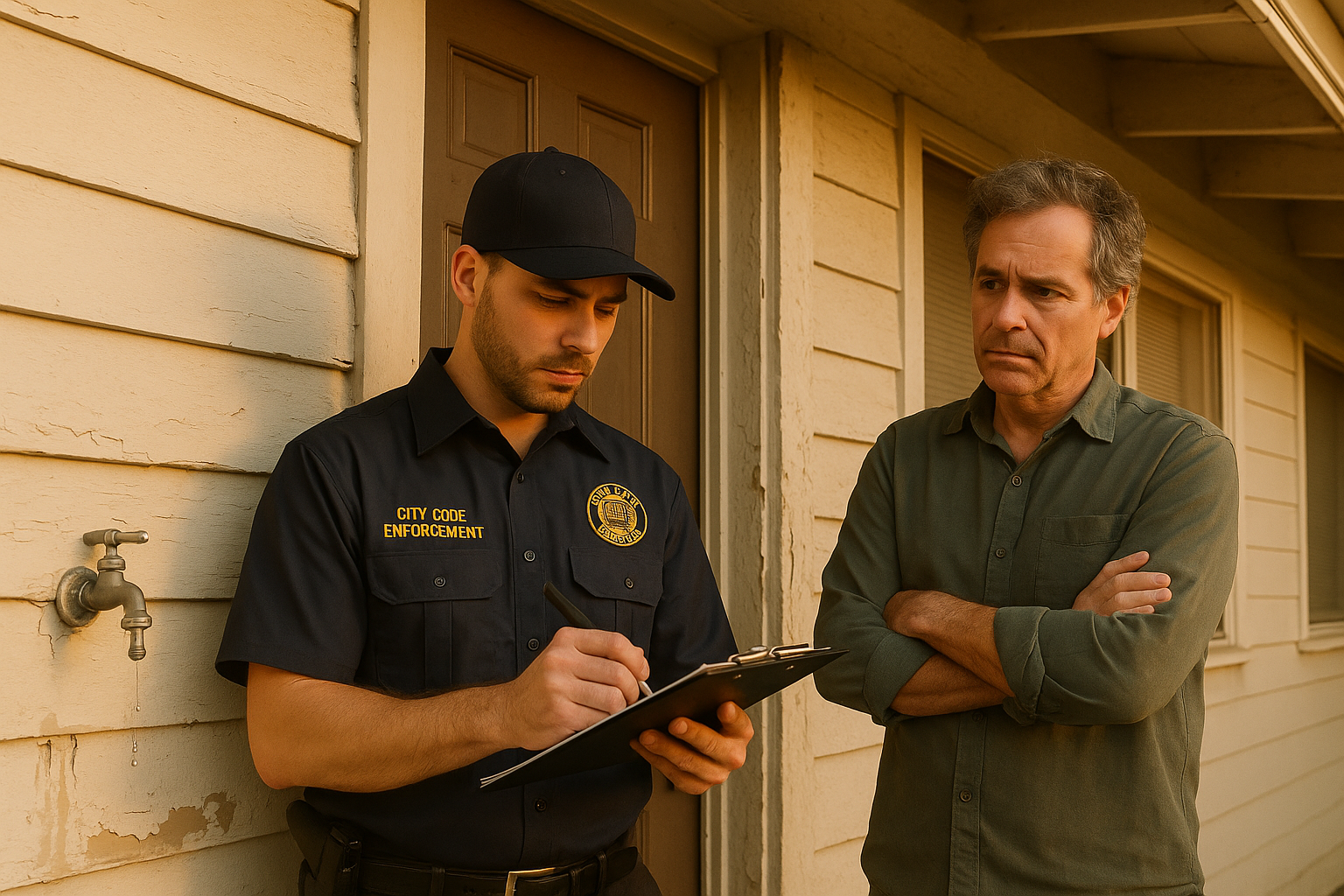
The code enforcement officer or building inspector arrives at the property and inspects the areas identified in the complaint, as well as any other areas that are reasonably accessible and that the officer determines warrant inspection. Inspectors are authorized to inspect common areas, exterior grounds, and, with tenant consent, interior units.
You, as the landlord, cannot deny access to a code enforcement inspector who presents proper credentials and a complaint-based inspection notice. Health & Safety Code §17920.5 provides that refusal to allow a duly authorized inspection is itself a misdemeanor.
Step 5: Notice of Violation Issued (If Warranted)
If the inspector finds one or more conditions that meet the substandard threshold, the agency issues a Notice of Violation (NOV) or Notice and Order to Repair. This notice:
- Identifies each specific code violation
- References the applicable code sections
- Sets a compliance deadline for each violation (typically 30–60 days for standard repairs; shorter for urgent conditions)
- Notifies you of the appeal process
- In many jurisdictions, is recorded as a lien against the property if not resolved
Critically, under AB 838, the local agency is also required to provide a copy of the inspection report to the complaining tenant or any affected tenant in the building. This transparency requirement means tenants immediately have documentary evidence of the violations — evidence that is admissible in civil proceedings.
Landlord Obligations After a Notice of Violation
Receiving a Notice of Violation triggers a set of legal obligations that run in parallel under both state building law and the civil warranty of habitability framework.
Repair Timelines After an NOV
| Violation Severity | Typical NOV Repair Deadline | What Happens If You Miss It |
|---|---|---|
| Immediate hazard (gas, structural failure, sewage) | 24–72 hours | Emergency closure order; tenants may be immediately displaced; daily civil penalties begin |
| Serious habitability violation (no heat, mold, major plumbing) | 10–30 days | Reinspection; escalating civil penalties; potential recordation of lien |
| Standard code violation (lighting, minor structural, weatherproofing) | 30–60 days | Reinspection; civil penalties; potential criminal referral for willful non-compliance |
You can typically request a compliance extension from the enforcement agency if you can demonstrate good-faith repair efforts — for example, a signed contract with a licensed contractor showing a scheduled repair date. Extensions are not automatic and must be requested before the deadline expires.
Your Obligation to Notify Tenants
Once you receive an NOV, you are generally required by the same local agency order to notify all affected tenants in writing of the violation, the required repairs, and the expected completion date. Failure to notify tenants, while they continue paying full rent, exposes you to additional liability under Civil Code §1942.4, which prohibits demanding rent when certain conditions exist.
Civil Code §1942.4 states that a landlord of a residential dwelling unit may not demand rent, collect rent, issue a notice of a rent increase, or issue a three-day notice to pay rent or quit after any of the following occur:
- The dwelling substantially lacks any of the habitability conditions described in Civil Code §1941.1
- A code enforcement officer or housing inspector has notified the landlord (or the landlord has knowledge) of the substandard conditions
- The conditions were not caused by the tenant
- The conditions have existed for more than 35 days since written notice to the landlord
Demanding rent in violation of Civil Code §1942.4 exposes you to actual damages, a civil penalty of $1,000 per offense, and the tenant’s attorney fees.
Tenant Rights During an Active Habitability Violation
Rent Withholding
California law does not give tenants an unlimited right to withhold rent. The right to withhold arises under Civil Code §1942 when:
- The rental unit is uninhabitable under Civil Code §1941.1
- The landlord has been notified of the defect
- A reasonable time has elapsed for the landlord to make repairs (courts have interpreted this as as few as 30 days for serious conditions)
When these conditions are met, a tenant may vacate and stop paying rent, asserting that the landlord’s failure to repair constructively evicted them. Alternatively, tenants may remain and pursue a rent reduction in small claims court, asserting that the rental value of the unit is less than the contracted rent due to the uninhabitable conditions.
An NOV issued under AB 838 significantly strengthens the tenant’s position in either scenario — it is official government documentation that the unit does not meet habitability standards.
Repair and Deduct
Under Civil Code §1942, after giving the landlord reasonable notice (typically 30 days, though shorter notice may be adequate for urgent conditions), a tenant may repair the defect themselves and deduct the cost from rent, up to one month’s rent. The repair and deduct remedy is limited to once in any 12-month period and applies only to defects affecting habitability, not general maintenance or aesthetics.
Rent Reduction (Partial Rent Withholding)
In cases where the unit is habitable but substandard conditions reduce its rental value, tenants may petition for a rent reduction. In rent-controlled jurisdictions, this is typically done through the local rent board. In non-rent-controlled units, tenants may assert a breach of the implied covenant of habitability in civil court, seeking a retroactive rent reduction for the period during which conditions existed.
Courts calculate rent reductions based on the “fair rental value” methodology — the difference between the agreed rent and the fair rental value of the unit in its defective condition. Multi-condition violations in significant defects can result in rent reductions of 20–40% or more.
Relocation Obligations When a Unit Is Declared Uninhabitable
If a code enforcement officer issues an order to vacate — declaring the unit uninhabitable and requiring tenants to leave — your relocation obligations depend on a combination of state law, local ordinances, and the circumstances of the vacancy.
State Law Baseline
California does not have a single statewide mandatory relocation assistance statute that applies universally to uninhabitable unit vacancies. However, several provisions create obligations:
- Health & Safety Code §17975–17975.6 — Applies to localities that have not adopted their own habitability relocation ordinances. Provides that tenants displaced by code enforcement orders are entitled to temporary housing assistance, with costs shared between the landlord and the local government in certain circumstances.
- Civil Code §1946.2 (AB 1482) — If your property is subject to AB 1482 just cause eviction protections and you must vacate a unit due to habitability conditions, you owe one month’s rent as relocation assistance.
- Common law constructive eviction — If conditions are severe enough to constitute constructive eviction (i.e., the unit was rendered uninhabitable by the landlord’s failure to maintain it), the tenant may be entitled to moving costs and temporary housing costs as compensatory damages.
Local Ordinance Requirements
Many California cities with strong tenant protections have enacted relocation assistance ordinances that exceed the state baseline. In Los Angeles, for example, tenants temporarily or permanently displaced by code enforcement orders are entitled to relocation assistance equivalent to two to four months’ rent, plus moving costs, regardless of whether the property is subject to rent control. San Francisco’s Code Enforcement Relocation Assistance Ordinance (SFMCO Chapter 39) requires landlords to pay relocation assistance of two to six months’ rent for tenants displaced by uninhabitable conditions.
If you own property in a city with its own rent ordinance, contact your city’s rent board or housing department immediately upon receiving an order to vacate — relocation assistance timelines are typically 15–30 days from the date of the order.
Civil and Criminal Penalties Under AB 838
Civil Penalties
Health & Safety Code §17995 authorizes civil penalties for substandard building violations. The penalty structure after AB 838:
| Violation Type | Civil Penalty | How Penalties Accumulate |
|---|---|---|
| Substandard building condition (Health & Safety Code §17920.3) | Up to $1,000 per violation | Per violation, per day after NOV compliance deadline |
| Unlawful renting of a substandard unit (Civil Code §1942.4) | $1,000 per offense | Per instance of demanding or collecting rent after notice of violation |
| Retaliation against complaining tenant (Civil Code §1942.5) | Actual damages + punitive damages up to $2,000 | Per retaliatory act; attorney fees awarded to tenant |
| Refusal to allow code enforcement inspection (Health & Safety Code §17920.5) | Misdemeanor | Per refusal; see criminal penalties below |
To illustrate how quickly penalties accumulate: a building with three distinct substandard conditions — mold, inadequate lighting in stairwells, and a plumbing defect — where the landlord misses the 30-day NOV deadline by 30 days, can accrue: 3 conditions × $1,000/day × 30 days = $90,000 in maximum civil penalties. Courts do not always impose the maximum, but they can — and do — in cases of willful non-compliance.
Criminal Penalties
Health & Safety Code §17995 also provides that a willful violation of a notice and order to repair, or willful failure to comply with a substandard building order, constitutes a misdemeanor. Conviction can result in:
- Up to 6 months in county jail
- A fine of up to $1,000
- Both jail and fine
Criminal prosecution for habitability violations is rare in practice but is not theoretical. Prosecutors in Los Angeles, San Francisco, and Oakland have used criminal misdemeanor charges against landlords who repeatedly ignore orders affecting tenant health and safety. Criminal conviction also creates significant exposure in any parallel civil litigation.
Retaliation Protections Under Civil Code §1942.5
Civil Code §1942.5 is one of the most important statutes in the California landlord-tenant framework, and AB 838 complaint filings fall squarely within its protection. The statute prohibits retaliatory conduct by a landlord against a tenant who has exercised a protected right.
What Counts as a Protected Activity Under §1942.5
- Complaining to the landlord about habitability conditions in writing or verbally
- Filing a complaint with a code enforcement agency, housing authority, or other governmental entity about housing conditions
- Contacting the media or public officials about habitability conditions
- Organizing or joining a tenant association or union
- Exercising any right afforded to the tenant under local or state rent control or tenant protection laws
- Filing or threatening to file a civil lawsuit related to housing conditions
What Counts as Prohibited Retaliation
- Serving a notice to terminate tenancy within 180 days of a protected activity (creates a rebuttable presumption of retaliation)
- Raising rent within 180 days of a protected activity
- Decreasing housing services (parking, laundry, storage access) within 180 days of a protected activity
- Threatening eviction in response to protected activities
- Engaging in conduct that interferes with the tenant’s quiet enjoyment of the unit in response to protected activities
The 180-Day Presumption and How to Rebut It
If you take any of the above actions within 180 days of a tenant’s protected activity, the law presumes the action was retaliatory. You can rebut this presumption only by proving, by a preponderance of the evidence, that the action was taken for a legitimate, non-retaliatory reason — for example, nonpayment of rent, material lease violation, or a bona fide intent to remove the unit from the rental market.
The practical implication: if a tenant files an AB 838 complaint today, you cannot raise rent for any unit occupied by that tenant (or arguably any tenant in the same building) for 180 days unless you can clearly document a legitimate, independent basis for the increase. Even then, the timing will invite scrutiny.
Penalties for Retaliation
A successful retaliation claim under Civil Code §1942.5(h) entitles the tenant to:
- Actual damages (lost wages, moving costs, replacement housing premium, emotional distress)
- Punitive damages up to $2,000 per retaliatory act
- Attorney fees and costs
- Injunctive relief (court order prohibiting the retaliatory conduct)
A landlord who serves a 30-day notice to vacate one month after a tenant files an AB 838 complaint — without a legitimate documented reason — is looking at a likely $5,000–$15,000 exposure in a small claims or limited civil court proceeding, plus attorney fees that can easily exceed the underlying damages.
How AB 838 Interacts with Civil Code §1941–1942.5 (Warranty of Habitability)
AB 838 and the Civil Code warranty of habitability framework operate independently but are designed to reinforce each other. Understanding how they interact is critical for assessing your liability exposure.
Two Parallel Legal Tracks
| Track | Governing Law | Triggered By | Enforced By |
|---|---|---|---|
| Administrative / Code Enforcement | Health & Safety Code §17920.3 (AB 838) | Tenant complaint to code enforcement agency | City/county code enforcement; building department; HCD |
| Civil / Judicial | Civil Code §1941–1942.5 | Tenant lawsuit in small claims, limited civil, or superior court | Courts; tenant can bring private right of action |
How a Code Enforcement Finding Strengthens Civil Claims
The intersection is where landlords face compounding liability. Here is the mechanism:
- Tenant files an AB 838 complaint with code enforcement
- Inspector finds substandard conditions and issues an NOV
- The NOV — a government document identifying the violations — is now public record and is provided to the tenant under AB 838’s transparency requirements
- Tenant (or tenant’s attorney) uses the NOV as evidence in a civil lawsuit under Civil Code §1941 (breach of warranty of habitability)
- The NOV establishes that the conditions existed, that the landlord had government-documented notice, and that the landlord failed to repair within the official timeline
This evidence chain substantially reduces the tenant’s burden of proof in civil litigation. Courts treat official inspection findings as highly probative. A landlord defending a habitability lawsuit while holding an outstanding NOV is in a very difficult evidentiary position.
Civil Code §1941.1 vs. Health & Safety Code §17920.3: The Standards Are Similar But Not Identical
Civil Code §1941.1 defines habitability conditions for civil law purposes. Health & Safety Code §17920.3 defines substandard conditions for building code enforcement purposes. The lists substantially overlap, but AB 838 expanded the §17920.3 list (particularly for dampness and mold) beyond what is strictly enumerated in §1941.1. A condition that qualifies as substandard under §17920.3 will almost always also constitute a habitability defect under §1941.1, giving tenants both administrative and civil remedies simultaneously.
Local Enforcement Variations and Proactive Inspection Programs
AB 838 establishes state minimums. Cities and counties retain the authority to adopt more stringent programs. Several California jurisdictions operate Proactive Rental Inspection Programs (PRIPs) that inspect rental units on a scheduled basis — not just in response to complaints.
Jurisdictions with Proactive Rental Inspection Programs
| City / County | Program Name | Key Features |
|---|---|---|
| Los Angeles (City) | Systematic Code Enforcement Program (SCEP) | Inspects all multifamily buildings (2+ units) on a rotating basis; $90–$180/unit inspection fee; requires owner registration in LAHD database |
| Oakland | Rental Adjustment Program (RAP) Inspections | Annual or biennial inspections for rent-controlled buildings; habitability violations can result in rent roll-back; violations shared with tenant |
| San Francisco | DBI Proactive Inspection Program | Department of Building Inspection inspects buildings with habitability complaints and buildings on the Unsafe or Substandard Buildings list; all inspection reports public |
| Sacramento | Code Enforcement Division Complaint Response | Complaint-driven; AB 838 timelines apply; no separate proactive program for most residential buildings as of 2026 |
| San Jose | Apartment Building Operating Permit (ABOP) | Annual permit required for all apartments; permit renewal triggers inspection for buildings with prior violations; fee varies by unit count |
If you own property in a jurisdiction with a proactive inspection program, AB 838 complaint-triggered inspections are in addition to scheduled proactive inspections. You may face code enforcement visits multiple times per year in these jurisdictions, independent of tenant complaints.
Contact your city’s code enforcement or housing department to determine whether your building is registered in any proactive inspection program and when your next scheduled inspection is due. This is not optional — failing to register in mandatory programs (like SCEP in Los Angeles) is itself a code violation.
AB 838 Compliance Checklist for Landlords
The most effective response to AB 838 is a preventive maintenance program that identifies and corrects substandard conditions before a tenant complaint triggers mandatory inspection. Use this checklist on an annual basis for each unit and building.
Structural and Exterior
- Inspect roof for missing, cracked, or deteriorated shingles or tiles; check flashing around chimneys, vents, and skylights for sealant failure
- Inspect exterior walls for cracks, deterioration, or moisture intrusion points; repaint or re-seal as needed
- Inspect foundation visible from exterior for cracks wider than 1/4 inch or signs of settling; consult structural engineer if in doubt
- Test all exterior doors and windows — they must open, close, lock, and seal against weather; replace broken hardware and deteriorated weatherstripping
- Inspect stairways, railings, and balconies for structural soundness; all railings must be secure and meet applicable height requirements under CBC Chapter 10
- Clear gutters and downspouts; verify downspouts discharge away from foundation
Moisture, Dampness, and Mold
- Inspect all ceilings, walls, and floors in bathrooms and kitchens for signs of moisture staining, soft spots, or bubbling paint — these are indicators of moisture intrusion even without visible mold
- Inspect under sinks and around toilet bases for evidence of slow leaks; replace supply lines and angle stops older than 7 years proactively
- Check bathroom grout and caulk lines; re-caulk anywhere caulk is cracked, missing, or discolored
- Inspect attic and crawl space for condensation, staining, or mold; ensure adequate ventilation in both spaces
- Run bathroom exhaust fans and verify they actually vent to exterior (not just to attic); measure CFM output if possible
- If any tenant has previously complained of moisture or mold, commission a professional mold inspection from a California-licensed industrial hygienist before the next lease renewal
Plumbing
- Run all faucets and verify hot water temperature reaches at least 120°F at the fixture within 60 seconds (California law requires water heater set point of at least 120°F under H&S Code §17926.1)
- Flush all toilets and verify they do not run continuously (flapper valve failure is the most common cause)
- Test all shower valves for proper hot/cold mixing; anti-scald requirements apply to new installations
- Inspect garbage disposal if present; verify drain trap is seated and not leaking
- Inspect water heater anode rod and flush sediment annually for units older than 5 years; pressure relief valve should be tested every 3 years
- For multi-unit buildings, confirm main shutoff valves are accessible and functional for each unit
Electrical
- Test all smoke detectors — press test button; replace batteries; California law requires CO detectors within 10 feet of all sleeping areas in units with gas appliances or attached garages (H&S Code §17926)
- Inspect electrical panel for double-tapping (two wires on one breaker), aluminum wiring, or signs of heat damage; consult licensed electrician if found
- Verify GFCI outlets are functional in all bathrooms, kitchens, garages, and exterior locations (test the reset button)
- Replace any cracked, broken, or discolored outlets or switch plates
- Inspect common area lighting — all stairwells, hallways, parking areas, and building entrances must have functional lighting at all times; AB 838 explicitly includes inadequate lighting as a substandard condition
- Verify exterior lighting activates at dusk (or by timer) in common areas
Heating and Ventilation
- Test central heating system at the beginning of each heating season (September/October in California); verify system can maintain 70°F in all habitable rooms when outdoor temperature is 60°F
- Replace HVAC filters; inspect heat exchanger for cracks (cracked heat exchangers can vent carbon monoxide into living space)
- Test thermostat calibration; replace thermostats older than 15 years
- Inspect gas furnace flue for obstructions and proper draft; ensure flue connections are tight
- Verify bathroom and kitchen exhaust fans are functional and vented to exterior
Pest Control
- Conduct a visual inspection for signs of rodent activity (droppings, gnaw marks, entry points) at unit turnovers and annually during occupied tenancies
- Seal all penetrations in exterior walls, foundation, and around plumbing and electrical entries larger than 1/4 inch using steel wool and expandable foam or hardware cloth
- Inspect common areas for cockroach evidence; ensure garbage areas are tightly sealed and cleaned regularly
- If pest infestation is confirmed, hire a licensed pest control operator (PCO) and document treatment in writing; provide tenants with advance notice of pesticide applications as required by Health & Safety Code §8538
Documentation Protocol
- Document every inspection with dated photographs stored by unit address and inspection date
- Record all maintenance requests in writing (even if received by phone — send a confirming email or text); log date received and date resolved
- Keep contractor invoices and permit records for all repair work for a minimum of 3 years after the work is completed
- If a tenant signs a move-in inspection form, retain a copy for the duration of the tenancy plus 3 years
- If you receive any code enforcement correspondence (complaint notice, inspection notice, NOV), file it immediately and calendar the compliance deadline with a 15-day buffer
Frequently Asked Questions
Can a tenant file an AB 838 complaint anonymously?
Many jurisdictions accept anonymous complaints. However, anonymous complaints do not trigger the same mandatory 15-business-day inspection timeline under AB 838. The mandatory timeline is triggered by verified complaints from identified complainants. Anonymous complaints may still result in inspections at the agency’s discretion, particularly if the complaint describes a clear safety hazard.
What if a tenant’s complaint is false or exaggerated?
Code enforcement officers are trained to evaluate conditions objectively. If an inspector visits and finds no qualifying substandard conditions, no NOV will be issued. However, the landlord should still document the inspection outcome (including a copy of any written clearance from the inspector) and should not take adverse action against the tenant within 180 days of the complaint, as the retaliation presumption under Civil Code §1942.5 applies regardless of whether the complaint was substantiated.
Does AB 838 apply to single-family homes?
Yes. Health & Safety Code §17920.3 applies to all residential dwellings, including single-family homes, condominiums rented to tenants, mobile homes, and accessory dwelling units. The mandatory inspection timeline applies to any residential building subject to the state housing law (Part 1.5 of Division 13 of the Health & Safety Code).
Can I require a tenant to submit maintenance requests in writing before I am legally obligated to act?
No. California courts have consistently held that oral notice of a habitability defect is legally sufficient to trigger the landlord’s repair obligation under Civil Code §1941. You may have an internal policy requiring written requests, but that policy does not affect your legal obligation or the timeline for retaliation protection to attach.
If I’m fixing the problem, can I still receive an NOV?
Yes. The inspector will document conditions as found on the date of inspection. If you began repairs before the inspection but have not completed them, the NOV will note the remaining deficiencies and set a compliance deadline. The fact that repairs are in progress is relevant to any civil penalty proceeding and will typically result in a more favorable compliance deadline, but does not prevent issuance of the NOV for conditions that exist at the time of inspection.
How long does an NOV stay on the property record?
This varies by jurisdiction. In most California cities, an NOV that is resolved within the compliance period is closed, but the inspection record remains in the code enforcement database permanently. Some jurisdictions record unresolved NOVs as liens against the property title. Recorded liens affect the property’s title and must be cleared before sale or refinancing. Resolving the underlying violation promptly and obtaining a written clearance from the inspector is essential — and you should follow up to confirm the lien, if any, has been released.
Do I need a permit to make repairs required by an NOV?
It depends on the scope of work. Minor repairs (caulking, replacing a faucet, patching drywall) typically do not require permits. Structural work, electrical panel upgrades, plumbing rerouting, HVAC replacement, and similar major repairs generally require permits pulled by a licensed contractor. Completing required repairs without required permits creates an additional code violation. When in doubt, ask the code enforcement officer whether permits are required for the specific repairs ordered.
Can I pass code enforcement fines to my tenants via rent increases?
No. Civil penalties issued under Health & Safety Code §17995 are assessed against the property owner. You cannot include civil penalty costs in rent increases, particularly during the 180-day retaliation protection window following any tenant complaint, and particularly when penalties arise from conditions that constitute habitability violations. Attempting to recover penalty costs from tenants could itself be characterized as retaliatory conduct under Civil Code §1942.5.
What’s the relationship between AB 838 and AB 1482 rent control?
They operate independently. AB 838 governs building conditions and code enforcement timelines. AB 1482 (Tenant Protection Act) governs rent increases and just cause eviction. However, they interact in one important way: if your property is subject to AB 1482 and you fail to maintain habitability, tenants have both a rent reduction remedy (through the civil courts or rent board) and the ability to challenge any rent increase as pretextual if it follows closely after a habitability complaint. Maintaining habitability is the first condition of preserving your rent increase rights under AB 1482.
Does receiving an AB 838 NOV affect my ability to raise rent?
Not directly — there is no automatic rent freeze from an NOV under state law. However: (1) Civil Code §1942.4 prohibits demanding or collecting rent for a unit with habitability violations where the landlord has notice and more than 35 days have passed without repair; (2) the 180-day retaliation presumption under Civil Code §1942.5 makes any rent increase within 180 days of a complaint potentially retaliatory; and (3) local rent boards in jurisdictions with rent control (Los Angeles LAHD, Oakland RAP, San Francisco Rent Board) can order rent reductions or roll-backs for buildings with outstanding habitability violations. In practice, outstanding NOVs severely constrain your ability to raise rents without significant legal risk.
Legal Disclaimer: This guide is for informational purposes only and does not constitute legal advice. California landlord-tenant law and local ordinances change frequently, and the application of these laws depends on the specific facts of each situation. Consult a licensed California attorney for advice specific to your situation before taking action based on this material.