Key Takeaways
- SB 721 covers ALL multifamily rental buildings with 3+ units — including small landlords with triplexes and fourplexes; there is no small-landlord exemption
- The initial inspection deadline was January 1, 2025 — if you missed it, you are already out of compliance and accruing civil penalty exposure; act immediately
- Inspections repeat every 9 years — the next cycle for buildings inspected in 2024 runs through January 1, 2034
- Three inspector types are authorized — licensed architect, licensed civil or structural engineer, or a general contractor holding a C-5 (framing and rough carpentry) license with at least 5 years of experience
- Necessary repairs must be completed within 180 days of the inspection report; emergency hazards require immediate action and unit closure
- SB 721 applies to rental properties; SB 326 applies to HOAs (common interest developments) — they share the same intent but have different inspector requirements, thresholds, and deadlines
- Civil penalties can reach $500 per day per violation and insurance carriers are increasingly adding exclusions for uninspected elevated elements
Why SB 721 and SB 1510 Exist
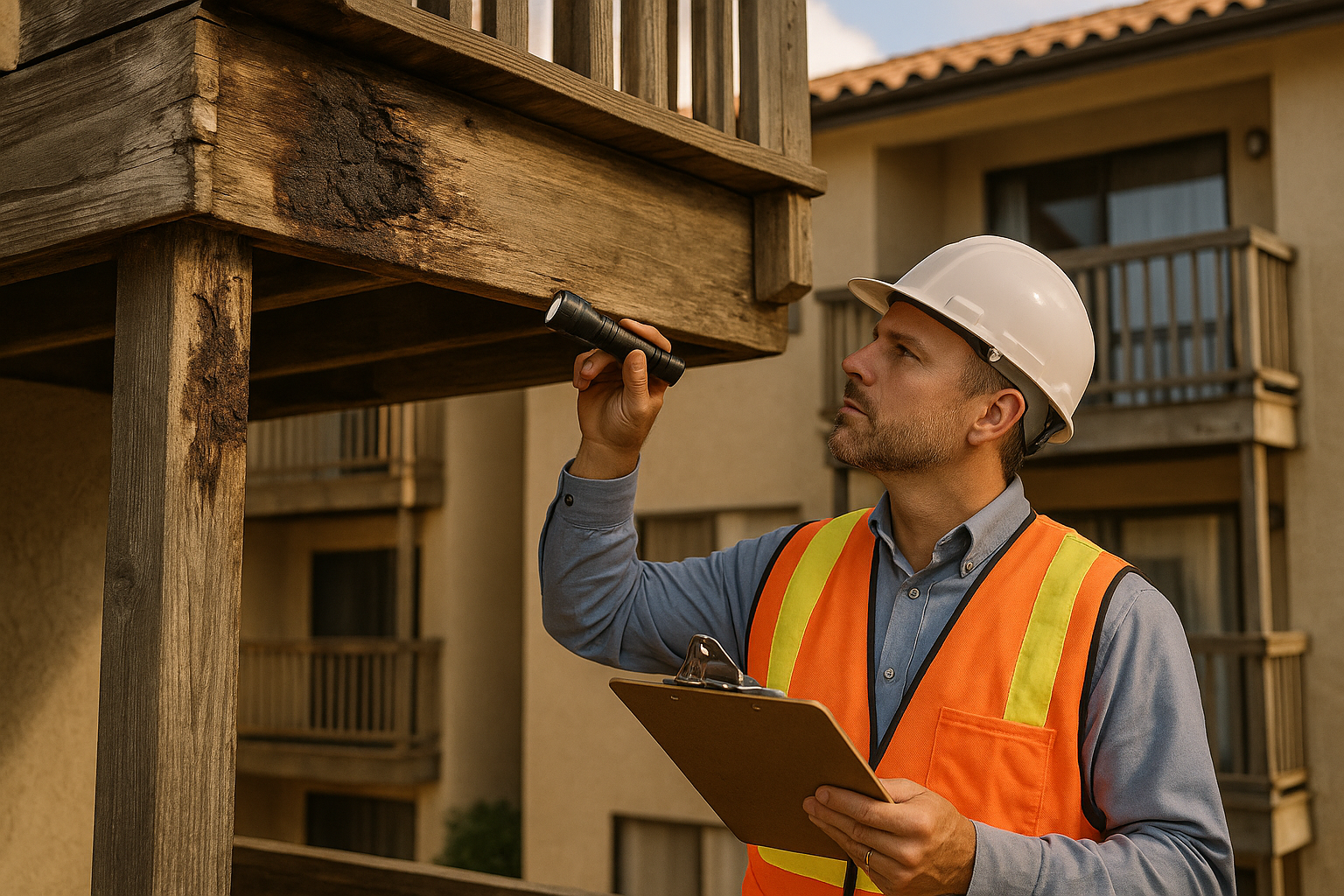
On January 16, 2015, a third-floor balcony at 2020 Kittredge Street in Berkeley collapsed during a birthday party, killing six UC Berkeley students and injuring seven more. An investigation found that the deck framing had been rotting for years inside a waterproofed exterior that concealed the decay. No one had ever inspected it.
The Legislature responded with SB 721, signed by Governor Brown on September 17, 2018 and codified at Health and Safety Code §§17973–17979.3. The bill created a mandatory periodic inspection program for elevated exterior elements on California multifamily rental buildings. A follow-up bill, SB 1510, signed in 2019, amended Section 17973 to clarify inspection report content requirements and clean up ambiguities in the original statute.
Together, these two laws represent the most significant structural safety mandate ever imposed on California rental property owners. Unlike habitability inspections triggered by tenant complaints, SB 721 inspections are scheduled, mandatory, and owner-initiated regardless of whether any defects are known or reported.
Which Buildings Are Covered
SB 721 applies to any building containing 3 or more multifamily dwelling units — specifically to “exterior elevated elements” on those buildings. The statute does not carve out small portfolios, owner-occupied triplexes, or buildings constructed before a certain year.
Building Types Subject to SB 721
- Triplexes (3 units)
- Fourplexes (4 units)
- Small apartment buildings (5–20 units)
- Mid-size apartment complexes (20–100 units)
- Large apartment buildings (100+ units)
- Mixed-use buildings with 3+ residential rental units
- Garden-style and podium-style apartment communities
- Townhome complexes held as rental (not HOA-governed)
If your building has 3 or more rental units and has a balcony, deck, walkway, stairway, or any walkable elevated surface attached to the structure, SB 721 applies to you.
What Is an “Exterior Elevated Element”?
Health and Safety Code §17973 defines “exterior elevated elements” as load-bearing components of balconies, decks, porches, stairways, walkways, and entry structures that are located more than 6 feet above ground level, are designed for human occupancy or use, rely in whole or in part on wood or wood-based products for structural support, and are exposed to the exterior environment.
The critical qualifier is the wood or wood-based waterproofing element. If a surface is entirely concrete, steel, or masonry with no wood structural component — no joists, no ledger boards, no sheathing — it may fall outside the scope of SB 721. But in practice, the vast majority of California multifamily buildings built before 2000 use wood-framed balconies, decks, and walkways. If you are uncertain, assume the law applies and confirm with your inspector.
What Is Specifically NOT Covered
- Single-family residences and accessory dwelling units (ADUs) not part of a multifamily building
- Condominiums governed by an HOA (those fall under SB 326, Civil Code §5551 — discussed below)
- Elevated elements more than 6 feet above ground that are not walkable (e.g., decorative overhangs, fascia)
- Ground-floor patios that are at grade level
- Buildings with no exterior elevated elements at all (rare in multifamily)
What Must Be Inspected
The inspector must evaluate all exterior elevated elements and their associated waterproofing systems on the building. Health and Safety Code §17973 specifies that the inspection must cover the following categories:
| Element Type | What Is Inspected | Why It Matters |
|---|---|---|
| Balconies | Decking surface, joists, ledger board connection to building, guardrails, waterproofing membrane | Ledger failure was the primary cause of the Berkeley collapse; most common point of rot |
| Decks | Structural framing, post connections, beam-to-post hardware, decking boards, flashing at wall | Deck boards can conceal rotted framing below; moisture infiltration at wall attachment is a primary failure mode |
| Walkways and breezeways | Walking surface, underlying framing, handrail attachment, drainage slope and penetrations | Exterior walkways in California apartment buildings often lack adequate waterproofing; drainage defects cause rot over years |
| Stairways | Stringers, treads, risers, guardrails, balusters, top and bottom connections, landings | Stair collapse under occupant load is a life-safety event; deteriorated stringers can fail without visible surface warning |
| Entry structures | Overhead entry canopies, elevated entry platforms, attached trellises or pergolas over entryways | Overhead failure at building entries creates high-risk collapse zones; often overlooked |
| Waterproofing systems | Membranes, sealants, flashings, caulking at penetrations, drainage outlets | Waterproofing failure is the root cause of structural deterioration; SB 721 targets wood-based waterproofing systems specifically |
The inspector does not have a statutory obligation to inspect the building’s interior framing or any element that is not an “exterior elevated element” as defined by §17973. However, if an inspector observes signs of water infiltration on an interior wall adjacent to a balcony or walkway, a qualified inspector may flag it for further evaluation.
Inspection Sample Size
Health and Safety Code §17973(a)(1) permits inspectors to use a statistically significant sample of each type of element rather than inspecting every individual unit’s balcony. For buildings with multiple identical balconies, the inspector may inspect a representative sample and extrapolate findings. However, if deficiencies are found in any sampled element, the inspector must expand the inspection to cover all similar elements. If you have 10 identical third-floor balconies and two show significant rot, the inspector must inspect all 10.
Do not rely on the sampling provision to reduce your cost by pressuring inspectors to inspect fewer elements. A deficiency found in a sampled element will require full expansion, and a missed deficiency that later causes injury will expose you to catastrophic liability.
Inspection Timeline and Deadlines
SB 721 established the following deadline structure under Health and Safety Code §17973:
| Milestone | Deadline | Status (as of August 2026) |
|---|---|---|
| Initial inspection — first cycle | January 1, 2025 | PAST DUE. Buildings not yet inspected are out of compliance. |
| Second and subsequent inspections | Every 9 years from the date of the last inspection | Next due January 1, 2034 for buildings inspected in 2025 |
| Repair completion after inspection report | 180 days from inspection report date | Running deadline; triggered by each inspection |
| Emergency hazard — closure | Immediate upon inspector determination | Cannot be deferred; inspector must notify local enforcement |
| Inspection report submission to local jurisdiction | 45 days from inspection completion | Owner must provide to local building official |
What “Already Past Due” Means for Your Building
If your building had exterior elevated elements covered by SB 721 and you did not complete an inspection by January 1, 2025, you are in violation of Health and Safety Code §17973. You should schedule an inspection immediately — not because the penalty clock necessarily started on January 1, 2025 (enforcement varies by jurisdiction and formal notice), but because:
- Local building departments in San Francisco, Oakland, Los Angeles, Sacramento, and other major cities are actively sending compliance notices to property owners
- Insurance carriers are adding endorsements excluding coverage for elevated element failures on properties without SB 721 compliance documentation
- If an element fails and someone is injured before you completed your inspection, your liability exposure is dramatically higher than if you inspected, found a deficiency, and were repairing it
- Penalties of up to $500 per day per violation can be assessed after the local jurisdiction provides a written notice and you fail to cure
The practical guidance is simple: book the inspection this week, not next quarter.
Who Can Perform the Inspection
Health and Safety Code §17973(a) permits inspections to be performed only by one of three categories of qualified professionals:
Option 1: Licensed Architect
A California-licensed architect (licensed by the California Architects Board, CAB) with experience in exterior elevated element assessment. Not all architects specialize in structural wood systems, so confirm the architect has specific SB 721 experience before engaging. Ask for their inspection protocol and sample report.
Option 2: Licensed Civil or Structural Engineer
A California-licensed civil engineer (PE) or structural engineer (SE) is the most common choice for mid-size and larger buildings. Structural engineers are best equipped to evaluate load-bearing framing conditions, particularly ledger connections, post-base hardware, and beam-to-column attachments. For complex buildings or those with prior structural concerns, a licensed structural engineer is the highest-confidence choice.
Option 3: Licensed Contractor with C-5 Classification
A general or specialty contractor holding a California Contractors State License Board (CSLB) C-5 license (Framing and Rough Carpentry) with at least 5 years of experience constructing or repairing the type of exterior elevated elements being inspected. This is typically the most cost-effective option for smaller buildings (triplexes and fourplexes) and is fully compliant under the statute.
Important: Who Cannot Perform the Inspection
The property owner cannot self-inspect. A property manager without the above licenses cannot inspect. A general handyman, unlicensed contractor, or building maintenance worker cannot perform a compliant SB 721 inspection. The inspection must be conducted and certified by a professional meeting one of the three statutory categories. An inspection performed by an unqualified person has no legal standing and does not satisfy the statute.
Tips for Hiring Your Inspector
- Verify the inspector’s license with the California Architects Board, Board for Professional Engineers, or CSLB before signing an engagement letter
- Ask specifically whether they follow the SB 721 inspection protocol and whether their report format will satisfy Health and Safety Code §17973(b)
- Ask for references from other SB 721 inspections they have completed — particularly buildings similar in age and construction to yours
- Confirm they carry errors and omissions (E&O) insurance; this protects you if they miss a deficiency and an element later fails
- Get the report format in advance and confirm it includes all elements required by the statute (detailed below)
What the Inspection Report Must Contain
Health and Safety Code §17973(b), as amended by SB 1510, specifies the minimum contents of the inspection report. A compliant report must include:
- Identification of all inspected elements — specific location, type, and condition of each exterior elevated element evaluated (or each element in the inspected sample)
- Description of any observed deterioration — rot, corrosion, delamination, split or cracked members, inadequate flashing, failed waterproofing membrane, missing or inadequate hardware
- Determination of whether each element poses an immediate risk to the safety of occupants — this is the emergency trigger provision; if any element is found to pose an immediate threat, the inspector has an obligation to notify the building owner immediately
- Recommendations for any necessary repair or replacement — specific scope of work, not a general statement; the report must be actionable
- Inspector’s license number and type (architect license number, PE/SE license number, or CSLB C-5 license number)
- Date of inspection
- A signed certification that the report is accurate and complete to the best of the inspector’s professional knowledge
Under SB 1510’s amendments, the inspector must provide the report to the property owner within 45 days of completing the inspection. The property owner must then provide a copy of the report to the local enforcement agency (typically the city or county building department) within 45 days of receiving it.
Record Retention
Retain inspection reports for the life of the building or until you dispose of the property, whichever is later. At a minimum, retain the two most recent inspection reports. Courts, insurance carriers, and future buyers will ask for SB 721 documentation in any real estate transaction involving a covered building.
Repair Timelines — What Happens After the Inspection
Standard Repairs: 180-Day Window
If the inspection report identifies deficiencies that are not an immediate safety hazard, you have 180 days from the date of the inspection report to complete all necessary repairs. The 180-day clock starts from the report date, not from when you receive it or when you provide it to the building department.
The 180-day window is a maximum, not a target. Do not schedule repairs on day 170. Delays caused by permitting, contractor availability, or supply chain issues do not automatically extend the deadline. If you cannot complete repairs within 180 days due to circumstances outside your control (e.g., a contractor is on a 120-day backorder for specialized hardware), document your good-faith efforts and communicate proactively with the local building department. Some jurisdictions will grant extensions with proper documentation; others will not.
Emergency Repairs: Immediate Action Required
If the inspector determines that any exterior elevated element poses an immediate hazard to the safety of occupants, you must act immediately. The statute does not provide a grace period. Specifically:
- The inspector must notify you immediately (in the field, not just in the written report delivered 45 days later)
- The owner must immediately restrict access to the affected element — lock the balcony door, barricade the stairway, post visible warnings, and if necessary, prohibit occupancy of any unit that relies on the hazardous element for egress
- The inspector must notify the local enforcement agency within 15 days of finding an immediate hazard, regardless of whether the owner has taken action
- Repairs must be completed or the element must remain closed until a licensed professional certifies it is safe
If you close a unit due to an emergency balcony or stairway hazard, you have a potential relocation obligation under California Civil Code §1941 and local tenant protection ordinances. Tenants displaced from a unit due to landlord-caused habitability conditions may be entitled to relocation assistance under local law (Los Angeles, San Francisco, Oakland, and Berkeley all have relocation assistance requirements). Consult an attorney immediately if you must displace a tenant due to an SB 721 emergency finding.
Repair Permits and Sign-Off
Most structural repairs to exterior elevated elements will require a building permit from the local building department. Do not have a contractor repair balcony framing, replace a ledger board, or rebuild a stairway without pulling the required permits. Unpermitted structural repairs:
- Do not satisfy SB 721 repair requirements
- Create disclosure obligations in future property sales
- May void your property insurance coverage for future claims
- Can be ordered to be demolished and redone by the local building department
Factor permit timelines into your 180-day repair schedule. In many California jurisdictions, structural repair permits take 4–8 weeks for plan check, inspection scheduling, and sign-off. Submit permit applications within the first 30 days of receiving the inspection report.
Penalties for Non-Compliance
Civil Penalties
Under Health and Safety Code §17980.7, local enforcement agencies can assess civil penalties of up to $500 per day per violation after providing written notice of the violation and a reasonable opportunity to cure. The penalty accrual structure works as follows:
- Local building department discovers or is notified that your building is out of SB 721 compliance (no inspection completed, report not submitted, repairs not made)
- Department issues a written Notice of Violation specifying the deficiency and a cure deadline
- If you do not cure by the deadline, penalties accrue at up to $500 per day
- Penalties are assessed per violation, not per building — a building with 10 balconies that were not inspected could theoretically face $5,000 per day
In practice, most local jurisdictions use penalties as a compliance lever rather than a revenue source. They will often work with a property owner who is actively pursuing compliance in good faith. But they will pursue aggressive penalties against owners who ignore notices or fail to act after multiple warnings.
Civil Liability from Element Failure
If an exterior elevated element fails and someone is injured, the property owner faces civil liability under both negligence and strict liability theories. SB 721 creates an important legal dynamic: once the statute exists, failure to comply with its inspection mandate is evidence of negligence per se. An injured plaintiff’s attorney does not need to prove the owner knew about the defect — only that the owner failed to conduct the mandated inspection that would have revealed the defect.
Verdicts and settlements in balcony collapse cases in California routinely exceed $1 million per injured plaintiff. The Berkeley collapse resulted in a $21.5 million settlement against the building owners and management companies. No insurance policy and no asset protection structure fully shields you from catastrophic liability at this level.
Insurance Implications
California property insurance carriers are increasingly adding SB 721 compliance clauses to landlord policies and commercial general liability policies. Common policy impacts include:
- Exclusion for uncompleted inspections: Some carriers are excluding coverage for elevated element failures on buildings without SB 721 inspection documentation
- Subrogation rights: After paying a claim, your insurer may pursue recovery from you if they discover the inspection was overdue
- Renewal requirements: At policy renewal, carriers may require proof of SB 721 compliance or decline to renew
- Premium increases: Buildings with no SB 721 documentation are increasingly being underwritten as higher risk, resulting in premium surcharges
Contact your insurance agent immediately after completing your SB 721 inspection and provide them with a copy of the inspection report. Some carriers offer premium credits for demonstrated compliance.
SB 326 (HOA Version) vs. SB 721 (Rental Property Version)
California enacted two separate balcony inspection laws depending on the ownership structure of the building:
| Feature | SB 721 — Rental Properties | SB 326 — HOA / Common Interest Developments |
|---|---|---|
| Statutory citation | Health & Safety Code §§17973–17979.3 | Civil Code §5551 |
| Who it applies to | Owners of rental buildings with 3+ multifamily units | HOA boards of common interest developments (condos, planned developments, stock cooperatives) |
| Building threshold | 3+ units | 3+ units |
| Inspector requirements | Licensed architect, PE/SE, or C-5 contractor with 5 years experience | Licensed architect or licensed structural engineer only (no contractor option) |
| Initial inspection deadline | January 1, 2025 | January 1, 2025 |
| Inspection frequency | Every 9 years | Every 9 years |
| Who receives the report | Building owner; submitted to local enforcement agency | HOA board; included in HOA reserve study documentation |
| Elements covered | All exterior elevated elements with wood structural components above 6 feet | Exterior elevated elements that are part of common area or serve multiple units |
| Enforcement | Local building department; civil penalties up to $500/day | HOA member rights; derivative suits; Civil Code §5551 enforcement |
If you own units in a condominium association but rent them to tenants, your HOA is responsible for SB 326 compliance on common area elements (shared walkways, common balconies, stairs). However, if you own the building outright (a triplex, fourplex, or apartment building where you are the sole owner), SB 721 is your obligation, not SB 326.
Do not confuse the two laws when talking to inspectors or attorneys. Inspectors who specialize in SB 326 (HOA work) may not be familiar with SB 721 requirements for rental buildings, and vice versa.
Cost Estimates for Inspections and Common Repairs
Inspection Costs
SB 721 inspection costs vary significantly by building size, number of elements, inspector type, and geographic market. The following ranges are representative as of 2025–2026 in California:
| Building Size | Inspector Type | Typical Cost Range |
|---|---|---|
| Triplex or Fourplex (3–4 units) | C-5 Licensed Contractor | $400 – $900 |
| Triplex or Fourplex (3–4 units) | Licensed Structural Engineer | $800 – $1,800 |
| Small apartment (5–20 units) | C-5 Licensed Contractor | $900 – $2,500 |
| Small apartment (5–20 units) | Licensed Structural Engineer | $1,500 – $4,000 |
| Mid-size building (20–50 units) | Licensed Structural Engineer | $3,000 – $8,000 |
| Large building (50–100+ units) | Licensed Structural Engineer | $6,000 – $20,000+ |
Common Repair Costs
Repair costs depend heavily on the extent of deterioration and whether elements can be repaired or must be rebuilt. The following are common deficiencies and their typical repair cost ranges:
| Repair Type | Typical Cost Range | Notes |
|---|---|---|
| Waterproofing membrane replacement (per balcony) | $1,500 – $4,000 | Most common repair; necessary when membrane is cracked, bubbled, or delaminated |
| Ledger board replacement (per balcony) | $3,000 – $10,000 | Requires partial decking removal; high labor intensity; may require permit and engineering |
| Full balcony rebuild (per unit) | $8,000 – $25,000 | Required when framing is extensively rotted; includes demo, new framing, decking, railings, waterproofing |
| Stair stringer replacement (per stairway) | $4,000 – $12,000 | Often requires temporary access via alternate stairs; permit required |
| Guardrail or baluster repair/replacement | $500 – $3,000 per run | Often standalone repair; post attachment to deck framing is the critical point |
| Walkway re-waterproofing and reframing | $5,000 – $20,000 per run | Wide range based on length, access complexity, and framing condition |
| Flashing replacement at wall penetrations | $800 – $3,000 per element | Frequently deferred maintenance; prevents future moisture infiltration |
For a 12-unit building with moderate deferred maintenance, a realistic total repair cost after the initial SB 721 inspection might range from $15,000 to $80,000, depending on building age and prior maintenance history. Buildings built in the 1970s–1990s in coastal or high-humidity climates (Bay Area, Los Angeles coastal areas) tend to have higher repair costs due to longer exposure to moisture without proactive maintenance.
Is This Tax-Deductible?
SB 721 inspection costs are deductible as an ordinary and necessary business expense under IRC §162. Repair costs that restore — but do not materially improve — an existing element are also deductible in the year incurred. Costs that materially improve or extend the useful life of an element (e.g., a full balcony rebuild that installs a better-quality deck than the original) may need to be capitalized and depreciated over time. Consult a CPA for guidance specific to your situation.
How SB 721 Applies to Small Landlords (Triplexes and Fourplexes)
This is the most common misunderstanding about SB 721: many small landlords believe the law only applies to large apartment complexes. It does not. The statutory threshold is 3 or more dwelling units with no upper or lower portfolio size limit.
If you own a triplex and each unit has a balcony, you have three covered balconies. If your fourplex has exterior stairs and a second-floor walkway, those are covered. The law does not care whether you are a full-time investor or an accidental landlord who inherited the property.
Practical Impact on Small Landlords
For a small landlord with one triplex or fourplex, SB 721 compliance has several practical implications:
- Inspection cost is proportionately higher as a percentage of rents — a $600 inspection on a $4,500/month triplex represents a more significant cost than a $5,000 inspection on a $50,000/month apartment complex, but it is still a manageable and deductible expense
- The C-5 contractor option matters most for small buildings — this is where the C-5 contractor inspector option is most valuable; for a small 4-unit building, a C-5 contractor inspection costs $400–$900 versus $1,200–$1,800 for a structural engineer
- You may be able to negotiate inspection with a repair contractor — if you hire a C-5 contractor to do a compliant inspection, they may credit or reduce the inspection fee if they are also retained to perform any required repairs
- Small buildings are not exempt from penalties — local building departments will issue violations for non-compliant small buildings just as they will for large apartment complexes
- Insurance exposure is the same — a balcony collapse at a fourplex can generate the same catastrophic liability as a collapse at a large building
SB 721 Compliance Checklist
Use this checklist to track your SB 721 obligations. For each covered building in your portfolio:
Before the Inspection
- ☐ Confirm whether the building has 3+ dwelling units (SB 721 threshold)
- ☐ Identify all exterior elevated elements above 6 feet with wood or wood-based structural components (balconies, decks, walkways, stairways, entry structures)
- ☐ Identify and verify inspector credentials: licensed architect (CAB), licensed PE/SE, or C-5 contractor with 5+ years experience (CSLB)
- ☐ Confirm inspector carries E&O insurance
- ☐ Obtain sample inspection report format and confirm it meets Health & Safety Code §17973(b) content requirements
- ☐ Schedule inspection — immediately if not yet done
- ☐ Notify tenants of inspection date, time, and need for access (follow California 24-hour entry notice requirements under Civil Code §1954)
Immediately After Inspection
- ☐ Receive and review inspection report from inspector (inspector must deliver within 45 days of inspection date)
- ☐ Identify any elements flagged as immediate safety hazards — restrict access immediately if flagged
- ☐ Submit inspection report to local building department within 45 days of receiving it from inspector
- ☐ Provide copy to your property insurance carrier
- ☐ Enter repair scope and 180-day deadline in your property maintenance calendar
Within 30 Days of Receiving Inspection Report
- ☐ Obtain contractor bids for any identified repairs
- ☐ Submit building permit applications for structural repairs requiring permits
- ☐ Retain contractor(s) and schedule repair work
- ☐ Notify tenants of repair work, timeline, and any access interruptions (use proper notice under Civil Code §1954)
- ☐ Confirm permit approval timeline and build buffer into repair schedule
Before the 180-Day Repair Deadline
- ☐ All repairs completed by licensed contractors with proper permits
- ☐ Final permit inspection signed off by local building department
- ☐ Obtain completion certification or signed letter from contractor confirming work meets applicable codes
- ☐ File repair completion documentation with local building department (if required by your jurisdiction)
- ☐ Update insurance carrier with repair completion documentation
- ☐ Set 9-year calendar reminder for next required inspection (date = inspection date + 9 years)
Ongoing (Between 9-Year Cycles)
- ☐ Conduct annual visual inspection of all exterior elevated elements as part of routine maintenance (this is not a substitute for SB 721 inspections but helps identify deterioration early)
- ☐ Respond promptly to tenant reports of balcony, stairway, or walkway defects
- ☐ Document all maintenance work on exterior elevated elements (dates, contractor, scope, cost)
- ☐ Re-waterproof balconies and decks per manufacturer recommendations (typically every 5–7 years, not waiting for the 9-year SB 721 cycle)
- ☐ Retain all inspection reports and repair records for the life of the building
FAQ: SB 721 and SB 1510 for California Landlords
Q: My triplex was built in 1955 and has wood balconies. Does SB 721 apply even though it is an older building?
A: Yes. SB 721 does not have a construction date cutoff. Any multifamily rental building with 3+ units that has exterior elevated elements with wood or wood-based structural components is covered, regardless of when it was built. In fact, older buildings (pre-1980) are the most likely to have deteriorated elements, because modern pressure-treated lumber, improved flashing standards, and waterproofing technology were not used in their original construction.
Q: I own a duplex. Am I covered by SB 721?
A: No. SB 721 applies only to buildings with 3 or more multifamily dwelling units. A duplex (2 units) is outside the statutory scope. However, a duplex with any elevated exterior elements still has ordinary habitability and structural maintenance obligations under California Civil Code §1941. Even without SB 721, a property owner who ignores a rotted balcony and someone is injured can face civil liability for negligence.
Q: My building’s balconies are concrete with no wood structural components. Do I need an SB 721 inspection?
A: Likely no, if the balconies are entirely reinforced concrete with no wood structural support whatsoever (no wood joists, no ledger boards, no wood sheathing in the balcony structure). However, this determination requires a professional assessment. Many buildings that appear to be concrete construction have wood blocking or framing elements inside the walls or beneath the concrete topping slab. Do not self-certify a concrete balcony as exempt without a professional confirming it contains no wood-based structural elements.
Q: Can I hire my general contractor to do the SB 721 inspection if they have a B (General Building) license but not a C-5?
A: No. The statute specifies a C-5 (Framing and Rough Carpentry) license, not a general B license. A general contractor with a B license but no C-5 classification is not authorized to perform a compliant SB 721 inspection. Verify your contractor’s specific license classification on the CSLB website (cslb.ca.gov) before engaging them for the inspection.
Q: The inspector found minor cosmetic issues but no structural deficiencies. Do I need to repair those?
A: SB 721 requires repair of deficiencies that pose a safety risk or that are identified in the inspection report as “necessary repair or replacement.” Purely cosmetic deficiencies — a faded paint finish, a surface gouge in a deck board that does not affect structural integrity — are not mandated repairs under SB 721. However, review the inspection report carefully. If the inspector listed something as a “recommended repair,” understand whether it is cosmetic or structural before deferring it. Deferred structural maintenance will appear as a more serious deficiency in 9 years.
Q: The inspector found a significant deficiency and said the balcony must be closed immediately. What are my tenant obligations?
A: You must immediately restrict tenant access to the affected element (lock the balcony door, remove the balcony furniture, post a sign). If the tenant’s unit has only one means of egress (e.g., an exterior stairway is the sole egress path), and that element is an immediate hazard, you may need to temporarily relocate the tenant, provide alternative egress, or arrange for emergency repairs on an expedited basis. Contact your attorney immediately, and contact your insurer to open a notice of potential claim. This is not a situation where you wait for the normal 180-day repair window — emergency hazards require emergency action.
Q: My building has 8 units and 8 identical balconies. Can the inspector just check 2 or 3 and issue the report?
A: The statute allows statistically significant sampling, but the inspector must expand the inspection to all similar elements if any deficiency is found in the sample. For a building with 8 identical balconies, a qualified inspector will typically inspect 3–4 at minimum. If any of the sampled balconies show deterioration, they must inspect all 8. Practically, for a building of this size, it is often cost-effective to inspect all elements rather than risk expanded inspection costs if deficiencies are found.
Q: Can I pass the SB 721 inspection cost to my tenants?
A: No, not directly. SB 721 is a landlord obligation. You cannot add a line item to a tenant’s rent statement labeled “SB 721 inspection fee” or charge tenants a specific assessment for this cost. However, SB 721 compliance costs are a legitimate operating expense that can factor into your overall cost of ownership when setting market rents for new tenancies. Existing tenants subject to rent control in cities like Los Angeles, San Francisco, Oakland, or Berkeley may be entitled to pass-through petitions for capital improvements — check your local rent board rules about whether SB 721 compliance repairs qualify as passable capital expenditures.
Q: What happens if I complete the inspection but cannot finish the repairs within 180 days due to contractor delays?
A: Document your good-faith efforts: contractor bids obtained within 30 days, permit applications submitted on time, repair contracts signed, materials ordered. Proactively contact your local building department and explain the situation before the deadline passes, not after. Some jurisdictions will grant a limited extension for documented circumstances outside your control. Others will not — and will begin penalty accrual at $500/day on day 181. Do not assume an extension will be granted. Pursue all available repair contractors in parallel if your first choice cannot meet the timeline.
Q: My local building department sent me a letter saying my building failed to comply with SB 721. What do I do?
A: Do not ignore it. The letter typically initiates the notice-and-cure period before penalty accrual begins. Read the letter carefully for the cure deadline. Contact a California attorney who handles landlord compliance or construction matters immediately. Schedule the inspection (or, if already done, identify why the report was not submitted) within days, not weeks. Respond to the building department in writing acknowledging receipt of the notice and providing a specific timeline for cure. Documented good faith and prompt response significantly reduce the risk of maximum penalty assessment.
Disclaimer
This guide is for informational purposes only and does not constitute legal advice. Consult a licensed California attorney for advice specific to your situation. Health and Safety Code §§17973–17979.3 (SB 721) and Civil Code §5551 (SB 326) are complex statutes with local enforcement variations. This content reflects California law as of August 2026. New regulations, local ordinances, and amendments may apply. Before making compliance decisions, consult a qualified California attorney with experience in landlord-tenant law and building code compliance.