Key Takeaways
- NYC Admin Code §26-138 restricts video surveillance in common areas — cameras cannot record audio, cannot be placed where tenants have a reasonable expectation of privacy, and must have a legitimate safety or security purpose documented in writing
- Hallways, lobbies, and stairwells are permissible locations — but only with proper notice to all tenants via lease addendum or written disclosure before camera installation
- Bathrooms, changing rooms, and bedrooms are absolutely prohibited — even if accessed through common areas; violations trigger Civil Rights Act liability and NYC Human Rights Law penalties up to $250,000 per violation
- Audio recording is illegal in all tenant-accessible areas — including lobbies and hallways; violations expose you to wiretapping charges under Penal Law §250.00 and federal Title III wiretapping penalties up to $100,000 per instance
- Written disclosure must occur before installation, not after — tenants have a right to know about surveillance when they sign or renew; failure to disclose violates §26-138 and gives tenants grounds to withhold rent or terminate the lease
- Camera retention policies must be documented and enforced — footage older than 30 days should not be retained without business justification; data minimization is required under NYC privacy standards
Why Surveillance Camera Rules Matter Now
You install a camera in the lobby to catch package thieves. Two weeks later, a tenant's attorney sends a cease-and-desist letter claiming the camera violates her privacy rights. You check your lease—there's no disclosure. Now you're facing a §26-138 violation complaint filed with the NYC Department of Housing Preservation and Development (HPD), potential injunctive relief forcing removal, and a settlement demand for $15,000.
This scenario plays out dozens of times per month in New York City's rental market. Unlike states with broad surveillance permission, New York has specific, enforceable rules about where cameras can go, what they can record, and how landlords must notify tenants. Ignorance doesn't protect you—it's an affirmative violation that tenants and their attorneys know how to exploit.
As a self-managing landlord, you don't have a compliance officer. You need to know exactly where the law draws the line before you spend money on equipment that becomes a legal liability instead of a security asset.
What NYC Admin Code §26-138 Actually Says About Surveillance
NYC Admin Code §26-138, part of the Integrated Pest Management Law framework but also governing broader tenant privacy in common areas, establishes that landlords may install video surveillance in common areas of residential buildings only if:
- There is a documented, legitimate business purpose (security, crime prevention, package theft prevention)
- The camera does not record audio under any circumstances
- The camera is not placed in areas where tenants have a reasonable expectation of privacy
- Written notice is provided to all tenants before installation—not after
- The footage retention policy is reasonable and minimizes unnecessary data storage
Additionally, the New York City Human Rights Law (§8-102 et seq.) overlays protection against discrimination based on protected classes. A tenant could claim surveillance targeting her disability, national origin, or family status violates NYCHRL even if the technical camera placement is legal.
The Penal Law §250.00 (wiretapping) and federal Title III (18 U.S.C. §2511) create criminal exposure if audio is recorded without consent. This is not a civil fine—this is potential felony exposure.
Permitted Camera Locations in Common Areas
Hallways and Corridors
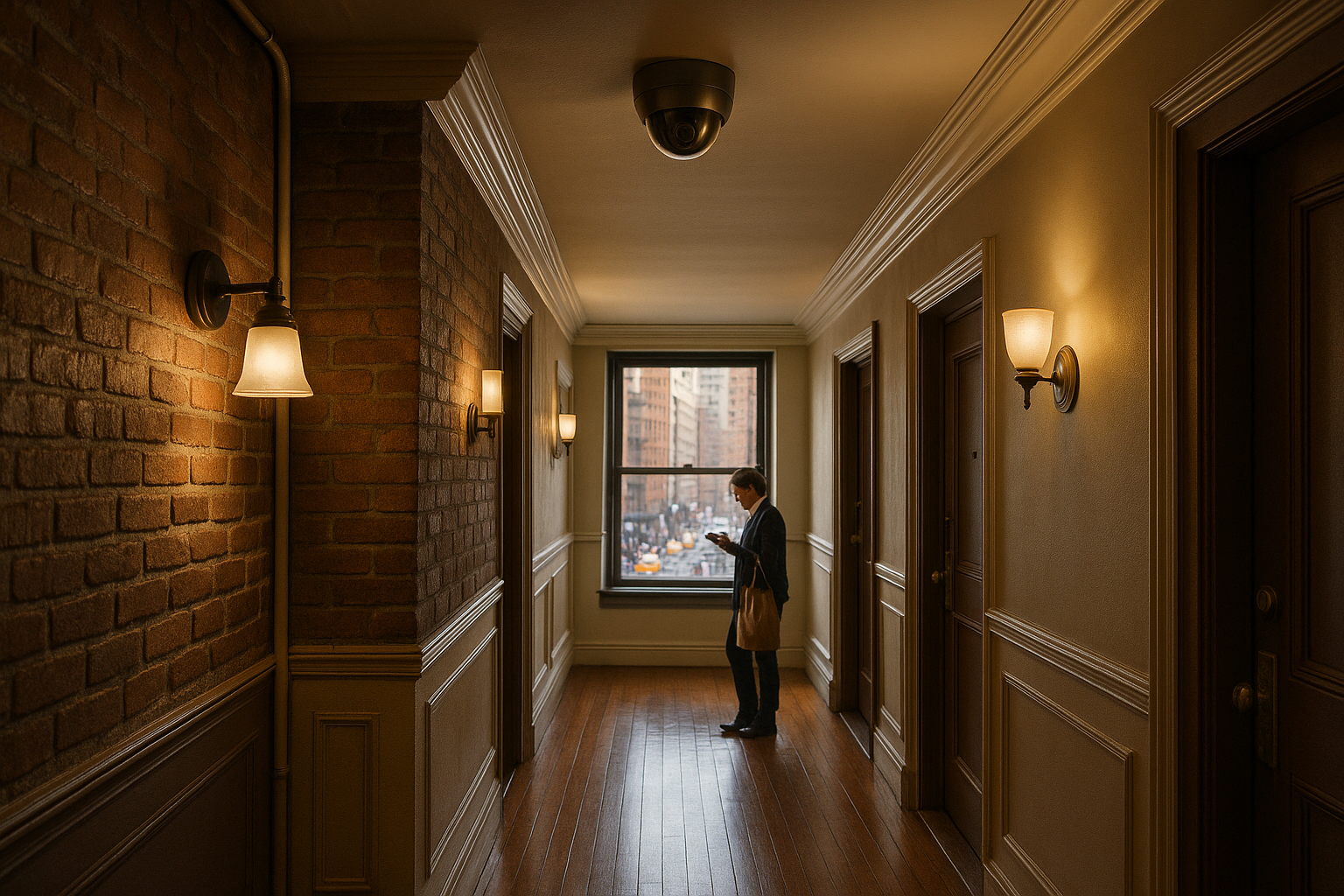
Hallways are permissible locations for video surveillance because tenants do not have a heightened privacy expectation walking through a shared space. However, the camera must:
- Be mounted in a location visible to tenants (not hidden)
- Be disclosed in the lease or a separate addendum signed before move-in or lease renewal
- Be positioned to avoid capturing doorways to individual apartments more than necessary for security
- Not record audio
Best practice: Position hallway cameras to cover the central corridor and stairwell access points, not aimed at specific apartment doors where tenants might reasonably undress before entering their unit.
Lobbies and Building Entrances
Front lobbies and entryway areas are generally acceptable locations, particularly for buildings with package theft, mail tampering, or unauthorized entry issues. Cameras must still comply with §26-138:
- Not record audio (no microphones)
- Be disclosed to tenants in writing before installation
- Not focus excessively on mail room or package delivery areas if tenants have privacy interest there
A building lobby camera is defensible because it serves the legitimate purpose of identifying intruders and monitoring common-area security. Courts in New York recognize this as a valid business purpose under §26-138(b)(1).
Stairwells and Fire Exits
Stairwell cameras are permissible with the same notice and audio-free requirements. They can help document unauthorized access and safety hazards. However, do not position a camera inside a stairwell landing where it captures someone entering from a specific apartment—that crosses into invasion of privacy.
Parking Areas and Loading Docks
If your building has a parking garage or loading area accessible to tenants, surveillance is permissible and often expected for theft prevention. The same §26-138 rules apply: no audio, written notice, legitimate purpose, and reasonable retention.
Strictly Prohibited Camera Locations
Bathrooms (Even Common Bathrooms)
Do not place cameras in any bathroom accessible to tenants, including shared bathrooms in common areas. This is a direct violation of Penal Law §250.00 and §26-138. Penalties include:
- Criminal misdemeanor charges (Class E felony for intentional recording)
- Civil liability up to $250,000 per violation under the NYC Human Rights Law
- Mandatory injunctive relief (camera removal) plus damages
- Potential sex offender registration in extreme cases
Changing Rooms, Locker Rooms, and Exercise Areas
If your building has a fitness room, yoga studio, or changing area, cameras are prohibited. Tenants have an explicit reasonable expectation of privacy in these spaces.
Apartments (Private Units)
You cannot install cameras inside a tenant's apartment, period. This is a criminal trespass and invasion of privacy violation. Some landlords attempt to claim a "maintenance portal" camera—illegal. Tenants have absolute privacy in their unit.
Bedroom Windows or Doors (Partial Common Area Adjacency)
If a camera positioned in a hallway can see into a bedroom window or captures someone entering a bedroom, it's prohibited. Courts in New York apply a "reasonable expectation of privacy" test. Even if technically in a common area, a camera aimed at a bedroom is a violation.
The Written Notice Requirement — Timing and Content
When Notice Must Happen
Under §26-138, notice must be provided before camera installation. This is not a post-installation notice scenario. If you already have cameras up and haven't notified tenants, you are currently in violation.
For new tenants: Include the surveillance disclosure in the lease or as a separate signed addendum. For existing tenants: You must provide written notice at least 10 days before installation. Provide notice in writing, in person or via certified mail.
Courts have held that verbal notice or email (without confirmation of receipt) is insufficient. You need a paper trail showing each tenant received the notice.
What the Notice Must Include
Your written notice should state:
- The specific locations where cameras will be installed (e.g., "Lobby entrance, hallway third floor, stairwell between floors 2-3")
- The business purpose (e.g., "to prevent package theft and monitor unauthorized entry")
- The fact that audio is NOT recorded
- How long footage is retained (e.g., "30 days")
- Who can access footage (e.g., "Management and licensed security personnel only")
- The tenant's right to request a copy of footage under FOIL (Freedom of Information Law) if applicable to their lease matter
Sample language: "Management has installed video surveillance in the building lobby and hallways for security and theft prevention purposes. These cameras record video only—no audio is recorded. Footage is retained for 30 days and accessed only by authorized management and security staff."
Documenting Tenant Acknowledgment
Have tenants sign an acknowledgment that they received and understood the notice. Keep these signed acknowledgments in your tenant file. If a dispute arises later, you can prove you complied with §26-138's notice requirement.
For month-to-month tenants, annual re-notification is prudent. For lease renewals, include the disclosure in the renewal addendum.
Audio Recording — Absolute Prohibition
New York is a two-party consent state for audio recording. This means all parties must consent to being recorded. Recording someone's voice in a common area without their explicit consent is a violation of:
- Penal Law §250.00 (wiretapping/eavesdropping) — misdemeanor or felony depending on intent
- Federal Title III (18 U.S.C. §2511) — civil penalties up to $100,000 per violation, plus criminal exposure
- NYC Admin Code §26-138 (privacy protection)
Do not install cameras with built-in microphones or that record audio in any tenant-accessible area. Even if you never activate the audio, simply having the capability in a common area is problematic and invites tenant complaints.
If you purchase a camera system that includes audio capability, physically disable or remove the microphone before installation in a residential building. Document this action in your compliance records.
Consequence of audio recording: A tenant discovers your hallway camera has a microphone. She files a complaint with HPD and consults an attorney. Even if you never actually recorded audio, the presence of the capability gives her grounds to sue for invasion of privacy and demand camera removal plus damages. Many settlements exceed $20,000 in this scenario.
Retention Policies and Data Minimization
New York courts and regulatory guidance favor data minimization—keeping footage only as long as necessary for the stated business purpose. If your purpose is identifying package thieves, 30 days is reasonable. If your stated purpose is "general security," keeping footage for 90 days is defensible. Keeping footage for 6 months or 1 year requires documented justification.
Create a Written Retention Policy
Document your retention schedule in writing:
"Surveillance footage in common areas is retained for 30 days from the date of recording. Footage older than 30 days is automatically deleted unless it is evidence of a crime or maintenance issue, in which case it is retained for 90 days pending resolution. Only authorized management staff may access footage. Tenants may request copies of footage involving their unit for lease-related disputes via written request to [your contact info]."
Include this policy in your tenant handbook or lease addendum. It demonstrates compliance with §26-138's implicit requirement for reasonable, documented data practices.
If a tenant requests footage of a hallway incident involving her, you should have a process to provide it. If you cannot because it was deleted, your retention policy must justify the deletion (30-day standard = reasonable).
When Tenants Can Challenge Your Cameras
Non-Compliance with §26-138
A tenant can file a complaint with HPD if:
- You did not provide written notice before installation
- The camera records audio
- The camera is placed in an area where she has a reasonable expectation of privacy (e.g., directed at her bedroom window)
- No legitimate business purpose is documented
HPD can issue a violation notice to you. The penalty framework is not a published fine schedule—HPD determines violations on a case-by-case basis. However, documented HPD violations can trigger:
- Injunctive relief (court order to remove the camera)
- Civil penalties ranging from $500 to $5,000+ depending on severity and duration of violation
- Tenant's right to break the lease without penalty due to landlord breach of §26-138
Human Rights Law Claims
If a tenant can demonstrate the surveillance targets her based on a protected class (race, national origin, disability, family status, etc.), she has a claim under NYC Human Rights Law §8-102. Penalties in these cases are substantial:
- Actual damages (her out-of-pocket harm)
- Consequential damages (emotional distress, moving costs)
- Punitive damages (up to $250,000 per violation in egregious cases)
- Attorney's fees and costs
For example: You install a camera in the hallway outside a unit occupied by a single mother with a disability. She files a complaint alleging the camera was installed to monitor and discriminate against her. Even if your stated purpose was legitimate, the timing and placement fuel a plausible discrimination claim. Litigation costs and settlement demands become substantial.
Right to Withhold Rent
Under New York Real Property Law §223-b, a tenant may have the right to withhold rent if a landlord violates the warranty of habitability or violates tenant privacy rights under §26-138. If a tenant legitimately claims you violated surveillance rules, she can place rent in escrow pending resolution. While you can still pursue eviction for non-payment, the court will consider the landlord's violation a defense.
Compliance Checklist for Surveillance Installation
Use this step-by-step checklist before installing any camera system:
| Task | Compliance Requirement | Status |
|---|---|---|
| Determine business purpose | Document the specific reason for surveillance (theft prevention, unauthorized access, etc.) | ☐ |
| Identify permitted locations only | Cameras only in lobbies, hallways, stairwells, parking areas—never bathrooms, bedrooms, changing areas | ☐ |
| Verify no audio recording | Confirm cameras have no microphones; disable audio capability if built-in | ☐ |
| Draft written notice | Include locations, purpose, retention policy, no-audio statement, access controls | ☐ |
| Distribute notice to all tenants | Provide written notice at least 10 days before installation; certified mail or in-person | ☐ |
| Obtain signed acknowledgments | Have each tenant sign confirmation of receipt; keep in file | ☐ |
| Install cameras | Position to avoid private areas; use visible mounting | ☐ |
| Document retention schedule | Create written policy (30-day default recommended); retain in building file | ☐ |
| Update lease/house rules | Include surveillance disclosure in lease addendum or tenant handbook | ☐ |
| Establish access controls | Limit who can view footage; log all access; document in compliance file | ☐ |
| Annual review | Re-notify tenants annually; confirm cameras are functioning and compliant | ☐ |
Real-World Scenarios: What Compliance Looks Like
Scenario 1: Lobby Camera for Package Theft
Situation: Your 20-unit building has had recurring package thefts. You want to install a camera in the lobby focused on the package shelf area.
Compliant approach:
- Document the business purpose: "Prevent mail and package theft" (dated memo in your file)
- Select a camera without audio; confirm with the vendor
- Position camera to cover the package area and lobby entry, but not directed at apartment doors or windows
- Draft and send written notice to all 20 tenants at least 10 days before installation. Certified mail is safest.
- Include: specific location (lobby, package area), purpose (theft prevention), no-audio statement, 30-day retention schedule
- Collect signed acknowledgments from each tenant
- Set up automatic footage deletion after 30 days
- Create a written access log: only you and your maintenance manager can view footage
- Include the surveillance disclosure in all future lease renewals
Non-compliant approach (and why it fails): You install a camera without notice. A tenant sees it, files a complaint with HPD. HPD issues a violation for lack of prior notice under §26-138. You're ordered to remove it. Cost: removal, HPD fine ($500–$2,000), and damaged tenant relationship.
Scenario 2: Hallway Cameras on Upper Floors
Situation: You have a 50-unit building with unauthorized entry and break-ins occurring on the 5th and 6th floors. You want to install hallway cameras.
Compliant approach:
- Document the business purpose: "Prevent unauthorized entry and identify break-in suspects" (dated memo)
- Position cameras to cover the hallway corridor and stairwell entrance, NOT aimed at individual apartment doors
- Confirm cameras are audio-free
- Provide written notice to all tenants (not just 5th and 6th floor) because they all use common areas: "Surveillance cameras have been installed in the hallways on floors 5 and 6 to prevent unauthorized entry and identify intruders. Cameras record video only; no audio is recorded. Footage is retained for 30 days."
- Set retention to 30 days and automate deletion
- Document who can access footage (you, security company, police if requested with warrant)
Pitfall to avoid: Do not angle the camera to capture someone entering/exiting a specific apartment. This invades privacy of that tenant even though the camera is technically in a common area. Frame the shot to capture the broader hallway.
Scenario 3: Package Room with Tenant Access
Situation: Your building has a package room managed by tenants. You want to install a camera to track who takes what.
Compliant approach:
- Camera is permissible if positioned to view the shelving and entry only
- Documented purpose: "Prevent package misdelivery and theft"
- Written notice to all tenants; no-audio confirmation
- Retention: 30 days (reasonable for package-related disputes)
- Access: only management; tenants can request footage if they claim a package was wrongly taken
Non-compliant approach: You angle the camera at a specific tenant's packages because you suspect her of taking others' deliveries. This appears discriminatory (targeting one tenant) and violates her reasonable expectation of privacy in a shared-access space. She files a Human Rights Law complaint. Cost: $15,000–$50,000 settlement.
Compliance Tools and Documentation for Self-Managers
Managing compliance manually with spreadsheets and email folders creates blind spots. Use the following tools to document and track your surveillance compliance:
- Compliance checklist template — Save in your building file; update annually
- Tenant notice template — Customize with your building address and camera locations; send certified mail
- Signed acknowledgment forms — Keep copies in each tenant's file and in a master compliance binder
- Camera access log — Record every instance footage is viewed, by whom, and why
- Retention schedule reminder — Set a calendar alert to verify footage deletion is happening on schedule
- Vendor documentation — Keep camera specifications and proof that audio is disabled
LeaseBase's compliance engine tracks statutory requirements by jurisdiction, including New York surveillance rules. You receive alerts when notice is due or when your retention policy is about to create a compliance gap. For multi-property owners, this prevents one building's violation from going unnoticed while you manage others.
Changes and Updates in 2024-2026
As of July 2026, New York has not substantially amended §26-138 regarding residential surveillance, but enforcement has tightened. HPD and the NYC Commission on Human Rights have increased focus on surveillance complaints filed by tenants, particularly in buildings serving vulnerable populations (seniors, disabled tenants, immigrant communities).
The trend in New York case law favors tenant privacy. Courts are interpreting "reasonable expectation of privacy" broadly, especially in hallways where tenants transition between public and private spaces. A camera positioned to see into an apartment from a hallway, or capturing someone undressing before entering a unit, has been found to violate privacy even with notice.
Recommendation: If you have existing surveillance, audit it now. Ensure all cameras comply with the 2026 interpretation of §26-138—position conservatively, retain footage minimally, and confirm tenants received proper notice.
Frequently Asked Questions
Q: Do I need a lawyer to install a surveillance camera in my building's lobby?
A: You do not need a lawyer if you follow §26-138 strictly: document your business purpose, confirm the camera has no audio, provide written notice to all tenants at least 10 days before installation, collect signed acknowledgments, and set a 30-day retention schedule. However, if your building is large (50+ units) or serves a vulnerable tenant population, a brief legal review of your notice language is prudent. The cost of a lawyer reviewing your notice ($300–$500) is far less than the cost of defending an HPD violation or tenant lawsuit ($5,000–$50,000).
Q: What if I already have cameras installed and haven't notified tenants?
A: You are currently in violation of §26-138. Take immediate action: (1) Notify all tenants in writing of the cameras' locations and purpose. (2) Include a statement that you are providing retroactive notice. (3) Offer tenants a reasonable grace period (e.g., 10 days) to file complaints or concerns. (4) Document that you have corrected the violation. (5) Going forward, obtain signed acknowledgments from all new tenants. While you cannot undo the violation, documenting your immediate correction limits HPD's ability to impose further penalties and may help if a tenant sues.
Q: Can I install a hidden camera in a hallway as long as it's audio-free?
A: No. §26-138 requires transparency. Tenants must be able to see the camera (or at minimum, must have been notified of its existence and location). A hidden camera, even if audio-free, violates tenant privacy expectations and gives HPD grounds for a violation. Additionally, hidden surveillance may trigger criminal charges under Penal Law §250 (unlawful surveillance) depending on intent.
Q: Can I use footage from a hallway camera to evict a tenant for violation of house rules?
A: Yes, but only if the footage directly shows a violation (e.g., a tenant bringing an unpermitted pet into the building, or a guest violating the guest policy). However, the footage was taken in compliance with §26-138 (proper notice, no audio, legitimate purpose). Use it judiciously. Relying on footage to pursue strict enforcement can escalate tenant relationships and invite counter-complaints about privacy violations.
Q: Does the camera need to be visible, or can it be discreet/small?
A: The camera doesn't need to be a large, obvious dome camera, but it must be discernible to a reasonable person in the hallway or lobby. A discreet camera mounted in a corner is acceptable as long as tenants were notified of its presence and location. Hidden cameras disguised as smoke detectors or sprinklers are not permitted.
Summary: Surveillance Compliance Roadmap for NY Landlords
New York's approach to residential surveillance prioritizes tenant privacy over landlord convenience. §26-138 is enforceable, and violations carry real penalties: HPD citations, injunctive relief, tenant rights to withhold rent, and civil liability under the Human Rights Law.
The good news: Compliance is achievable with a straightforward process. Document your business purpose, choose permitted locations, eliminate audio, notify tenants in writing, and set a reasonable retention schedule. These steps take a few hours per building and create a defensible record if a tenant or regulator questions your cameras.
For self-managing landlords, the challenge is tracking compliance across multiple tenants and lease cycles. Spreadsheets fail. A compliance platform that flags when notice is due, when retention needs to be enforced, and when lease renewals require updated disclosures eliminates guesswork.
LeaseBase's platform includes compliance tracking for state-specific requirements like New York surveillance rules. You receive reminders to re-notify tenants, verify camera functionality, and document your access controls. For landlords managing 2–75 units, this centralization prevents the §26-138 violations that cost thousands in fines and tenant disputes.
Start by auditing your current surveillance setup against the checklist above. If you find gaps, correct them immediately. The cost of proactive compliance is minimal; the cost of a tenant lawsuit over privacy violations is substantial.
Disclaimer: This article is for informational purposes only and does not constitute legal advice. Consult a qualified attorney for guidance specific to your situation. Laws and regulations change; verify current requirements with NYC HPD and the Commission on Human Rights before implementing surveillance systems.