
Washington Rent Cap 2026: 9.68% — How It’s Calculated and What’s Next
Washington Rent Cap 2026 Calculation

Key Takeaways

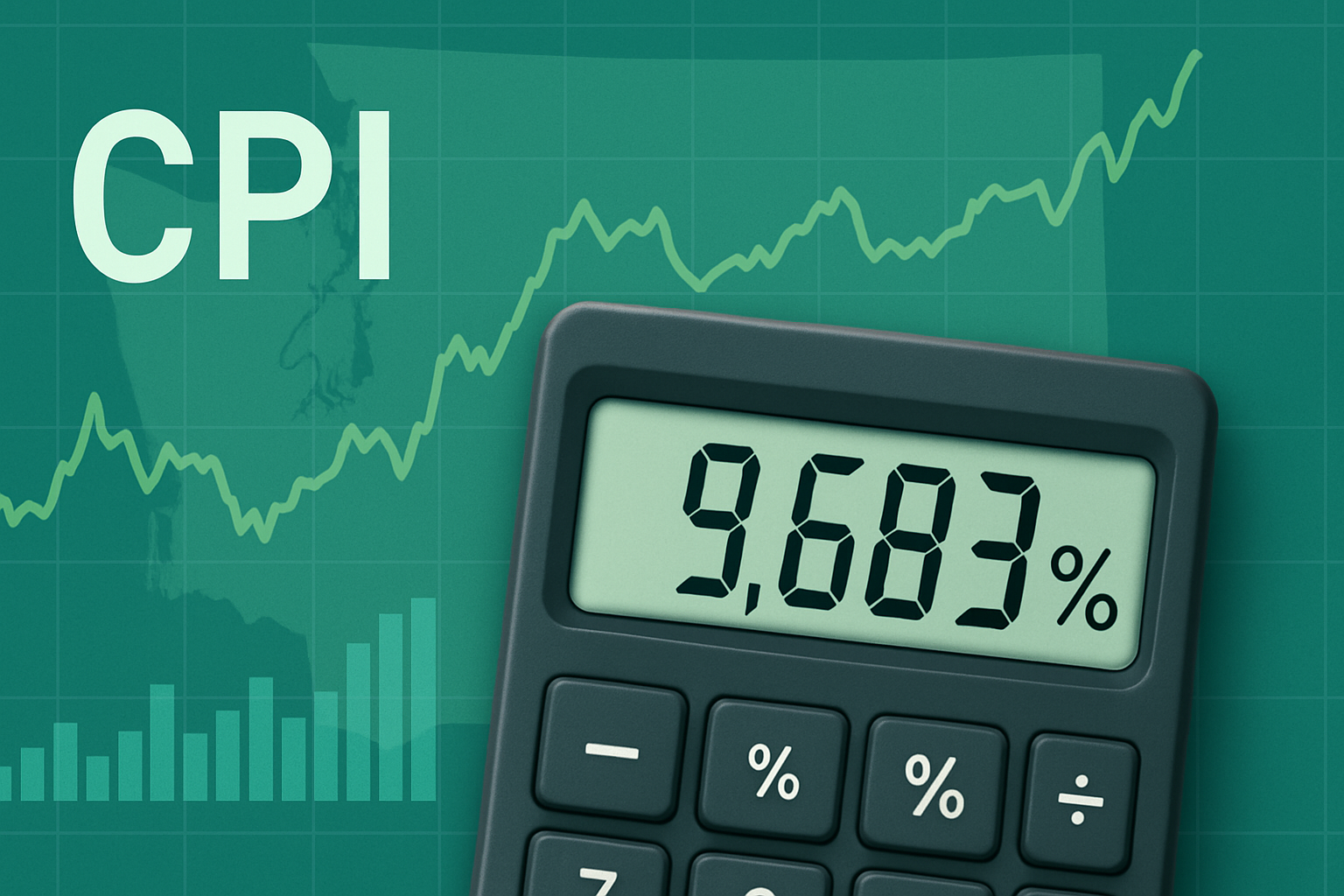
  • The 2026 Washington rent cap is 9.683%, calculated as 7% base + 2.683% Seattle-Tacoma-Bellevue CPI-U
  • The Washington Department of Commerce publishes the official maximum each July for the following 12-month period
  • The 2025 transitional cap was a flat 10% — 2026 is the first formula-based cap year
  • Compared to neighboring states: Oregon 2026 cap is 9.5%, California varies 6.3–8.8% by region
  • CPI trends suggest the 2027 cap could be lower if inflation continues moderating
  • Landlords must use the standardized notice form and provide at least 90 days’ notice (longer in Seattle, Tacoma, Olympia)

The 2026 Cap: 9.683%

For the period beginning July 1, 2026, Washington landlords can increase rent by a maximum of 9.683%. This is the first year the formula-based cap under HB 1217 applies, following the transitional 10% flat cap that was in effect from July 1, 2025, through June 30, 2026.

The 9.683% figure is not arbitrary. It is the result of a specific formula codified in the law, using published federal inflation data. Understanding how this number is derived helps landlords anticipate future caps and plan their rent strategies accordingly.

How the Cap Is Calculated

HB 1217 defines the maximum allowable rent increase as the lesser of:

  • 7% + the annual percentage change in CPI-U for the Seattle-Tacoma-Bellevue metropolitan statistical area, or
  • 10%

Breaking Down the 2026 Number

Component Value Source
Base rate 7.000% HB 1217 statute
CPI-U (Seattle-Tacoma-Bellevue, June 2025) 2.683% Bureau of Labor Statistics
Formula result (7% + CPI) 9.683% Calculated
Hard ceiling 10.000% HB 1217 statute
2026 Maximum Allowable Increase 9.683% Lesser of 9.683% and 10%

The CPI-U figure used is the 12-month percentage change published by the Bureau of Labor Statistics for the Seattle-Tacoma-Bellevue metropolitan statistical area. The BLS publishes CPI data monthly, but the Department of Commerce uses the figure as of a specific reference month to calculate the annual cap.

Why the Seattle-Tacoma-Bellevue CPI?

Washington chose the Seattle-Tacoma-Bellevue CPI-U as the reference index because it is the most comprehensive regional CPI measurement available for Washington state. The BLS does not publish a statewide CPI for Washington. The Seattle-Tacoma-Bellevue MSA covers the majority of Washington’s population and serves as a reasonable proxy for statewide cost-of-living changes.

This means all Washington landlords — whether in Seattle, Spokane, Yakima, or Bellingham — use the same CPI figure and the same cap rate. There are no regional variations in the state-level cap, unlike California where different metro areas have different CPI figures and therefore different cap rates.

The Department of Commerce Publication Process

The Washington Department of Commerce is responsible for publishing the official maximum allowable rent increase each year. The process works as follows:

  1. BLS publishes CPI data. The Bureau of Labor Statistics releases CPI-U data monthly, including the Seattle-Tacoma-Bellevue figure.
  2. Department of Commerce calculates the cap. Using the statutory formula (7% + CPI, max 10%), the department determines the maximum allowable increase for the upcoming period.
  3. Publication in July. The official maximum is published each July, effective for the 12-month period beginning July 1.
  4. Standardized notice form updated. The department updates the required standardized notice form to reflect the current cap rate.

Landlords should check the Department of Commerce website each July for the updated cap rate and notice form. The published rate is the official number — do not calculate your own cap based on BLS data and assume it matches what Commerce publishes.

Historical and Projected Cap Rates

Period CPI Component Formula Result Effective Cap Notes
July 2025 – June 2026 N/A (transitional) N/A 10.0% Flat cap built into statute
July 2026 – June 2027 2.683% 9.683% 9.683% First formula-based year
July 2027 – June 2028 ~2.0–3.0% (projected) ~9.0–10.0% ~9.0–10.0% Depends on inflation trend
July 2028 – June 2029 ~2.0–2.5% (projected) ~9.0–9.5% ~9.0–9.5% Assumes continued CPI moderation

Important: The projected figures for 2027 and beyond are estimates based on current inflation trends and Federal Reserve projections. Actual figures will depend on economic conditions and will be published by the Department of Commerce each July.

How CPI Trends Affect Future Caps

Understanding CPI trends helps landlords plan multi-year rent strategies. Here are the key dynamics:

If Inflation Falls (CPI Below 2%)

If Seattle-Tacoma-Bellevue CPI-U drops below 2%, the cap would fall below 9%. At CPI of 1%, the cap would be 8%. At CPI of 0% (no inflation), the cap would be 7% — the statutory base alone. Even in a zero-inflation environment, Washington landlords can increase rent by up to 7%.

This 7% floor is a significant feature of HB 1217. Unlike some rent control regimes that tie caps entirely to CPI (resulting in very low allowable increases when inflation is low), Washington’s formula guarantees landlords can always adjust rents by at least 7% per year.

If Inflation Rises (CPI Above 3%)

If CPI rises above 3%, the formula result exceeds 10%, and the hard ceiling kicks in. At CPI of 3.1%, the formula gives 10.1%, but the cap stays at 10%. This means the 10% ceiling only matters during periods of elevated inflation (CPI above 3%).

During the high-inflation period of 2022-2023, Seattle-Tacoma-Bellevue CPI-U was well above 3%, meaning the cap would have been 10% in those years. As inflation has moderated, the formula produces a result below the ceiling.

CPI Scenarios and Cap Impact

CPI-U (Seattle-Tacoma-Bellevue) Formula (7% + CPI) Effective Cap
0.0% 7.0% 7.0%
1.0% 8.0% 8.0%
2.0% 9.0% 9.0%
2.683% (2026 actual) 9.683% 9.683%
3.0% 10.0% 10.0%
4.0% 11.0% 10.0% (ceiling)
5.0% 12.0% 10.0% (ceiling)

Comparison with Oregon and California

Washington’s cap formula is most similar to Oregon’s, but there are meaningful differences. Here is how the three West Coast states compare for 2026:

Feature Washington (HB 1217) Oregon (SB 608) California (AB 1482)
Formula 7% + CPI 7% + CPI 5% + CPI
Hard ceiling 10% None 10%
CPI index Seattle-Tacoma-Bellevue West Region CPI-U Regional (varies)
2026 cap 9.683% 9.5% 6.3–8.8% (varies)
Notice period 90 days (state) 90 days 30 days (under 10%)
Vacancy decontrol Yes Yes Yes
New construction exemption 12 years 15 years 15 years
Sunset 2040 None (permanent) 2035

Key Differences

Oregon has no hard ceiling. Oregon’s formula is identical to Washington’s (7% + CPI) but without a 10% maximum. In high-inflation years, Oregon landlords can exceed 10% if CPI justifies it. Washington landlords are always capped at 10%.

California uses a lower base. California’s 5% base rate (vs. 7% in WA and OR) results in consistently lower caps. A California landlord and a Washington landlord in the same CPI environment will see a 2% difference in their maximum allowable increase. Over multiple years, this compounds significantly.

California uses regional CPI. Because California uses different CPI figures for different metro areas, the cap varies across the state. Los Angeles has a different cap than San Francisco, which has a different cap than San Diego. Washington applies one statewide rate.

What Landlords Should Plan for 2027

As of mid-2026, the Federal Reserve projects continued moderation in inflation. If this projection holds, the 2027 Washington rent cap is likely to be in the 9.0-9.5% range. Here is how to plan:

1. Check the Department of Commerce in July 2027

The official 2027 cap will be published in July 2027. Do not assume the 2026 rate carries forward. CPI changes every year, and the cap changes with it.

2. Model Multiple Scenarios

Build your rent increase strategy around a range of possible caps. If the 2027 cap is 9%, plan for that. If it is 8%, plan for that too. Don’t set your entire strategy around a single assumed number.

3. Consider Multi-Year Compounding

Even at modest annual increases, compounding adds up. Here is what a $2,000/month unit looks like over five years under different cap scenarios:

Year 9.683% Cap (2026 rate) 9% Cap (lower CPI) 8% Cap (much lower CPI)
2026 $2,194 $2,180 $2,160
2027 $2,406 $2,376 $2,333
2028 $2,639 $2,590 $2,519
2029 $2,894 $2,823 $2,721
2030 $3,174 $3,077 $2,938

Over five years, the difference between a 9.683% cap and an 8% cap on a $2,000 unit is $236/month ($3,174 vs $2,938). This illustrates why CPI trends matter for long-term rental income projections.

4. Factor in Local EDRA Thresholds

In Seattle, the 2026 cap (9.683%) falls just under the 10% EDRA threshold. If the 2027 cap rises above 10%, maximizing the allowable increase would trigger EDRA. Plan your increase to stay under the EDRA threshold unless the additional revenue justifies the relocation payment. See our EDRA guide for break-even calculations.

When and How to Issue the Increase

The timing and format of your rent increase notice must comply with both state and local requirements:

Step 1: Verify the Current Cap

Check the Department of Commerce website for the official maximum allowable increase. For increases effective between July 1, 2026, and June 30, 2027, the cap is 9.683%.

Step 2: Calculate Your Increase

Multiply your current rent by the cap percentage. For a $2,000/month unit:

$2,000 x 9.683% = $193.66 maximum increase
Maximum new rent: $2,193.66/month

Use the Washington Rent Cap Calculator to verify your calculation and check EDRA exposure based on your city.

Step 3: Use the Standardized Notice Form

HB 1217 requires the use of a standardized notice form prescribed by the Department of Commerce. Download the current form from the department’s website. Do not use your own template, even if it contains all required information.

The notice must include:

  • Current rent amount
  • New rent amount
  • Effective date of increase
  • Percentage increase
  • Maximum allowable increase for the current period
  • Tenant resource information

Step 4: Provide Adequate Notice

Location Minimum Notice Period
Washington State (default) 90 days
Olympia (under 7%) 120 days
Tacoma (under 5%) 120 days
Seattle (all amounts) 180 days
Olympia (7%+) 180 days
Tacoma (5%+) 210 days

Step 5: Deliver and Document

Deliver the notice via a method that provides proof of delivery: certified mail, personal delivery with a witness, or posting and mailing as permitted by your jurisdiction. Keep a copy of the notice and proof of delivery in your records.

“The number that matters isn’t last year’s cap or what you think the cap should be. It’s the number published by the Department of Commerce this July. Check it, use it, and move on. The landlords who get into trouble are the ones who guess instead of looking it up.”

Rachid Abadli, Founder & CEO at LeaseBase

Frequently Asked Questions

Why is the 2026 cap 9.683% and not 10%?

The 2025 transitional year used a flat 10% cap written directly into the statute. Starting in 2026, the formula (7% + CPI) applies. Because the 2025 Seattle-Tacoma-Bellevue CPI-U was 2.683% (below 3%), the formula result (9.683%) is below the 10% ceiling. The cap will only hit 10% when CPI is 3% or higher.

Does the cap apply to all rent increases, including lease renewals?

Yes. The cap applies to any rent increase for an existing tenant, whether the tenancy is month-to-month or a fixed-term lease being renewed at a higher rate. The only exception is when a unit is vacant between tenants (vacancy decontrol).

Can I bank unused increases from prior years?

No. HB 1217 does not allow banking. If you don’t increase rent in 2026, you cannot increase by 19.366% (two years’ worth) in 2027. The cap applies to each 12-month period independently.

What if the 2027 cap is lower than the 2026 cap?

You must use the cap in effect at the time the increase takes effect. If the 2027 cap is 8.5%, that is your maximum for increases effective between July 1, 2027, and June 30, 2028, regardless of what the 2026 cap was.

How does the cap interact with EDRA in Seattle?

For 2026, the cap (9.683%) is under Seattle’s 10% EDRA trigger. A landlord who increases rent by the maximum allowable amount will not trigger EDRA. However, if CPI rises in future years and the cap exceeds 10%, maximizing the allowable increase would trigger EDRA in Seattle.

Where can I find the official published cap rate?

The Washington Department of Commerce publishes the official maximum allowable rent increase each July. Check their website for the current figure and the standardized notice form.

Is the 9.683% cap the same everywhere in Washington?

Yes, at the state level. HB 1217 uses a single CPI figure (Seattle-Tacoma-Bellevue) for the entire state. Unlike California, which has different caps for different regions, Washington applies one cap statewide. However, local ordinances in Seattle, Tacoma, and Olympia add additional requirements (notice periods, EDRA) that vary by city.

Calculate Your Maximum Increase

Don’t guess — calculate. The Washington Rent Cap Calculator uses the current cap rate to show your maximum allowable increase, EDRA exposure, and required notice timeline based on your property’s city.

LeaseBase tracks the annual cap rate automatically and updates your compliance dashboard when the Department of Commerce publishes new figures each July. No spreadsheets, no guesswork.

Related Reading

← Washington Compliance Hub

Get weekly landlord tips

Practical advice on rent collection, compliance, and self-managing profitably.

Ready to self-manage your rentals without the chaos?

LeaseBase™ handles rent collection, maintenance, leases, compliance, and reporting — so you don’t have to.

Free for up to 3 units. No credit card required.

The Landlord Independence Platform™

Every month without a system is another month of unnecessary stress.

You’re already doing the work. Now do it with a system that keeps you organized, compliant, and profitable.

14-day trial. No credit card required.