Key Takeaways
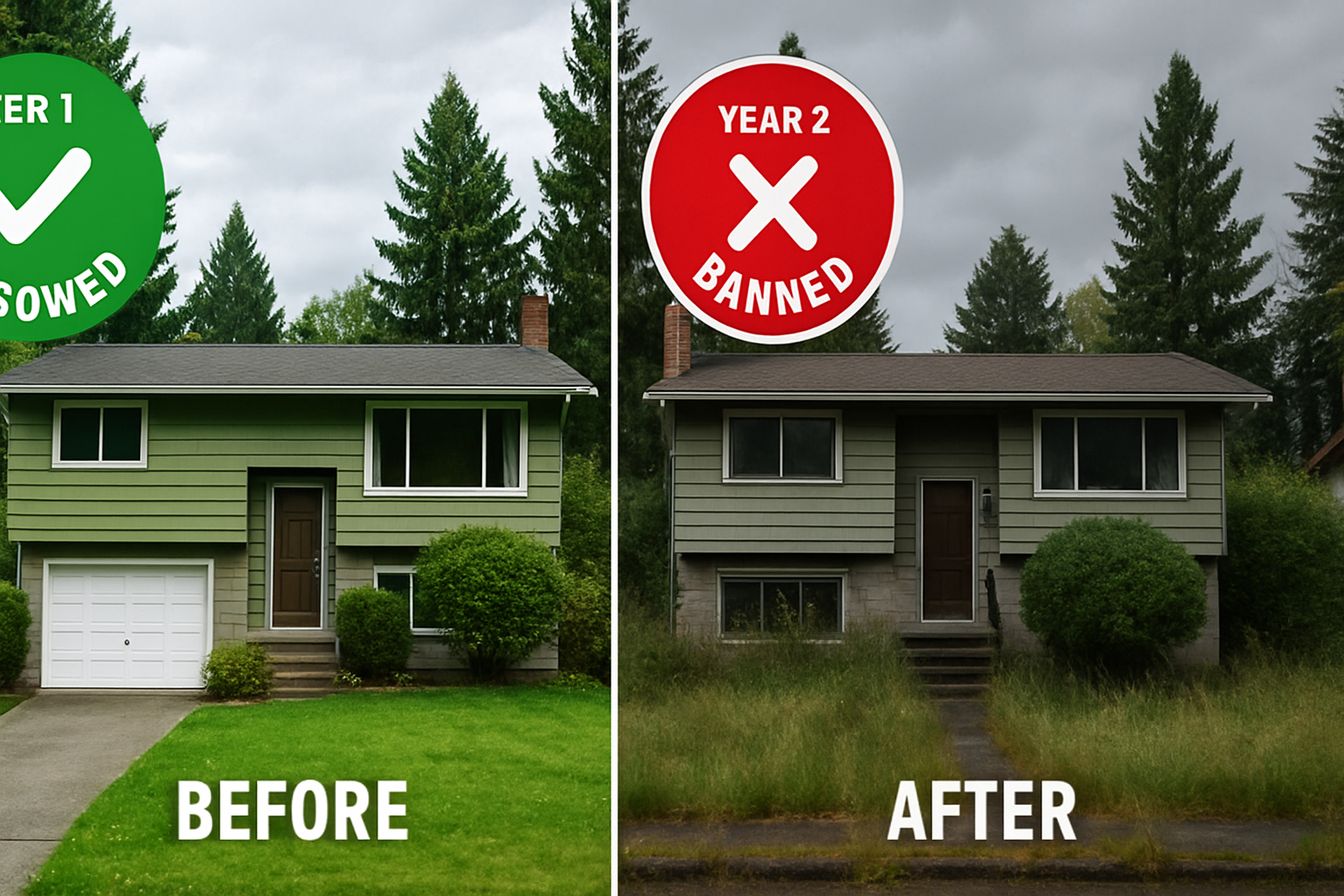
- First year: 30-day no-cause termination allowed statewide (90 days in Portland, Milwaukie, and Bend)
- After first year: No-cause evictions are banned entirely — must cite a qualifying landlord reason
- Qualifying-reason terminations require 90-day notice + 1 month’s rent relocation (unless ≤4 units)
- Portland adds relocation of $2,900–$4,500 for no-cause terminations at any point
- Washington bans no-cause from day one; California requires just cause after 12 months
Oregon’s No-Cause Eviction Rules: Before and After Year One
Oregon’s approach to no-cause evictions is a two-phase system created by SB 608 (2019). During the first year of a tenancy, landlords retain the ability to terminate without providing a reason, subject to notice requirements. After the first year, no-cause terminations are banned entirely, and the landlord must cite one of several qualifying reasons to end the tenancy. This framework, codified in ORS 90.427, fundamentally changed the landlord-tenant relationship in Oregon and remains one of the most consequential tenant protection measures in the state.
First Year of Tenancy: No-Cause Still Allowed
During the first year of a tenancy, Oregon landlords may issue a no-cause termination notice. The required notice period depends on location:
| Location | No-Cause Notice (First Year) | Key Detail |
|---|---|---|
| Most of Oregon | 30 days | Standard statewide minimum |
| Portland | 90 days | Local ordinance overrides state minimum |
| Milwaukie | 90 days | Local ordinance |
| Bend | 90 days | Local ordinance |
The first-year exception exists because the legislature recognized that landlords need some ability to end tenancies that are not working out before committing to long-term protections. A tenant who is disruptive, incompatible with neighbors, or otherwise problematic — but whose behavior doesn’t rise to the level of a lease violation — can be given notice during this trial period.
However, even during the first year, the termination cannot be retaliatory. Oregon’s anti-retaliation statute (ORS 90.385) prohibits landlords from terminating a tenancy in response to a tenant exercising their legal rights, such as requesting repairs, filing a housing complaint, or joining a tenant organization. A no-cause termination issued within six months of a tenant’s exercise of legal rights is presumed to be retaliatory, shifting the burden to the landlord to prove otherwise.
Portland’s First-Year Distinction
Portland’s 90-day first-year notice requirement is significant because it transforms what would be a relatively quick process into a months-long timeline. A Portland landlord who wants to issue a no-cause termination to a problematic tenant who moved in two months ago must still wait 90 days from the date of notice — meaning the tenant could occupy the unit for nearly five months before the termination takes effect.
Additionally, Portland requires relocation assistance for no-cause terminations at any point during the tenancy, including during the first year. The amounts range from $2,900 for a studio to $4,500 for a 3+ bedroom unit. This makes first-year no-cause terminations in Portland expensive — often more expensive than working through the lease term and not renewing.
After the First Year: No-Cause Evictions Are Banned
Once a tenant has occupied the unit for more than one year, no-cause terminations are banned entirely throughout Oregon. The landlord must cite a qualifying landlord reason to end the tenancy. This is the most significant change introduced by SB 608 and represents a fundamental shift in Oregon landlord-tenant law.
Before SB 608, Oregon landlords could terminate any month-to-month tenancy with a 30-day or 60-day no-cause notice, regardless of how long the tenant had lived there. This allowed landlords to reset rents to market rate by terminating the tenancy and re-renting the unit at a higher price. SB 608 closed this loophole by requiring qualifying reasons for termination after year one, preventing landlords from using eviction as a rent-setting mechanism.
Qualifying Landlord Reasons for Termination After Year One
After the first year, a landlord may only terminate a tenancy for one of the following qualifying reasons under ORS 90.427:
At-Fault Reasons (Tenant Did Something Wrong)
- Nonpayment of rent — after proper pay-or-vacate notice
- Material lease violation — after written notice to cure (typically 14 days for curable violations, 24 hours for certain serious violations)
- Substantial damage to the premises beyond normal wear and tear
- Illegal activity on the premises, including drug manufacturing or distribution
- Repeated violations — three or more written warnings within 12 months for the same or similar violations
- Criminal act that threatens health or safety of other residents or the landlord
- Refusal to sign a new rental agreement that is substantially similar to the current one
No-Fault Reasons (Not the Tenant’s Fault — Relocation Required)
- Owner move-in — the landlord or an immediate family member intends to occupy the unit as their primary residence
- Demolition — the landlord intends to demolish the unit (requires permits)
- Major renovation — renovations that cannot be completed with the tenant in place and require the unit to be vacated (requires permits)
- Conversion — the landlord intends to convert the unit to a non-residential use
- Sale of the property — under certain conditions, where the buyer intends to occupy the unit
Notice and Relocation Requirements
For no-fault qualifying reasons, the landlord must provide:
- 90 days’ written notice specifying the qualifying reason
- One month’s rent as relocation assistance — unless the landlord owns four or fewer residential dwelling units
The relocation assistance must be paid at the time the notice is served or no later than the date the tenancy terminates, depending on the specific reason. In Portland, the Portland-specific relocation amounts ($2,900–$4,500 by unit size) apply in addition to the statewide one month’s rent — potentially creating a dual relocation obligation.
The Four-Unit Exception
Oregon’s statewide relocation assistance requirement includes an exception for landlords who own four or fewer residential dwelling units. These landlords must still provide 90 days’ notice and cite a qualifying reason, but they are not required to pay the one month’s rent relocation assistance.
This exception was designed to protect small, individual landlords from the financial burden of relocation payments. A landlord who owns a single rental property — perhaps a family home they’re renting out while living elsewhere — is not subject to the same relocation obligation as a large portfolio owner.
However, this exception does not override Portland’s local relocation requirement. Even a landlord with four or fewer units who issues a no-cause termination (during the first year) or a qualifying-reason termination in Portland must still pay the Portland relocation amounts. The four-unit exception only applies to the statewide relocation under ORS 90.427.
How Oregon Compares to Washington and California
The three West Coast states take different approaches to just cause eviction, particularly regarding when protections begin and what triggers relocation:
| Feature | Oregon (ORS 90.427) | Washington (RCW 59.18.650) | California (AB 1482) |
|---|---|---|---|
| Just cause kicks in | After first year | From day one | After 12 months |
| First-year no-cause | 30 days (90 in PDX/Milwaukie/Bend) | Not allowed | Allowed (30 days) |
| Qualifying reasons | Multiple (see above) | 17 enumerated causes | At-fault and no-fault categories |
| No-fault relocation | 1 month’s rent (if >4 units) | Varies by city | 1 month’s rent or waive last month |
| Wrongful eviction penalty | Damages + attorney fees | Greater of damages or 3x rent + fees | Damages + potential punitive |
| Notice for no-fault | 90 days | Varies (90–180 days) | 60 days |
The most striking difference is Washington’s approach: just cause eviction applies from day one of the tenancy, with no first-year exception. This is the most tenant-protective approach among the three states. Oregon occupies a middle ground with its one-year grace period. California’s AB 1482 requires 12 months of tenancy before just cause protections apply, similar to Oregon but using a 12-month rather than a one-year threshold.
Penalties for Wrongful Eviction
Landlords who terminate a tenancy without a qualifying reason (or who fabricate a qualifying reason) face serious legal consequences. A tenant who prevails in a wrongful eviction action is entitled to:
- Actual damages — including moving costs, temporary housing costs, and the difference between the old and new rent
- Reasonable attorney fees and court costs
- Potential statutory damages depending on the circumstances
Oregon courts have interpreted wrongful eviction broadly. If a landlord claims owner move-in as the reason for termination but then re-rents the unit within a reasonable period, the tenant can bring an action for wrongful eviction. If the landlord claims major renovation but fails to obtain permits or complete substantial work, the same risk applies.
Additionally, tenants displaced by wrongful eviction may file complaints with the Oregon Bureau of Labor and Industries, which can investigate and impose administrative penalties. The combination of civil liability, attorney fee exposure, and regulatory oversight creates strong deterrents against pretextual evictions.
Practical Compliance: What Landlords Should Do
- Track tenancy start dates. Know exactly when each tenancy passes the one-year threshold. After that date, your termination options are limited to qualifying reasons only.
- Document qualifying reasons thoroughly. If you need to terminate for a qualifying reason after year one, document everything: permits for renovation, evidence of owner move-in plans, records of lease violations, etc.
- Serve proper notice. No-fault terminations require 90 days’ written notice specifying the qualifying reason. Use the statutory language required by ORS 90.427.
- Pay relocation assistance on time. For no-fault terminations (if you own more than four units), provide one month’s rent as relocation. In Portland, add the city-specific amounts.
- Don’t use no-cause as a rent-setting tool. Even during the first year, no-cause terminations in Portland require 90 days’ notice and $2,900–$4,500 in relocation. The economics rarely favor this approach over simply waiting for natural lease turnover.
- Be aware of anti-retaliation protections. Never issue a no-cause termination shortly after a tenant exercises their legal rights. The timing creates a presumption of retaliation that you must overcome.
- Consult an attorney for complex situations. Just cause eviction law is nuanced. An hour of legal consultation before serving a termination notice is far less expensive than defending a wrongful eviction lawsuit.
The Retaliatory Eviction Trap
One of the most common legal pitfalls for Oregon landlords is the retaliatory eviction claim. Oregon law presumes that a termination is retaliatory if it occurs within six months of a tenant:
- Complaining to a government agency about habitability issues
- Requesting repairs or maintenance
- Filing a fair housing complaint
- Joining or organizing a tenant association
- Testifying in a legal proceeding related to the rental
The presumption means the landlord has the burden of proving the termination was for a legitimate reason, not in retaliation. During the first year, when no-cause termination is allowed, this presumption is particularly dangerous because the landlord doesn’t need to state a reason — which means a tenant can argue that the real reason was retaliation, and the landlord cannot point to a documented qualifying reason to rebut the claim.
The best protection against retaliatory eviction claims is thorough documentation. Maintain written records of all tenant communications, repair requests, complaints, and your responses. If you issue a no-cause termination during the first year, ensure it is not within six months of any protected tenant activity. If it is, be prepared to demonstrate a legitimate, non-retaliatory reason with documentary evidence.
Frequently Asked Questions
Can I evict a tenant without cause in Oregon?
Only during the first year of the tenancy. After the first year, no-cause evictions are banned statewide under ORS 90.427. You must cite a qualifying reason such as nonpayment, material lease violation, owner move-in, or major renovation. During the first year, you can issue a no-cause termination with 30 days’ notice (90 days in Portland, Milwaukie, and Bend).
What is the notice period for a no-cause termination?
During the first year: 30 days statewide, 90 days in Portland, Milwaukie, and Bend. After the first year: no-cause termination is not allowed. For qualifying-reason terminations after year one: 90 days’ notice plus one month’s rent relocation (if landlord owns more than 4 units).
Do I have to pay relocation for a no-cause termination?
In Portland: yes, always — $2,900 to $4,500 depending on unit size. In the rest of Oregon during the first year: no relocation is required for no-cause terminations. After the first year: no-cause is banned; qualifying-reason terminations require one month’s rent relocation if you own more than four units.
How does Oregon compare to Washington?
Washington bans no-cause evictions from day one of the tenancy (no first-year exception). Oregon allows no-cause during the first year but bans it after. Washington’s approach is stricter, with 17 enumerated just cause reasons applying from the start. Oregon’s first-year grace period is more favorable to landlords.
What happens if I violate the just cause eviction law?
The tenant can bring a wrongful eviction action to recover actual damages, attorney fees, and court costs. If you claim owner move-in but don’t actually move in, or claim renovation but don’t complete the work, you face liability for wrongful eviction. Tenants can also file complaints with the Oregon Bureau of Labor and Industries.
Automate Compliance Tracking
Tracking tenancy duration, just cause eligibility, notice periods, and relocation obligations across multiple properties is complex. LeaseBase tracks all of these automatically, alerting you when a tenancy passes the one-year threshold, calculating notice deadlines, and flagging Portland-specific relocation requirements for every unit in your portfolio.