Key Takeaways
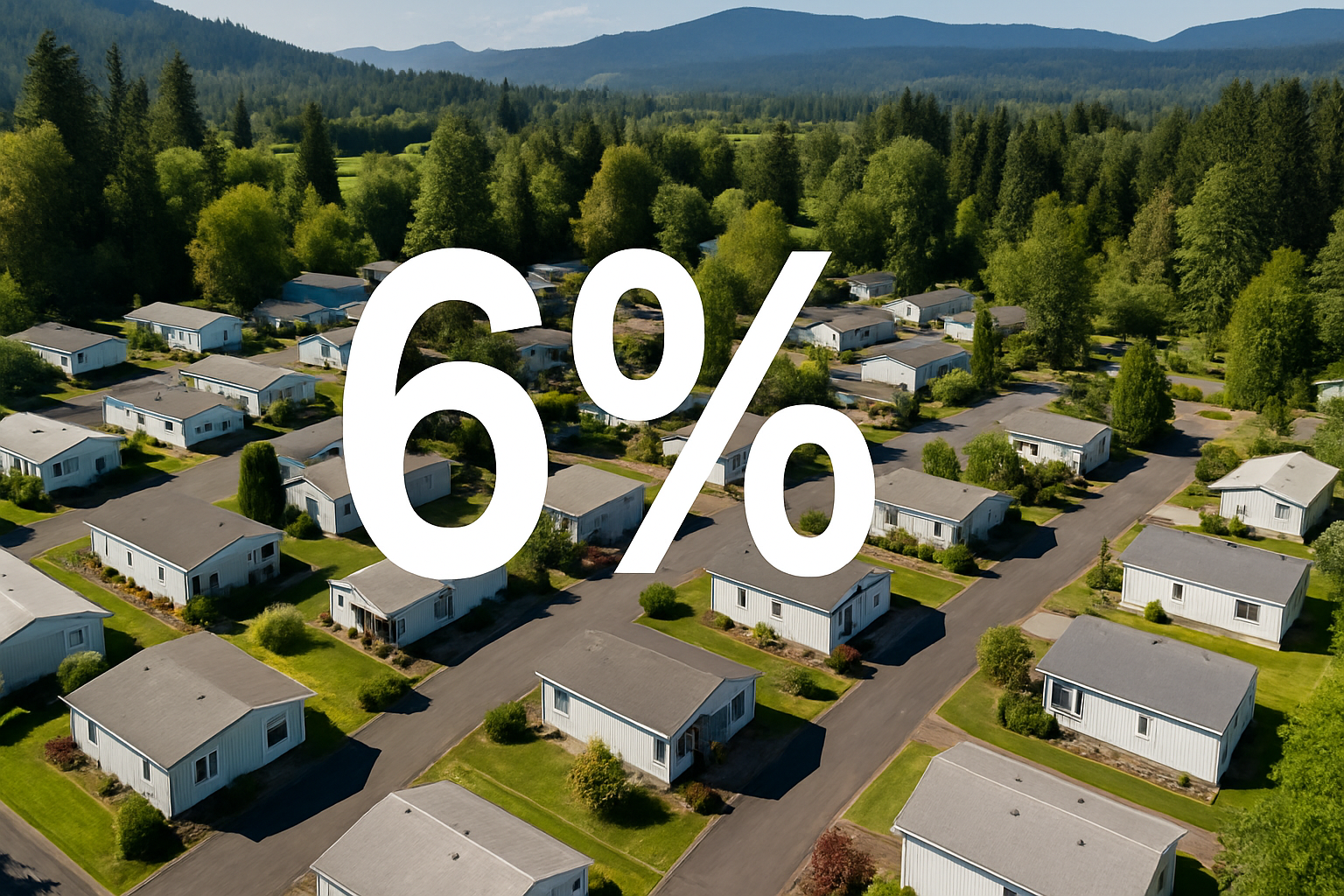
- HB 3054 (2025) creates a separate 6% cap for manufactured home parks with 30+ spaces
- Parks with ≤30 spaces follow the standard SB 608 formula: 7% + CPI (9.5% for 2026)
- The 6% cap is flat — it does not vary with CPI and is always 6% regardless of inflation
- The space count is based on total spaces in the park, not occupied spaces
- All other Oregon rules still apply: just cause eviction, 90-day notice, one increase per 12 months
Oregon’s Manufactured Home Rent Cap: A Separate System Most Owners Miss
In 2025, the Oregon legislature quietly passed one of the most significant changes to the state’s rent control framework since SB 608 itself. House Bill 3054 created a separate, stricter rent increase cap specifically for manufactured home parks with 30 or more spaces. While standard residential properties and smaller parks follow the SB 608 formula of 7% + CPI (9.5% for 2026), larger manufactured home parks are capped at just 6% per year.
This distinction is critical for park owners and managers, and it’s one that many in the industry have not yet absorbed. Applying the wrong cap — using the standard 9.5% when the 6% manufactured housing cap applies — could expose park owners to tenant challenges, forced rent rollbacks, and legal liability.
Why Manufactured Housing Gets a Separate, Stricter Cap
Manufactured home parks occupy a unique position in the housing market. Unlike traditional apartments, where the landlord owns both the building and the land, manufactured home parks typically involve a split-ownership model: the resident owns the home (a manufactured structure), while the park owner owns the land beneath it. The resident pays a monthly space rent for the right to keep their home on the park’s land.
This arrangement creates a fundamental power imbalance. When rent increases on a traditional apartment, the tenant can move to another apartment — an inconvenient but financially manageable transition. When space rent increases in a manufactured home park, the resident faces a dramatically different calculation. Moving a manufactured home costs $5,000 to $20,000 or more, requires finding a new park with an available space (increasingly rare), and may involve zoning and permitting hurdles. Many older manufactured homes cannot be moved at all without being destroyed.
The result is that manufactured home residents are effectively captive tenants. They own their home but cannot practically leave, giving the park owner extraordinary leverage over rent increases. The legislature recognized this vulnerability and enacted HB 3054 to provide additional protection.
The 30-Space Threshold: Which Cap Applies?
HB 3054 divides manufactured home parks into two categories based on size:
| Park Size | Annual Rent Cap | Governing Law | Varies with CPI? |
|---|---|---|---|
| 30 or more spaces | 6% | HB 3054 (2025) | No — flat 6% every year |
| 30 or fewer spaces | 9.5% (2026) | SB 608 / SB 611 | Yes — 7% + CPI, max 10% |
| Standard residential (not MH) | 9.5% (2026) | SB 608 / SB 611 | Yes — 7% + CPI, max 10% |
How to Determine Your Space Count
The space count for determining which cap applies is based on the total number of spaces in the park, not the number currently occupied. If your park has 35 platted spaces but only 28 are currently occupied, you still fall under the 30+ space category and the 6% cap applies. The space count is determined by:
- The number of spaces approved by the local planning/zoning authority
- The number of spaces shown on the park’s approved site plan
- The number of spaces in the park’s business license or registration
If your park is near the 30-space boundary, document the official space count carefully. A park with exactly 30 spaces falls into the “30 or fewer” category and follows the standard formula. A park with 31 spaces falls into the “30 or more” category and is subject to the 6% cap.
What About Mixed-Use Parks?
Some manufactured home parks include a mix of resident-owned homes (where the resident owns the manufactured home and rents the space) and park-owned homes (where the park owns the manufactured home and rents it to the tenant). The 30-space threshold typically counts all residential spaces, regardless of ownership structure. However, the specific cap that applies to a given tenancy may depend on whether the tenant is renting space only or renting a park-owned home. Consult with a qualified Oregon attorney if your park has a mixed-ownership structure.
The 6% Cap in Practice: What It Means for Park Owners
The flat 6% cap for larger parks is notably different from the standard SB 608 formula in several ways:
It Does Not Vary with CPI
The standard formula (7% + CPI) produces a different cap each year depending on inflation. In 2026, the CPI is 2.5%, producing a 9.5% cap. In a high-inflation year, the formula could produce up to 10% (the hard cap). The manufactured housing 6% cap is fixed — it’s 6% every year regardless of inflation. This provides more predictability for both park owners and residents, but it also means that in high-inflation years, park owners absorb the real cost of inflation above 6%.
The Gap Between Standard and Manufactured Housing Caps
For 2026, the gap is significant: 9.5% for standard residential versus 6% for manufactured housing (30+ spaces). On a $600/month space rent (typical for Oregon manufactured home parks), this translates to:
Standard cap (9.5%): $600 × 0.095 = $57/month increase (new rent: $657)
MH 30+ cap (6%): $600 × 0.06 = $36/month increase (new rent: $636)
Difference: $21/month per space ($252/year)
For a 50-space park, this adds up to $12,600 per year in foregone revenue compared to what the standard cap would allow. Over five years, the cumulative impact is substantial, particularly when accounting for compounding.
Compounding Over Time
The flat 6% cap creates a growing gap over time compared to the standard formula. Consider a space starting at $600/month under each cap regime:
| Year | Standard Cap (assume 9.5%) | MH 30+ Cap (6%) | Difference |
|---|---|---|---|
| 2026 | $657 | $636 | $21/mo |
| 2027 | $719 | $674 | $45/mo |
| 2028 | $787 | $714 | $73/mo |
| 2029 | $862 | $757 | $105/mo |
| 2030 | $944 | $802 | $142/mo |
Note: The standard cap varies annually with CPI. This table assumes 9.5% for illustration.
Other Rules That Still Apply
The separate 6% cap does not exempt manufactured home parks from Oregon’s other rental housing regulations. All of the following still apply:
- One increase per 12 months — park owners can only raise space rent once per 12-month period
- 90-day written notice — rent increases require 90 days’ written notice
- Just cause eviction after year one — no-cause termination is banned after the first year of tenancy under ORS 90.427
- 15-year new construction exemption — parks less than 15 years old from their first certificate of occupancy are exempt from the cap (but this is rare for manufactured home parks, which tend to be older)
- Portland-specific rules — if the park is in Portland, relocation assistance and registration requirements apply
- Vacancy decontrol — when a space turns over, the park owner may set any initial rent for the next tenancy
Manufactured Home Park Specific Regulations
Oregon also has manufactured dwelling park-specific regulations under ORS Chapter 90 that go beyond the rent cap:
- Written rental agreement required — park tenancies must have a written rental agreement that includes specific disclosures
- Park rules must be provided in writing before tenancy begins
- Park sale notification — residents must be notified when the park is listed for sale, and they have certain rights related to purchase opportunities
- Closure notification — if a park is closing, residents must receive extended notice and may be entitled to relocation assistance
- Tree maintenance — park owners are generally responsible for maintaining trees in common areas
The Investment Impact: How HB 3054 Affects Park Values
The 6% cap has direct implications for manufactured home park valuations, which are typically based on net operating income (NOI) capitalized at a market rate. A lower revenue growth ceiling directly reduces projected NOI growth, which in turn affects valuation multiples.
For parks valued on a cap rate basis, the 6% rent growth ceiling means:
- Lower projected revenue growth compared to standard residential properties
- Higher risk of expense inflation exceeding revenue growth in high-CPI years
- Reduced ability to implement value-add strategies that rely on significant rent increases after capital improvements
- Potential downward pressure on acquisition prices as investors adjust their underwriting
However, manufactured home parks retain several advantages that partially offset the stricter cap: extremely low turnover (residents rarely move), minimal capital expenditure requirements (residents own the homes), low management intensity per space, and strong demand driven by housing affordability pressures. Parks with below-market rents still have meaningful upside, even at 6% annual increases, if the gap to market rent is large enough.
How to Determine Which Cap Applies to Your Property
Use the following decision tree:
- Is your property a manufactured home park? If no → standard 9.5% cap (SB 608/611).
- Does your park have 30 or more total spaces? If no → standard 9.5% cap.
- If yes to both: 6% cap (HB 3054).
- Is the property less than 15 years old from its first CoO? If yes → exempt from the cap entirely (rare for MH parks but possible).
You can also use the Oregon Rent Cap Calculator, which includes manufactured housing inputs and automatically applies the correct cap based on your property type and space count.
Legislative Context and Future Outlook
HB 3054 reflects a broader national trend toward protecting manufactured home residents from aggressive rent increases. Similar measures have been enacted or proposed in several other states:
- Colorado passed HB 22-1287, creating manufactured home park rent protections and dispute resolution processes
- California’s MRL (Mobilehome Residency Law) provides extensive protections for mobilehome park residents, though it does not impose a specific rent cap
- Washington has proposed manufactured housing protections alongside its broader HB 1217 rent cap
- Vermont and Maine have enacted manufactured housing protections that include rent stabilization provisions
Oregon’s HB 3054 is notable for its simplicity: a flat 6% cap for larger parks, with smaller parks following the standard formula. This approach avoids the complexity of separate CPI calculations or dispute resolution mechanisms. It also sets a precedent that manufactured housing may warrant stricter protections than standard residential properties, which could influence future legislation in Oregon and other states.
Frequently Asked Questions
What is the rent cap for Oregon manufactured home parks?
Parks with 30 or more spaces are capped at 6% annual increases under HB 3054 (2025). Parks with 30 or fewer spaces follow the standard SB 608 formula of 7% + CPI, which is 9.5% for 2026. The 6% cap is flat and does not vary with inflation.
How do I know if the 6% cap applies to my park?
Count the total number of spaces in your park (not just occupied spaces). If the total is 30 or more, the 6% cap applies. If 30 or fewer, the standard 9.5% cap applies. The count is based on your park’s approved site plan or zoning authorization, not current occupancy.
Does the 6% cap apply every year?
Yes. Unlike the standard formula which varies with CPI, the manufactured housing cap for 30+ space parks is a flat 6% every year. In high-inflation years, this may be significantly below the standard formula result. In low-inflation years, the gap narrows.
Can I raise space rent more than 6% if I invest in improvements?
Under HB 3054, the 6% cap applies regardless of capital investments. There is no provision for pass-through of capital improvement costs above the 6% cap. Park owners must factor this cap into their investment decisions when planning major infrastructure upgrades.
Does the 15-year exemption apply to manufactured home parks?
Technically yes, but it is rare in practice. Most manufactured home parks are far older than 15 years. A newly developed park would be exempt from the cap for 15 years from its first certificate of occupancy, after which the 6% cap (if 30+ spaces) or standard formula (if ≤30 spaces) would apply.
Do Portland’s relocation rules apply to manufactured home parks?
Yes, if the park is located within Portland city limits. Portland’s relocation assistance ($2,900–$4,500 by unit size) applies to no-cause terminations and rent increases of 10% or more. Since the 6% cap makes increases of 10%+ impossible for larger parks, the relocation trigger is primarily relevant for no-cause terminations during the first year and for smaller parks or exempt properties where increases above 10% are possible.
Track Your Manufactured Housing Cap Automatically
Managing manufactured home park compliance requires tracking a different cap than standard residential properties, plus all the same notice requirements, just cause rules, and local ordinances. LeaseBase automatically applies the correct cap based on your property type and park size, and alerts you to all applicable deadlines and requirements.