Key Takeaways
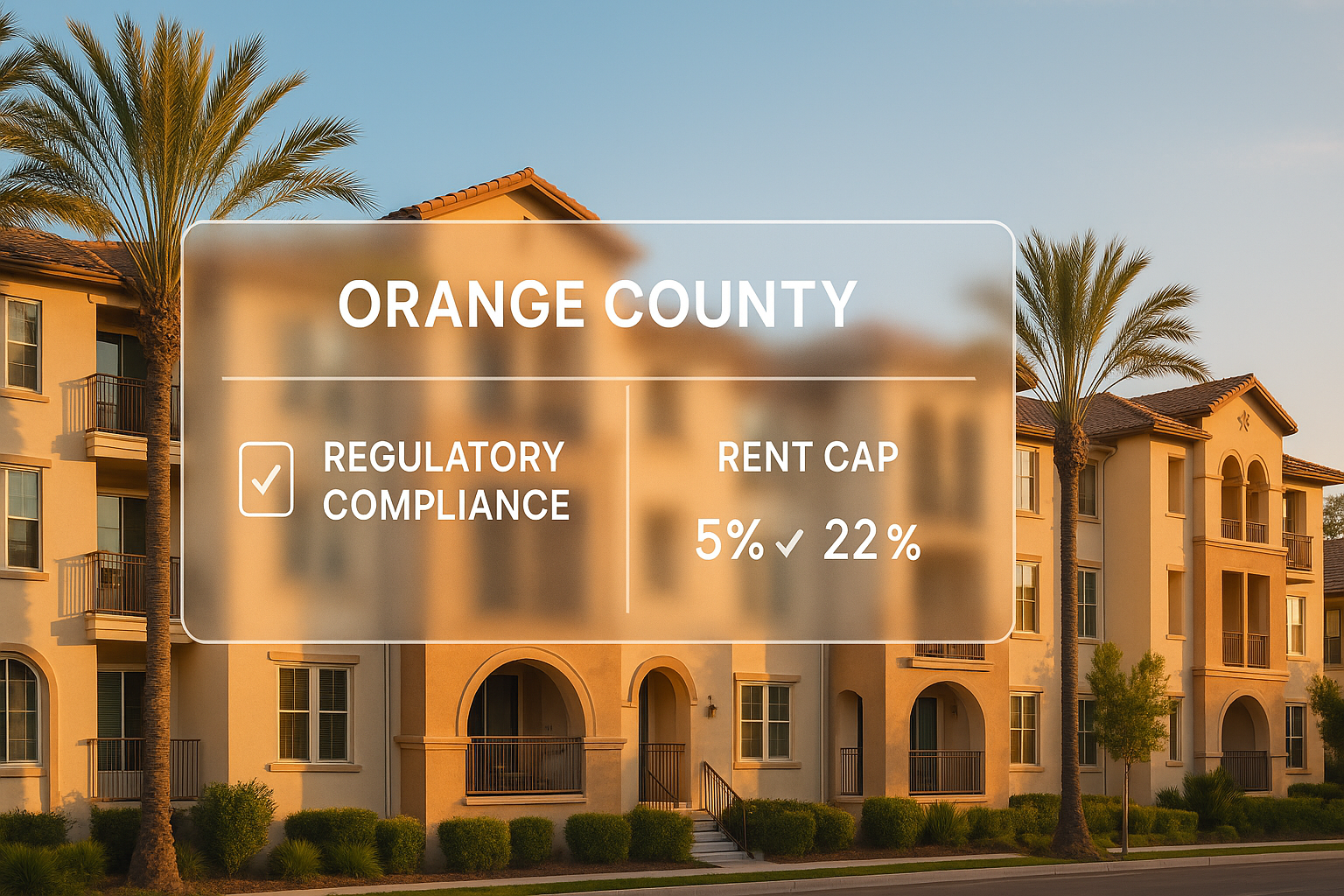
- AB 1482 applies to most OC multifamily owners regardless of local rent control status — the 2026 Southern California CPI adjustment puts the Orange County cap at approximately 8.8% for covered units, and just-cause eviction requirements kick in after 12 months of tenancy
- Single-family and condo owners must actively claim their AB 1482 exemption in writing — if you have not served the Civil Code § 1946.2(e) notice, your property may be inadvertently subject to both the rent cap and just-cause protections
- AB 2801 now requires timestamped photos at move-in, move-out, and post-repair — landlords without documentation are losing security deposit disputes they would have won under the prior law
- The lowest-rent-in-12-months trap is catching owners who gave concessions — any temporary rent reduction resets your AB 1482 baseline downward, potentially below what you were collecting before the concession
- Santa Ana operates its own ordinance with a 3% annual cap, rent registry, and relocation assistance requirements — stricter on every dimension than AB 1482; if you own there, the local ordinance is your primary constraint
- Anaheim has no local ordinance today but council activity is increasing — owners with significant exposure should monitor proceedings through 2026 and into 2027 as the regulatory environment shifts county-wide
Orange County landlords have long operated under a different set of assumptions than their counterparts in Los Angeles or the Bay Area. No local rent control. No just-cause-at-will. Cities like Irvine, Anaheim, and Huntington Beach have historically kept their hands off the landlord-tenant relationship in ways that Sacramento and San Francisco simply have not. If you own apartments in OC, that mindset is largely still correct — but the word "largely" is doing a lot of work in 2026.
Three significant state laws took effect or are now being enforced more aggressively this year. One OC city has already passed its own rent stabilization ordinance. Another is watching legislation closely. And the statewide regulatory pipeline is fuller than it has been in a decade: as of mid-2026, California has 191 active rent control and tenant protection bills moving through the legislature. Not all will pass. But the direction of travel is clear.
This article covers what OC apartment owners need to understand right now — not eventually, not when it affects you — now.
AB 1482 Applies to You. Yes, You.
The most common misconception among Orange County owners is some version of: "We don't have rent control here." And that's mostly true at the local level. But AB 1482 — the Tenant Protection Act of 2019 — is a state law, and it applies across California regardless of what your city council has or hasn't done.
Under AB 1482, if your property is covered:
- Annual rent increases are capped at 5% plus local CPI, with a hard ceiling of 10%. For 2026, the Southern California CPI adjustment puts the OC cap at approximately 8.8% for most covered units. That number changes annually.
- Just-cause eviction is required after a tenant has lived in the unit for 12 months. You cannot end a tenancy without one of the enumerated reasons — non-payment, lease violation, owner move-in, substantial remodel, etc.
Both provisions apply together. You don't get one without the other.
What's covered: Multifamily buildings with 15 or more units, condos, and single-family homes owned by corporations or LLCs where the owner is not an individual. Buildings constructed within the past 15 years are exempt. The 15-year rolling window means a building that was exempt last year may be covered this year.
What's not covered: Single-family homes and condos owned by individual landlords — but only if you've served the proper written exemption notice. More on that below.
The Single-Family Exemption: You Have to Claim It
This is the mistake that catches OC landlords off guard more than any other.
If you own a single-family home or condo and rent it out as an individual (not through a corporate entity), AB 1482 provides a full exemption — from both the rent cap and just-cause requirements. But the exemption is not automatic. California requires that you serve tenants with a written notice stating that the property is exempt.
The required language is specified in Civil Code Section 1946.2(e):
"This property is not subject to the rent limits imposed by Section 1947.12 of the Civil Code and is not subject to the just cause requirements of Section 1946.2 of the Civil Code. This does not affect any local jurisdiction's ability to adopt or maintain any rent control ordinance."
If you have not served this notice, and you've been operating under the assumption that your single-family rental is automatically exempt, you may have inadvertently subjected yourself to AB 1482's protections without knowing it. Tenants can and do raise this in eviction proceedings.
What to do: If you haven't served the exemption notice, serve it now with a lease amendment or addendum. For new tenants, include it in the lease itself. This is not optional paperwork — it is the legal mechanism for claiming the exemption.
The "Lowest Rent in 12 Months" Trap
Here is one of the most consequential traps in AB 1482 for owners who've been raising rents irregularly.
The rent cap calculation doesn't use whatever rent you're currently charging. It uses the lowest rent charged in the preceding 12 months. If you gave a tenant a concession, a temporary reduction, or a COVID-era discount at any point in the last year, that lower number becomes your baseline for the cap calculation — not the amount you've actually been collecting.
Example: Your unit normally rents for $2,400. In January, you gave the tenant a $300 rent reduction for two months because they lost work. By July, you want to raise rent. Your AB 1482 cap calculation starts from $2,100 — the lowest rent charged in the prior 12 months — not $2,400. At an 8.8% cap, that's a maximum increase to $2,285, which is actually below what you were collecting before the concession.
The lesson: document every concession in writing as a temporary one-time discount, not a rent reduction. Your lease should reflect the actual contract rent, with a separate addendum for any temporary accommodation.
AB 2801: Photo Documentation Is Now the Law
AB 2801 took effect January 1, 2025, and Orange County landlords — particularly the roughly 80% of individual rental owners who self-manage their properties — are underexposed to this requirement.
The law requires landlords to photograph rental units at three specific points in time:
- Before a new tenancy begins (prior to tenant move-in)
- At move-out, after the tenant has vacated and before any repairs or cleaning
- After any repairs or cleaning for which you intend to make deductions from the security deposit
The photographs must be taken before returning the security deposit or serving an itemized statement of deductions. This isn't a best practice or a recommendation — it is a statutory requirement. Failure to comply limits your ability to make security deposit deductions.
For OC landlords accustomed to paper walk-through forms and handshake move-outs, this is a material change. Courts are beginning to see these cases, and landlords without timestamped photo documentation are losing deposit disputes they would have won under the old rules.
Practical guidance: Use your phone, but use it systematically. Photograph every room, every wall, every appliance, every cabinet interior. Store the photos with timestamps in a folder organized by unit and date. Cloud storage with automatic date metadata is sufficient — you don't need specialized software, though it helps for organization at scale.
AB 12: Application Fee Caps Are Tighter Than You Think
Effective July 2024 and continuing into 2026, AB 12 significantly tightened the rules around rental application fees.
The maximum application fee is now capped at the actual, documented cost of a tenant screening report — not a fixed dollar amount. If you use a screening service that charges $32, you may charge $32. If you use one that charges $45, you may charge $45. You may not charge a flat $65 "application fee" and pocket the difference.
Additionally:
- You must provide applicants with a receipt showing exactly what their fee paid for.
- If you receive more applications than you can screen, you must refund the fees of applicants you did not screen.
- You may not charge an application fee at all if you know the unit is not available.
The refund requirement catches owners who run competitive application processes. If you accept five applications and screen only two, you owe refunds to the three you didn't process. This is not widely understood among self-managing landlords.
Santa Ana's Rent Stabilization Ordinance: The Local Layer
Within Orange County, Santa Ana stands apart. The city passed a Rent Stabilization and Just Cause for Eviction Ordinance that went into effect in 2023 and has been operative since. If you own property in Santa Ana, you're operating under both state law (AB 1482) and the local ordinance — and where they conflict, the more protective provision typically governs.
| Provision | AB 1482 (Statewide) | Santa Ana Ordinance |
|---|---|---|
| Annual rent cap | 5% + CPI (up to 10%); ~8.8% for OC in 2026 | 3% per year, or 80% of CPI — whichever is lower |
| Coverage | Multifamily 15+ units; buildings over 15 years old | Units built before 1995 — captures many older OC properties |
| Relocation assistance | Required for no-fault just cause (one month's rent) | Required for owner move-in and substantial remodel — may exceed AB 1482 minimums |
| Registration requirement | None | Yes — covered landlords must register units and pay annual fee |
If you own in Santa Ana, the local ordinance is your primary operating constraint. AB 1482 sets a floor that the city ordinance builds upon.
Anaheim: A City to Watch
Anaheim does not currently have a local rent control or rent stabilization ordinance. But the city has seen increasing tenant advocacy activity, and several council members have openly discussed studying local protections. Anaheim's rental stock is substantial — the city has one of the largest concentrations of older apartment inventory in the county, with a significant portion of units built before 1980.
If Anaheim were to pass a local ordinance, it would follow the same pattern as Santa Ana: a city-level cap on top of AB 1482, with potentially broader coverage and registration requirements. Owners with significant Anaheim exposure should watch city council proceedings through 2026 and into 2027.
This is not a prediction that Anaheim will act. It is a flag that the political environment in the county's second-largest city is more active than it has been in years.
Just-Cause Eviction: The 12-Month Threshold
Under AB 1482, a tenant who has continuously occupied a covered unit for 12 months becomes entitled to just-cause eviction protections. Prior to the 12-month mark, you can terminate a tenancy with proper notice for any lawful reason. After it, you need one of the enumerated just-cause grounds.
The enumerated grounds fall into two categories:
At-Fault Just Cause (tenant has done something wrong)
- Non-payment of rent
- Breach of a material lease term
- Maintaining a nuisance
- Unauthorized subletting
- Criminal activity on the premises
No-Fault Just Cause (owner is ending the tenancy for legitimate business reasons)
- Owner or immediate family member moving in
- Withdrawal of the unit from the rental market (Ellis Act)
- Compliance with a government order requiring vacancy
- Intent to demolish or substantially remodel
The no-fault grounds come with relocation assistance requirements — generally one month's rent paid to the tenant.
The 12-month clock resets if tenancy ends and a new lease begins. Some owners have attempted to use lease non-renewals at the 12-month mark to avoid just-cause protections. Courts and the California legislature are both aware of this strategy, and it is increasingly risky.
Your Compliance Checklist for 2026
For OC apartment owners, here is the practical checklist that applies right now:
- Audit your portfolio for AB 1482 coverage. Check each property's build date. Confirm whether entities or individuals hold title.
- Serve single-family exemption notices for any individual-owned SFR or condo where you haven't done so.
- Review your last 12 months of rent history for each covered unit before setting any increase. Use the lowest-rent figure as your baseline.
- Implement an AB 2801 photo protocol for all move-ins and move-outs. If you moved tenants in this year without photos, document current condition now.
- Update your application fee process to charge only actual screening costs, with receipts, and implement a refund workflow for unscreened applicants.
- If you own in Santa Ana, confirm your registration status and review your rent history against the 3%/CPI cap — not the AB 1482 cap.
You can run a free compliance check on your specific property and rent situation at LeaseBase Compliance Check. For AB 1482 rent cap calculations specific to your unit, the AB 1482 Calculator walks through the baseline and allowable increase based on your property's location and history.
The OC Outlook for 2027
Orange County's regulatory environment in 2027 will be shaped by three forces:
The State Pipeline
With 191 active rent control and tenant protection bills in the legislature, some portion will pass. The most likely near-term additions involve expanded relocation assistance requirements, stricter application screening rules, and potentially broader AB 1482 coverage thresholds. OC owners should assume the statewide floor will rise.
Local Organizing
The Santa Ana ordinance demonstrated that OC cities can and will act when tenant advocacy reaches a threshold. Anaheim is the most visible next candidate, but Garden Grove, Fullerton, and Westminster have older rental stock and growing tenant populations. Whether any of these cities act depends heavily on local electoral outcomes in November 2026.
The Court Record
AB 1482 enforcement is moving from the legislature into the courts. Case law on the single-family exemption notice, the lowest-rent baseline, and just-cause standards is accumulating. The rules that seemed abstract when the law passed are becoming concrete through litigation. Landlords who haven't updated their practices will increasingly find themselves litigating on unfavorable terrain.
The foundational OC reality hasn't changed: you are not San Francisco. Most of your cities have not layered local ordinances on top of state law. The political culture here is more property-rights-friendly than the Bay Area. But the state laws that do apply are being enforced more rigorously, the compliance obligations are more specific than many owners realize, and the window for treating these as optional or theoretical is closing.
Getting current in 2026 is cheaper than getting corrected in 2027.
Disclaimer: This article is for informational purposes only and does not constitute legal advice. California landlord-tenant law is complex and changes frequently. The information presented reflects laws and regulations as of July 2026 and may not account for subsequent legislative or regulatory changes. Consult a licensed California real estate attorney for guidance specific to your property, jurisdiction, and situation. LeaseBase's compliance tools provide informational guidance and do not substitute for professional legal counsel.
Sources: California AB 1482 (Civil Code §§ 1946.2, 1947.12); AB 2801 (Civil Code § 1950.5); AB 12 (Civil Code § 1950.6); Santa Ana Rent Stabilization and Just Cause for Eviction Ordinance (Santa Ana Municipal Code § 8-3140 et seq.); Orange County Assessor-Recorder-Clerk 2025 Property Data; U.S. Census Bureau 2023 American Community Survey, Orange County Housing Characteristics; California Legislative Information, 2025–2026 Session Bill Tracker.