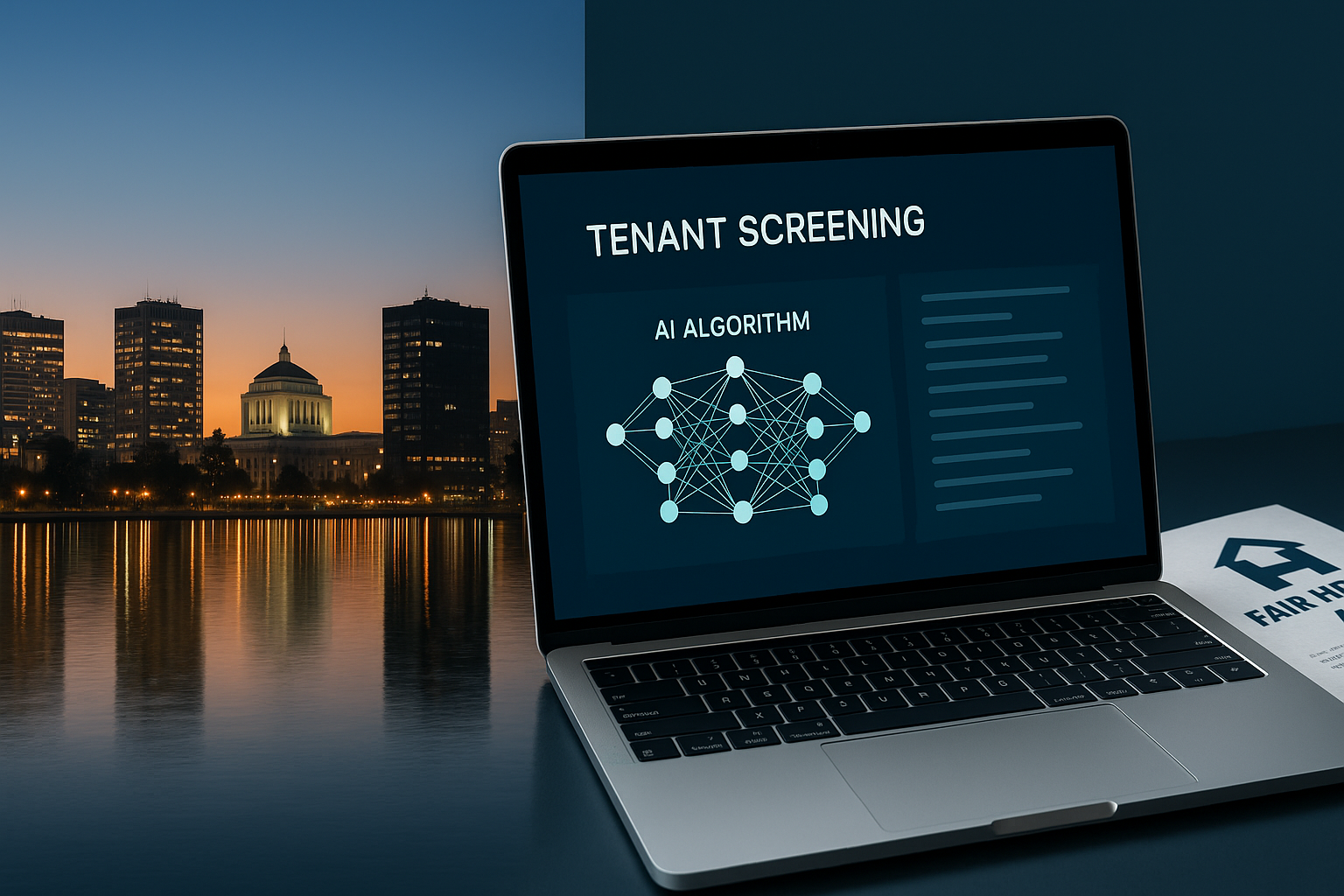
Key Takeaways
- AI screening tools can create Fair Housing liability even when removing human discretion — algorithmic systems trained on historical data inherit patterns correlated with race, national origin, and other protected characteristics
- East Bay landlords operate under three simultaneous legal frameworks — federal FHA, California FEHA (including SB 329 source-of-income protections), and city-level ordinances in Oakland, Berkeley, Richmond, and Hayward
- Oakland's Fair Chance Housing Ordinance breaks most AI screening workflows — criminal background checks cannot be run until after a conditional offer; most vendors do not support criminal-history-suppressed initial reports out of the box
- Section 8 voucher income is routinely mishandled by screening software — tools that require W-2/pay-stub documentation or calculate income ratios against gross rent effectively discriminate by source of income under SB 329
- Opacity is the primary risk factor — if you cannot explain, document, and defend every factor that influenced a screening decision, you are carrying liability you cannot quantify
- The landlord — not the vendor — remains legally responsible — most screening vendor contracts disclaim Fair Housing liability; you own the exposure regardless of whose software produced the output
East Bay landlords have always operated in one of the most legally dense rental markets in the country. Oakland's Just Cause for Eviction Ordinance predates AB 1482 by decades. Berkeley's Rent Stabilization Board has been litigating vacancy decontrol since the Dolan era. Richmond's Fair Rent, Just Cause for Eviction, and Homeowner Protection Ordinance added another layer when it passed in 2016. Hayward, Alameda, and Emeryville each brought their own rent stabilization frameworks. You already know this.
What's changed in the past two years is a new source of liability that's emerging precisely where landlords think they're reducing risk: tenant screening. AI-powered screening tools have proliferated across property management software stacks, promising faster decisions, fewer human errors, and more consistent criteria. Adoption among professional property managers jumped from 21% to 34% between 2024 and 2026, according to National Apartment Association survey data. The pitch is compelling — remove subjectivity, standardize the process, get out of the business of making gut-call decisions that might look discriminatory after the fact.
The problem is that algorithmic screening tools can create Fair Housing liability even when — sometimes especially when — they appear to be removing human discretion. This isn't hypothetical. HUD, the National Fair Housing Alliance, and state agencies are actively investigating how AI scoring systems function as a class. For East Bay operators, who already live at the intersection of three distinct layers of housing law, this is not a distant regulatory trend. It is arriving now.
The Three-Layer Problem
Most California landlords understand AB 1482. Fewer internalize that East Bay compliance actually requires reasoning across three separate legal frameworks simultaneously.
Layer 1: Federal Fair Housing Act (FHA)
The FHA prohibits discrimination based on race, color, national origin, religion, sex, familial status, and disability. Its reach extends to policies and practices with disparate impact — not just intentional discrimination. Under the Texas Department of Housing and Community Affairs v. Inclusive Communities Project (2015) ruling, a plaintiff does not need to prove discriminatory intent; they need to show a facially neutral policy produces a statistically disproportionate adverse effect on a protected class.
Layer 2: California FEHA
The Fair Employment and Housing Act extends federal protections and adds source of income, marital status, sexual orientation, gender identity, and immigration status as protected characteristics. California's definition of "source of income" is broad — SB 329, effective January 2020, specifically prohibits landlords from refusing to rent to applicants holding Section 8 vouchers. This means income ratio calculations that effectively screen out voucher holders — even without mentioning vouchers explicitly — can constitute source-of-income discrimination under state law.
Layer 3: Local Ordinances
Oakland, Berkeley, Richmond, and Hayward each add further requirements. Oakland's Fair Chance Housing Ordinance, passed in 2020, restricts when and how criminal history can be considered — landlords may not conduct criminal background checks until after a conditional offer of acceptance has been made, and must conduct an individualized assessment before any adverse action based on criminal history. Berkeley's tenant protections layer on additional just-cause requirements and, for rent-stabilized units, constrain denial criteria further. Richmond's ordinance ties fair-chance hiring principles to housing in ways that are still being litigated.
When you adopt an AI screening tool, you are not adopting one policy. You are stacking an algorithmic decision layer on top of all three frameworks at once. Most screening vendors have optimized for federal compliance at best.
How Algorithmic Scoring Creates Disparate Impact
AI screening systems learn from historical data. That's the point — they're supposed to detect patterns that predict tenant success. But historical housing and financial data in the United States carries embedded patterns that correlate strongly with race, national origin, and other protected characteristics.
Consider how a typical scoring model works. It might weight: credit score, debt-to-income ratio, rental history (including prior evictions), income verification, and employment stability. Each individual factor might appear neutral. The combined weight assigned to these factors — and the thresholds that produce "approve," "conditional," or "decline" outputs — is where disparate impact can emerge.
A 2019 HUD charge against Facebook's housing ad targeting algorithm was an early signal that regulators were prepared to pursue tech-mediated discrimination. More directly relevant: the National Fair Housing Alliance's 2023 investigation of automated underwriting systems in the rental market documented consistent patterns where Black and Latino applicants received lower algorithmic scores despite equivalent financial profiles, because the models weighted eviction history heavily and eviction filings are themselves unevenly distributed by race due to decades of housing segregation.
The mechanism matters here. Eviction filings — not eviction judgments, filings — disproportionately appear in records for Black and Latino renters, because landlords have historically filed evictions more frequently as a lease enforcement tool in communities of color. A model that penalizes any eviction filing history without distinguishing between a filed-but-dismissed case and an executed judgment is encoding that historical disparity into every future decision.
Credit scores carry analogous problems. The Consumer Financial Protection Bureau and academic researchers at Stanford and UC Berkeley have documented persistent racial gaps in credit scores that are not explained by current financial behavior but instead reflect historical exclusion from mortgage and banking access. An AI model trained to optimize for creditworthiness using credit scores will inherit those gaps.
For East Bay landlords, the exposure is particularly acute. Oakland and Berkeley have among the highest shares of Black and Latino renters in the state. If your screening tool produces statistically disparate outcomes across race or national origin, you are exposed to both FHA disparate impact claims and FEHA enforcement — regardless of your intent.
Source-of-Income Protections and the Section 8 Scoring Problem
SB 329 was clear: you cannot refuse to rent to a qualified applicant solely because they intend to pay with a Section 8 voucher. But AI screening tools introduce a subtler vector.
Many tools calculate income verification by comparing stated income against a rent-to-income threshold — often 2.5x or 3x monthly rent. Section 8 vouchers subsidize rent directly, meaning a voucher holder's out-of-pocket contribution may be a small fraction of the full rent. If the model calculates income ratio using gross rent rather than the tenant's portion — or if it flags income verification as "incomplete" because voucher documentation doesn't conform to the expected W-2/pay-stub format — the system produces a lower score or an adverse flag for voucher holders, even though the landlord is fully covered on the rent.
This is not a theoretical edge case. It is the default behavior of many widely-used screening platforms that were built before SB 329 or that have not been updated to handle voucher income correctly. The result is source-of-income discrimination produced by software, for which the landlord is liable.
If you rent in Oakland, Berkeley, or Richmond and your screening vendor cannot explain precisely how voucher income is handled in the scoring model, you have an open compliance gap.
Oakland's Fair Chance Housing Ordinance: Where AI Timing Creates Liability
Oakland's Fair Chance Housing Ordinance (OMCC § 8.22.800 et seq.) imposes a specific procedural requirement: you cannot consider criminal history, conduct a criminal background check, or allow any screening service to run criminal history before you have extended a conditional offer of acceptance to the applicant.
This timing requirement breaks most AI screening workflows. Standard screening tools run a comprehensive background check — which includes criminal history — as part of the initial screening package, producing a single score before any offer is made. In Oakland, that workflow is illegal. Running a criminal history check at the initial application stage, even as part of an automated bundle, violates the ordinance regardless of what you do with the information.
After a conditional offer, if criminal history is returned, Oakland requires an individualized assessment. The assessment must consider: the nature and gravity of the offense, the time elapsed since the offense or completion of sentence, and the nature of the rental housing (e.g., proximity to schools, the position's duties if a live-in manager is involved). A blanket policy of declining applicants with any criminal record — which some AI tools effectively implement through score thresholds — does not satisfy the individualized assessment requirement.
The practical implication for AI tools: you need a vendor that can segment the screening report, suppress criminal history from the initial application review, and provide compliant documentation flow for the post-offer individualized assessment. Most don't offer this out of the box.
What to Ask Your Screening Vendor
If you are currently using an AI screening tool, or evaluating one, these are not optional due diligence questions. They are the questions your attorney or a Fair Housing investigator would ask.
-
How was the model trained, and on what data?
Ask for a plain-language description of the training dataset and the outcome variable the model is trying to predict. "Predicts tenant success" is not an answer. What is the definition of success? Who was in the training data? What time period? Historical data from periods of discriminatory lending and rental practices will produce models that replicate those patterns.
-
Has the model been tested for disparate impact across protected classes?
Ask specifically: has the vendor conducted disparate impact analysis showing approval rates across race, national origin, sex, familial status, and disability? Will they share that analysis? A reputable vendor operating in California should be running these analyses internally and should be willing to share results under NDA if not publicly.
-
How does the model handle Section 8 vouchers and other income subsidies?
Ask for a specific walkthrough of how voucher income is scored. If the answer is "it's included as income," probe further: what documentation format does the model require, and what happens when that documentation differs from standard pay stubs?
-
Can the tool produce a criminal-history-suppressed report for initial screening?
For Oakland properties, this is a hard requirement. The vendor must be able to run a background check that excludes criminal history from the initial report and scoring, with criminal history only revealed after a conditional offer.
-
What is the adverse action documentation?
When the tool produces a decline recommendation, what documentation does it generate? You need a paper trail showing the specific, documented, consistent criteria applied — not just an AI score. Adverse action notices must state the specific reasons, and "the algorithm scored you low" is not a compliant reason.
-
Who is liable when the model is wrong?
Read the contract. Most screening vendors disclaim liability for Fair Housing violations that result from their model's outputs. You — the landlord — remain the responsible party. The vendor sells you a tool; the legal exposure is yours.
When AI Screening Helps — and When It Creates Liability
To be clear: automated screening tools are not inherently problematic. Used correctly, they can improve consistency, reduce the role of individual bias in decisions, and create better documentation trails. The goal is not to abandon technology but to deploy it in a way that is legally sound.
AI screening genuinely helps when it is used to apply transparent, documented criteria consistently across all applicants — income verification against a published threshold, identity verification, rental history retrieval. These are administrative tasks where automation reduces error and improves speed.
AI screening creates liability when the model is a black box producing opaque scores, when the training data is not disclosed or tested for disparate impact, when the workflow violates procedural requirements like Oakland's pre-offer criminal history ban, or when the tool cannot accommodate California-specific income definitions that include subsidies and housing vouchers.
The critical question is not "does this tool use AI?" but "can I explain, document, and defend every factor that influenced this screening decision?" If the answer is no — if the output is a number and you don't know what produced it — you are carrying liability you cannot quantify.
The UC Berkeley Terner Center's research on automated decision-making in housing has consistently found that opacity is the primary risk factor. Landlords who adopt AI tools without understanding their mechanics are not reducing their decision-making exposure; they are outsourcing it to a vendor who has disclaimed responsibility for outcomes.
For a deeper look at how California's layered compliance environment affects your operations, the California Landlord Compliance Report 2026 maps state and local requirements across the major markets. If you want to run your current screening criteria against East Bay-specific requirements, the LeaseBase Compliance Check walks through the framework interactively.
Compliance Audit Checklist: AI Screening Practices
Use this checklist to evaluate your current screening workflow. For properties in Oakland, Berkeley, Richmond, or Hayward, each item represents a distinct compliance vector.
Vendor Due Diligence
- Obtained written disclosure of training data sources and model methodology
- Confirmed vendor has conducted and will share disparate impact analysis by race, national origin, sex, familial status, and disability
- Confirmed vendor's income scoring correctly handles Section 8 vouchers and other housing subsidies under SB 329
- Confirmed vendor can produce criminal-history-suppressed reports for initial pre-offer screening (Oakland requirement)
- Reviewed vendor contract for liability allocation and indemnification provisions
Written Screening Criteria
- Screening criteria documented in writing before advertising any unit
- Criteria applied identically to every applicant for the same unit
- Income threshold defined in writing and applied consistently (including how voucher income is calculated)
- Criteria available to applicants upon request
- Criteria reviewed by a California-licensed attorney familiar with East Bay local ordinances within the past 12 months
Criminal History (Oakland / Fair Chance)
- No criminal background check initiated before conditional offer of acceptance is extended
- Conditional offer process documented in writing with date stamps
- Post-offer criminal history individualized assessment process defined in writing
- Individualized assessment considers: nature and gravity of offense, time elapsed, nature of housing
- No blanket policy of declining applicants based solely on criminal record
Adverse Action Documentation
- Every decline decision documented with specific, articulable reasons tied to written criteria
- Adverse action notices sent to every declined applicant with specific reasons
- Documentation retained for minimum three years
- Declined applicants informed of their right to dispute inaccurate background check information (FCRA requirement)
Source of Income (SB 329)
- Written policy explicitly prohibits rejection of applicants based solely on use of Section 8 or other housing vouchers
- Staff and screening tool both confirmed to process voucher income documentation correctly
- Income verification workflow does not require documentation formats that voucher holders cannot provide
Ongoing Monitoring
- Approval and decline rates tracked and periodically reviewed by applicant demographics
- Vendor agreement includes audit rights and annual disparate impact reporting
- Screening criteria reviewed whenever local ordinances are amended (Berkeley, Oakland, Richmond all update regularly)
- EBRHA membership and legal updates monitored for regulatory changes
The East Bay regulatory landscape will not get simpler. The trajectory of Oakland, Berkeley, and Richmond ordinances over the past decade — and the state's evident willingness to layer additional protections through FEHA and targeted legislation like SB 329 — points toward continued expansion. The arrival of AI tools in the screening stack adds a new dimension of liability that most property management software was not designed to handle at the level California law requires.
The landlords who navigate this well will be the ones who understand the tools they're using well enough to explain and defend every output, who apply documented criteria with genuine consistency, and who build vendor relationships that include accountability for compliance — not just disclaimers.
Disclaimer: This article is for informational purposes only and does not constitute legal advice. Consult a qualified attorney licensed in California for guidance specific to your situation and jurisdiction. Fair Housing law is complex and enforcement in the East Bay is active. When in doubt, seek counsel before making tenant screening decisions. Sources: HUD Memorandum on Artificial Intelligence and the Fair Housing Act (2023); National Fair Housing Alliance, "Technology and the New Housing Discrimination" (2023); UC Berkeley Terner Center for Housing Innovation, "Algorithmic Accountability in Rental Housing" (2024); California Department of Fair Employment and Housing guidance on SB 329; City of Oakland Municipal Code § 8.22.800 (Fair Chance Housing Ordinance); National Apartment Association 2026 Operations Survey.