Key Takeaways
- AB 1482 applies statewide — including Chico, Redding, Oroville, and Red Bluff — it is not a Bay Area or LA-only law; the misconception that rural landlords are automatically exempt has real legal consequences.
- Unit count does not determine AB 1482 coverage — there is no portfolio-size exemption; individual properties are evaluated by property type and ownership structure, not how many rentals you own.
- The single-family home exemption is real but requires written notice to the tenant — without the exact statutory language from Civil Code 1946.2 and 1947.12 in the lease or served separately, the exemption does not protect you even if the property qualifies.
- Owner-occupied duplexes are exempt, but only while you live there — the moment you vacate your unit, the exemption ends; keep utility bills and voter registration as documentation of primary residence.
- AB 2801 photo requirements apply to all landlords regardless of exemption status — timestamped move-in and move-out photos are now required before any security deposit deduction; no photos means no legal basis to withhold.
- Chico landlords face an additional local just-cause ordinance on top of state law — a state-level exemption from AB 1482 does not automatically exempt you from Chico's local ordinance; the two frameworks are separate and must both be evaluated.
If you own a rental in Chico, Redding, Paradise, Oroville, or anywhere else in the Northern Sacramento Valley, you've probably heard the name AB 1482 more times than you'd like. Maybe you've waved it off — "That's an LA and Bay Area thing." Maybe someone told you that small landlords are exempt. Maybe you've just decided not to think about it until a tenant brings it up.
Here's the honest truth: some of that thinking is right, and some of it will cost you. The exemptions under AB 1482 are real and meaningful — but they're not automatic, and they're not based on how many units you own. Getting this wrong means operating without protections you're entitled to, or assuming you have protections you don't.
This article is for the mom-and-pop landlord with one to five properties in Northern California. Let's walk through what actually applies to you, what doesn't, and — critically — what you have to do to claim an exemption when you're entitled to one.
First, What Is AB 1482?
AB 1482, the Tenant Protection Act of 2019, does two things:
- Caps rent increases at 5% plus local CPI (or 10%, whichever is lower) for covered units
- Requires just-cause for eviction after a tenant has lived in a unit for 12 months
The law applies statewide. It is not a Bay Area ordinance. It is not a Los Angeles law. It applies in Chico, in Redding, in Red Bluff, in Oroville — everywhere in California, unless a specific exemption applies to your property.
The Myth: "I Only Have Two Rentals, So I'm Exempt"
This is the most common misconception we hear from small landlords in Northern California, and it's simply not how the law works.
Unit count does not determine AB 1482 coverage. There is no exemption for portfolios under a certain size. Whether you own 1 rental or 15 rentals, your individual properties are evaluated based on property type and ownership structure — not the total number of units you own.
A duplex you don't live in? Likely covered. A single-family home where you gave your tenant proper written notice of the exemption? Likely exempt. The same single-family home where you forgot to send that notice? Covered.
The distinction matters because the remedies for violations are significant. A tenant who was wrongfully evicted or who received an unlawful rent increase can pursue damages, and in some cases attorney's fees.
The Single-Family Home Exemption — When It Applies and What You Must Do
Single-family homes are exempt from AB 1482 rent caps and just-cause requirements — but only under specific conditions.
The property must actually be a single-family home. This sounds obvious, but it means a standalone residence, not a unit within a larger building.
The landlord must not be a corporation, REIT, or LLC with a corporate member. If you own your rental through a standard LLC (common for liability protection), you are generally still eligible, as long as the LLC is not a corporate entity and does not have a corporate member. However, this is worth verifying with your attorney because the structure of your LLC matters.
You must provide written notice to your tenant. This is the part many landlords skip — and it's the part that blows up the exemption.
California Civil Code 1946.2 requires that landlords claiming the single-family home exemption include specific language in the lease or in a written notice served on the tenant. The required language is:
"This property is not subject to the rent limits imposed by Section 1947.12 of the Civil Code and is not subject to the just cause requirements of Section 1946.2 of the Civil Code. This property meets the requirements of Sections 1947.12 (d)(5) and 1946.2 (e)(8) of the Civil Code and the owner is not any of the following: (1) a real estate investment trust, as defined by Section 856 of the Internal Revenue Code; (2) a corporation; or (3) a limited liability company in which at least one member is a corporation."
If your current leases or rental agreements don't include this language, or if you never sent this notice to existing tenants, the exemption does not protect you — even if the property itself qualifies.
Action step: Review every lease on every single-family rental you own. If the notice language is missing, serve it on your tenant in writing now. For future leases, include it directly in the agreement.
The Owner-Occupied Duplex Exemption
If you live in one unit of a duplex and rent the other, you are exempt from AB 1482 — both the rent cap and the just-cause eviction requirement — for the unit you rent out.
This exemption also requires that you actually occupy the unit as your primary residence. If you move out and start renting both units, the exemption no longer applies.
For many rural and small-market Northern California landlords, this is the most natural ownership structure. You bought a duplex, you live on one side, you rent the other to cover the mortgage. This is a legitimate and lawfully exempt arrangement — no special notice required under the duplex exemption specifically — but keep documentation showing that your unit is your primary residence (utility bills, voter registration, driver's license address).
Chico's Local Just-Cause Ordinance: A Layer Many Landlords Don't Know About
After the Camp Fire in 2018, Chico's rental market was overwhelmed. Thousands of Paradise residents displaced overnight, a sudden surge in demand, and rental prices that shot up accordingly. In response to the housing crisis, Chico passed a local just-cause eviction ordinance.
This matters because local ordinances can be stricter than state law, and they apply on top of AB 1482 — not instead of it.
If you own rentals in Chico, you need to understand both the state rules and the local rules. An exemption from AB 1482 at the state level does not automatically mean you're exempt from Chico's local ordinance. The two frameworks are separate.
If you're a Chico landlord, this is worth a direct conversation with a local landlord association or a real estate attorney who practices in Butte County. The Northern Valley Property Owners Association is a good starting point for connecting with others who have navigated this.
Redding, Red Bluff, and Oroville operate under state law without additional local just-cause overlays as of this writing — but laws change, and it's worth confirming the current status in your specific city each year.
AB 2801 Photo Requirements Apply to Everyone — Even Exempt Landlords
Here's something many landlords in rural markets don't realize: AB 2801 applies regardless of whether your property is exempt from AB 1482.
AB 2801, effective July 1, 2025, requires landlords to take timestamped photographs of the rental unit:
- At or near the time of move-in (before the tenant takes possession)
- At or near the time of move-out (after the tenant vacates)
- Before and after making any deductions from the security deposit for repairs or cleaning
These photos must be provided to the tenant along with the security deposit itemization. If you don't have them, you cannot legally withhold from the security deposit for those items.
For rural landlords with older housing stock — and a lot of Northern California rentals are older — this matters especially for move-out disputes. If you charged a tenant $500 to replace carpet and you don't have move-in photos showing the carpet's condition at the start of the tenancy, that deduction is on shaky legal ground.
The practical fix is simple: create a move-in and move-out checklist, take photos of every room and every appliance on the day possession changes hands, date-stamp them, and keep them in your records. Do this for every tenancy, on every property, regardless of whether you think you're exempt from rent control.
AB 628: Appliance Habitability and Why Older Rural Properties Need to Pay Attention
AB 628 reinforces California's existing habitability standards as they relate to major appliances — specifically that landlords must ensure working heating, functioning plumbing, and adequate weatherproofing, among other requirements.
This is not a new legal concept, but the law strengthens tenant remedies and clarifies landlord obligations. For landlords in Redding, Oroville, and the rural foothills, where rental housing stock often includes older construction — 1950s and 60s homes, manufactured housing, older farm properties — this deserves attention.
An old wall heater that "sort of works" is not the same as a functional heating system. A water heater that takes three days to recover is a habitability question. Before your next lease renewal, it's worth walking each property with habitability standards in mind.
SB 1079 and the Corporate Ownership Restriction
SB 1079 is a separate but related law that restricts the ability of corporations to purchase single-family homes and small residential properties at foreclosure sales. It gives tenants and certain nonprofits the right of first refusal in those situations.
For individual landlords in Northern California — people who own their rental in their own name or through a simple family LLC — SB 1079 is mostly relevant as context: it reflects California's broader policy direction of limiting corporate ownership of residential housing. What it means for you directly is that if you do hold your properties through an LLC, the structure of that LLC matters for whether you can claim the AB 1482 single-family exemption. A corporate member in your LLC can disqualify you.
If you're not sure how your LLC is structured, your accountant or attorney can clarify this in about fifteen minutes.
The Reality of Small Portfolio Landlording in California
Roughly 80% of individually-owned rental properties in California are managed by the owner. In markets like Chico, Redding, and the surrounding rural areas, that number is likely higher. The reason? About 54% of self-managing landlords cite the cost of professional property management as the primary reason they handle it themselves.
That means the typical NVPOA member is not a passive investor. You're the one fielding the maintenance call at 10pm, writing the lease, handling the move-out walkthrough, and navigating all of this legal complexity without a team of attorneys. The regulations discussed in this article weren't written with you in mind — they were written in response to large corporate landlords in urban markets. But they apply to you anyway.
That's not a reason to despair. It is a reason to get organized, document carefully, and know your exemptions cold.
For a more complete picture of how California landlord law applies to properties like yours, the California Landlord Report 2026 covers current statewide compliance requirements with specific attention to smaller portfolios.
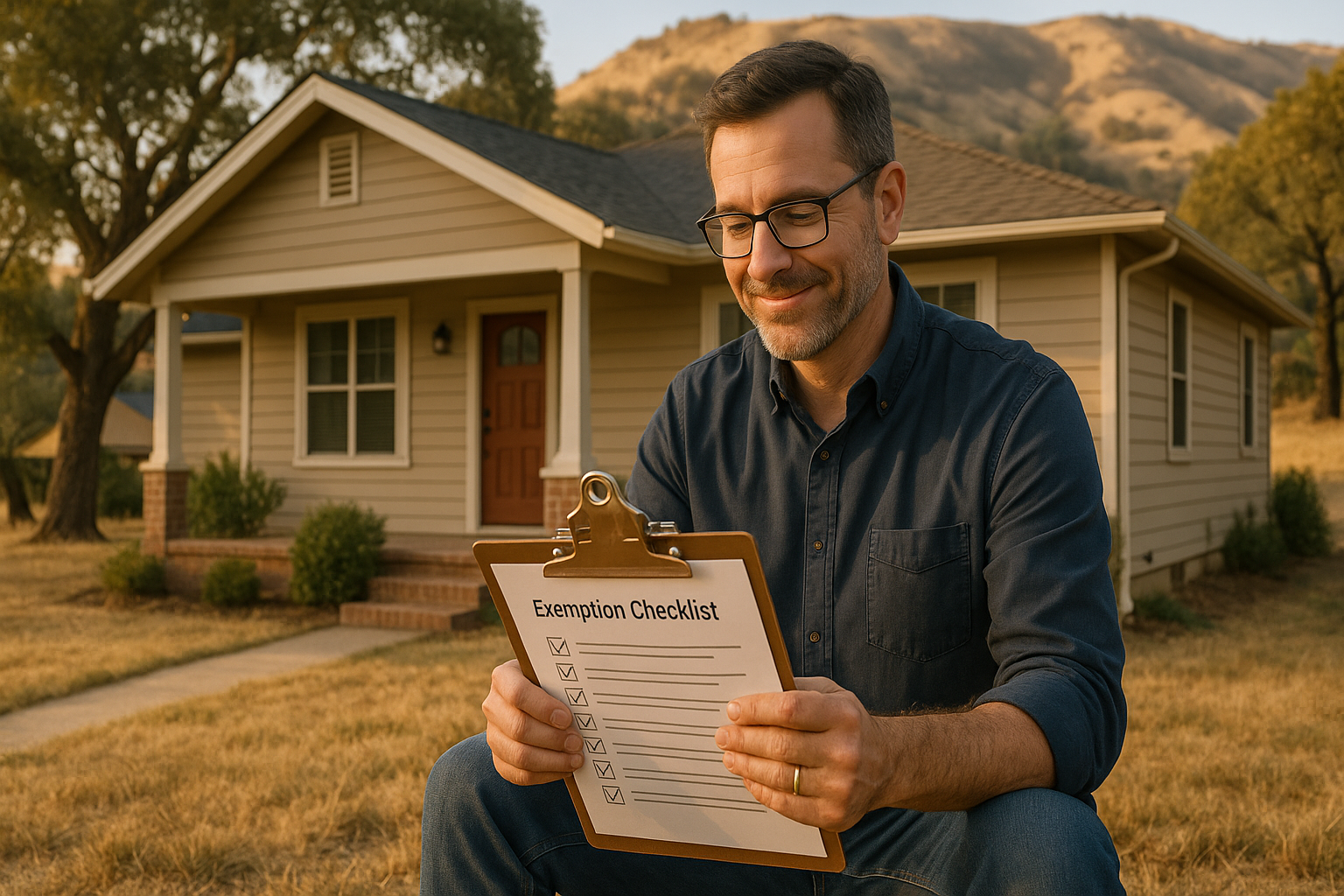
Your AB 1482 Exemption Checklist
Use this checklist for each rental property you own.
Single-Family Home Exemption
- Property is a standalone single-family home (not a unit in a multi-unit building)
- I do not own the property through an LLC with a corporate member, a REIT, or a corporation
- My current lease OR a written notice served on the tenant includes the exact statutory exemption language from Civil Code 1947.12 and 1946.2
- If I have not yet served written notice, I have added this to my immediate to-do list
Owner-Occupied Duplex Exemption
- I live in one of the two units as my primary residence
- I have documentation of my occupancy (utility bills, voter registration, license address)
- I understand that if I vacate my unit, the exemption no longer applies
For All Properties, Regardless of Exemption Status
- I have a move-in photo record for every current tenancy (timestamped, before tenant possession)
- I have a plan to take move-out photos on the day each tenant vacates
- I will provide photos alongside any security deposit itemization
- My rental units have functional heating, plumbing, and weatherproofing (AB 628 habitability baseline)
For Chico Landlords Specifically
- I have confirmed whether my property is subject to Chico's local just-cause ordinance
- I understand that local ordinances layer on top of state law, not instead of it
Ownership Structure
- I know whether my LLC (if applicable) has any corporate members
- If unsure, I have flagged this to review with my accountant or attorney
If you want to see how your specific properties map against current California requirements, the LeaseBase Compliance Check lets you enter your property address and get a summary of what applies in your jurisdiction — including local ordinances where we have data.
The regulations are genuinely complicated, and no article can substitute for a conversation with a qualified attorney when the stakes are high. But knowing your exemptions, documenting them correctly, and keeping current on the handful of laws that apply universally — regardless of exemption status — puts you in a much stronger position than most small landlords in California.
That's a real advantage, and it's one you can build with a few hours of focused attention.
Disclaimer: This article is for informational purposes only and does not constitute legal advice. AB 1482 exemptions depend on specific facts about your property, ownership structure, and compliance with notice requirements. Consult a licensed California real estate attorney to evaluate your individual situation before making decisions about rent increases, evictions, or exemption claims.