
Category: Uncategorized

  • The Real Rent Cap in Los Angeles Is 3%, Not 8% — Here’s Why

    The Real Rent Cap in Los Angeles Is 3%, Not 8% — Here’s Why

    Key Takeaways

    • If your rental property is in the City of Los Angeles and was built before October 1978, your rent cap is almost certainly 3% under LARSO — not AB 1482’s ~8%
    • LARSO’s new formula (effective July 1, 2026): 90% of CPI with a 1% floor and 4% ceiling
    • On a $2,500/month rent, LARSO allows a $75 increase vs. AB 1482’s $220 — that is $1,740/year less revenue
    • No-fault evictions in LA trigger $10,650–$26,550 in mandatory relocation payments
    • LARSO covers approximately 650,000 rental units in the City of Los Angeles — one of the largest rent-stabilized housing stocks in the country

    The Misconception That Costs LA Landlords Thousands

    Every year, landlords in Los Angeles make the same expensive mistake. They look up California’s AB 1482 rent cap — currently around 8% for the LA metro area — and assume that is the number they can raise rent by. They send out rent increase notices at 7% or 8%, fully believing they are in compliance with the law.

    They are wrong. And it can cost them dearly.

    If your property is in the City of Los Angeles and was built before October 1, 1978, your rent increase is not governed by AB 1482. It is governed by the Los Angeles Rent Stabilization Ordinance, commonly known as LARSO or the RSO. And the current Allowable General Adjustment (AGA) under LARSO is just 3.0% — less than half of what AB 1482 would allow.

    This is not a technicality. It is the difference between a legal rent increase and one that gives your tenant the right to file a complaint with the Los Angeles Housing Department (LAHD), recover excess rent, and potentially trigger an investigation into your property.

    How LARSO Works: The Formula Behind the Cap

    The Los Angeles Rent Stabilization Ordinance was originally adopted in 1979 in response to rapidly rising rents across the city. It has been amended multiple times, most recently in January 2026, when the City Council approved a significant change to how the annual rent increase is calculated.

    The New Formula (Effective July 1, 2026)

    Starting July 1, 2026, the Allowable General Adjustment is calculated using:

    • 90% of the percentage change in CPI for the LA–Long Beach–Anaheim metropolitan area
    • Floor: 1% — even if CPI is zero or negative, landlords can always raise rent by at least 1%
    • Ceiling: 4% — no matter how high inflation runs, the maximum AGA is 4%

    This is a substantial tightening from the prior formula.

    The Old Formula (Prior to July 1, 2026)

    Under the previous formula, the AGA was calculated as:

    • 100% of the percentage change in CPI
    • Floor: 3%
    • Ceiling: 8%

    The old formula also permitted additional increases for gas and electric utility pass-throughs and for each additional tenant (dependent) in the unit. These add-ons were eliminated under the 2026 amendments.

    Current Allowable General Adjustment

    For the period of July 1, 2025 through June 30, 2026, the AGA is 3.0%. This was calculated under the old formula but happens to fall within the range of the new formula as well. The CPI figure used is the Consumer Price Index for All Urban Consumers (CPI-U) for the Los Angeles–Long Beach–Anaheim metropolitan area, published by the Bureau of Labor Statistics.

    Future AGAs under the new formula will be announced by LAHD each year, typically in May or June, and take effect on July 1.

    The Math: What This Actually Means for Your Revenue

    Numbers tell the story more clearly than any legal analysis. Consider a standard two-bedroom apartment in a LARSO-covered building with a current rent of $2,500 per month.

    Scenario Cap Monthly Increase Annual Impact
    AB 1482 (LA CPI 3.0% + 5%) 8.0% $200.00 $2,400.00
    AB 1482 (LA CPI 3.7% + 5%, Aug 2026) 8.7% $217.50 $2,610.00
    LARSO (Current AGA) 3.0% $75.00 $900.00
    LARSO (Maximum under new formula) 4.0% $100.00 $1,200.00

    The gap is stark. A landlord who mistakenly applies the AB 1482 cap instead of the LARSO cap would overcharge by $125 to $142.50 per month. Over a year, that is $1,500 to $1,710 in excess rent that the tenant has a legal right to recover — plus penalties.

    Now multiply that across a 10-unit building. You are looking at $15,000 to $17,100 per year in potential liability, not counting LAHD fines, attorney fees, or the cost of defending a complaint.

    Which Properties Are Covered by LARSO?

    LARSO applies to residential rental properties in the City of Los Angeles that meet all of the following criteria:

    • Certificate of Occupancy issued before October 1, 1978
    • Two or more units
    • Located within the City of Los Angeles (not LA County unincorporated areas, not other cities within the county like Santa Monica, West Hollywood, or Pasadena — those have their own ordinances)

    This covers approximately 650,000 rental units across the city, making LA’s rent stabilization system one of the largest in the United States. Only New York City has a larger rent-stabilized housing stock.

    What Is NOT Covered by LARSO

    • Single-family homes (unless illegally converted to multi-unit)
    • Condominiums (unless rented as part of a multi-unit complex with a pre-1978 CoO)
    • Properties with a Certificate of Occupancy issued on or after October 1, 1978
    • Government-owned housing
    • Units in a building where the landlord resides and the building has three or fewer units (limited exemption)
    • Luxury accommodation (hotels, motels) not used as primary residences

    If your property is in the City of LA but was built after 1978, AB 1482 is your governing law instead. If your property is in an unincorporated area of LA County with no local ordinance, AB 1482 also applies.

    LARSO vs. AB 1482: Side-by-Side Comparison

    Understanding the differences between LARSO and AB 1482 is critical for any landlord who owns property in the City of Los Angeles. These are two entirely different legal regimes with different formulas, different coverage, and different consequences.

    Feature LARSO (Los Angeles RSO) AB 1482 (Statewide)
    Rent Cap Formula 90% of CPI (1% floor, 4% ceiling) 5% + CPI (10% ceiling)
    Current Cap 3.0% (July 2025–June 2026) 8.0% (Aug 2025–Jul 2026, LA region)
    Construction Cutoff Before October 1, 1978 15+ years old (rolling)
    Unit Threshold 2+ units 2+ units (SFH exempt with notice)
    Just Cause Required Yes, from day one After 12 months of tenancy
    No-Fault Relocation $10,650–$26,550 (varies) One month’s rent
    Registration Required Yes ($43.32/unit/year) No
    Utility Pass-Throughs Eliminated (as of Jan 2026) Not applicable
    Banking Unused Increases No No
    Administering Agency LAHD (LA Housing Dept) Courts / tenant complaint
    Sunset Date None (permanent ordinance) January 1, 2035 (extended by AB 12)

    The most important line in this table is just cause timing. Under LARSO, just cause eviction protections apply from the first day of tenancy. There is no 12-month grace period like AB 1482. The moment a tenant moves into a LARSO-covered unit, you need a legally recognized reason to terminate their tenancy.

    The Relocation Payment Trap

    One of the most expensive surprises for LA landlords is LARSO’s relocation assistance requirements. If you need to evict a tenant for a no-fault reason — owner move-in, Ellis Act withdrawal, demolition, or major renovation — you must pay relocation assistance.

    The amounts are significant and vary based on tenant circumstances:

    Tenant Category Relocation Amount (2025–2026)
    Standard tenant $10,650
    Qualifying tenant (senior 62+, disabled, or minor children) $26,550
    Each additional qualifying tenant in same unit Additional amounts per LAHD schedule

    These amounts are adjusted annually by LAHD. For an Ellis Act withdrawal of a 10-unit building where several tenants are seniors or have children, the total relocation payments can easily reach $150,000 to $200,000 or more.

    Compare this to AB 1482, which only requires one month’s rent as relocation assistance for no-fault evictions. The financial exposure under LARSO is dramatically higher.

    Additionally, LARSO imposes specific notice periods for no-fault evictions that exceed state requirements. Ellis Act withdrawals, for example, require 120 days’ notice for most tenants and one full year’s notice for elderly or disabled tenants who have lived in the unit for at least one year.

    Registration Requirements: $43.32 Per Unit, Every Year

    Every landlord with a LARSO-covered property must register each unit with the Los Angeles Housing Department. The current annual registration fee is $43.32 per unit.

    Key Registration Rules

    • 50% of the fee may be passed through to tenants — you can charge tenants up to $21.66 per year ($1.81/month) as a surcharge on rent
    • Registration is mandatory — failure to register does not exempt you from LARSO compliance; it just means you are also in violation of the registration requirement
    • Late registration penalties can apply, and LAHD may restrict your ability to raise rent until registration is current
    • LAHD tracks your rent history through the registration system, making it easy for tenants or investigators to verify whether your increases comply with the AGA

    Non-registration is a red flag. If a tenant files a complaint and LAHD discovers your units are not registered, it signals broader non-compliance. LAHD has the authority to audit your rent increases going back to the original base rent and order refunds for any excess rent collected over the entire period of non-registration.

    What Changed in January 2026

    In January 2026, the Los Angeles City Council adopted amendments to the Rent Stabilization Ordinance that represented the most significant changes to LARSO in decades. Understanding these changes is essential for any landlord with pre-1978 properties in LA.

    1. New AGA Formula

    The formula shifted from 100% of CPI (3%–8% range) to 90% of CPI (1%–4% range). This change alone cuts the maximum possible rent increase in half — from 8% to 4%. Even in high-inflation years, LA landlords will never be able to raise rent by more than 4% on a LARSO-covered unit.

    2. Elimination of Utility Pass-Through Increases

    Under the old rules, landlords who paid for gas or electricity could pass through a portion of utility cost increases to tenants, on top of the AGA. This add-on has been eliminated. The AGA is now the complete allowable increase — no add-ons for utilities.

    3. Elimination of Dependent (Additional Occupant) Surcharges

    Previously, landlords could charge a small surcharge for each additional tenant beyond the first occupant in a unit. This was sometimes used to incrementally increase rent above the AGA. The 2026 amendments eliminated this provision as well.

    4. Strengthened Enforcement

    LAHD received additional enforcement authority and resources under the 2026 amendments. The department can now more aggressively pursue landlords who exceed the AGA, fail to register units, or attempt to circumvent rent stabilization through creative lease structures.

    The net effect of these changes is clear: the City of Los Angeles has made a deliberate policy decision to tighten rent stabilization and reduce the gap between what landlords can charge and what tenants currently pay. Whether you agree with this policy or not, compliance is not optional.

    How to Comply: Step-by-Step Checklist for LA Landlords

    If you own rental property in the City of Los Angeles, here is what you need to do to ensure you are in full LARSO compliance:

    1. Determine whether your property is covered. Check your Certificate of Occupancy date. If it was issued before October 1, 1978, and the property has two or more units, LARSO applies. You can verify this through the LA ZIMAS system or by contacting LAHD.
    2. Register every unit with LAHD. If you have not already done so, register immediately. Pay the $43.32 per unit annual fee. Keep your registration current — LAHD will not let you file a legal rent increase on unregistered units.
    3. Look up the current AGA. Check the LAHD website for the current Allowable General Adjustment. For July 2025–June 2026, it is 3.0%. Do not rely on AB 1482 calculators or statewide CPI tables — those give you the wrong number.
    4. Calculate your maximum increase correctly. Multiply the current rent by the AGA percentage. On $2,500/month rent at 3.0% AGA, your maximum increase is $75/month. Do not add utility pass-throughs or dependent surcharges — those have been eliminated.
    5. Serve proper written notice. Provide 30 days’ written notice for increases of 10% or less (which all LARSO increases will be). Serve the notice properly: personal delivery, substituted service, or mail (add 5 days for mailing).
    6. Track the effective date. LARSO increases take effect based on the AGA period (July 1–June 30), but you must serve proper notice before the increase can take effect. Make sure your notice timing aligns with both the AGA period and the required notice period.
    7. Keep records. Document every rent increase notice, the date it was served, the method of service, and the amount. LAHD maintains a rent registry, but your own records are your first line of defense in any dispute.
    8. Never exceed the AGA. Even if you believe your property is exempt, verify with LAHD before applying a higher increase. The consequences of overcharging — refund of excess rent, penalties, and potential LAHD investigation — far outweigh the revenue from a slightly higher increase.
    9. Review your leases annually. Make sure your lease language does not reference AB 1482 caps or statewide formulas if your property is actually subject to LARSO. Inconsistent lease terms create confusion and potential liability.
    10. Consult an attorney for evictions. LARSO’s just cause requirements are stricter than AB 1482, and the relocation payment obligations are significantly higher. Do not attempt a no-fault eviction without legal counsel.

    “The biggest compliance failure I see among LA landlords is not malice — it is confusion. They Google ‘California rent cap,’ get the AB 1482 number, and apply it without realizing their pre-1978 building is subject to a completely different law. That single mistake can trigger years of rent refund liability. Know which law governs your property before you raise rent by a single dollar.”

    Rachid Abadli, Founder & CEO at LeaseBase, California landlord and compliance technology developer

    Common Mistakes LA Landlords Make

    Beyond the core misconception about which cap applies, LA landlords frequently make these additional errors:

    1. Confusing “Los Angeles” With “LA County”

    LARSO applies only to the City of Los Angeles. If your property is in an unincorporated area of LA County, or in a separate incorporated city like Glendale, Burbank, Torrance, or Long Beach, LARSO does not apply. Some of those cities have their own rent control ordinances (like West Hollywood and Santa Monica), while others default to AB 1482. Always verify the exact jurisdiction of your property.

    2. Applying the AGA to Vacant Units

    LARSO allows landlords to set rent at market rate when a unit is voluntarily vacated. This is known as vacancy decontrol, permitted under the Costa-Hawkins Rental Housing Act. However, once a new tenant moves in, the rent is re-stabilized at the new initial rent, and all future increases are limited to the AGA. Some landlords mistakenly believe they can continue raising rent at market rates after resetting on vacancy — they cannot.

    3. Ignoring the Registration Requirement

    Some landlords assume that if they are not registered with LAHD, LARSO does not apply to them. This is incorrect. LARSO applies based on the property’s characteristics (age, location, unit count), not based on whether you have registered. Non-registration simply adds another violation to your record.

    4. Using Statewide Calculators for LARSO Properties

    Online rent increase calculators that reference AB 1482 will give you the wrong number for LARSO-covered properties. The formulas are completely different. Make sure any tool you use specifically accounts for Los Angeles rent stabilization rules.

    How LARSO Interacts With AB 1482

    AB 1482 explicitly exempts properties that are covered by a local rent control ordinance that is more restrictive. Since LARSO’s 3% cap is stricter than AB 1482’s ~8% cap, LARSO-covered properties are exempt from AB 1482’s rent cap provisions.

    However, this exemption applies only to the rent cap. Some provisions of AB 1482 may still apply to LARSO properties in limited circumstances, particularly around notice requirements. In practice, LARSO’s own notice and just cause requirements are at least as protective as AB 1482’s, so the practical effect is that LARSO governs entirely for covered properties.

    The key point: if your property is subject to LARSO, you follow LARSO. You do not get to pick the more favorable law. The stricter local ordinance controls.

    Planning Ahead: Revenue Strategy Under LARSO

    With the new 4% ceiling on LARSO increases, LA landlords with pre-1978 properties need to think differently about revenue growth. Here are practical strategies within the bounds of the law:

    • Maximize vacancy decontrol. When a tenant voluntarily vacates, reset the rent to market rate. This is your primary mechanism for keeping rents aligned with the market in a LARSO building.
    • Invest in capital improvements. LAHD allows landlords to petition for rent increases above the AGA for qualifying capital improvements. These are separate from the AGA and require LAHD approval, but they can provide additional revenue when major upgrades are needed.
    • Apply the AGA every year. Do not skip years. Unlike some jurisdictions, LARSO does not allow you to bank unused increases. If you do not raise rent in a given year, that increase is lost permanently.
    • Reduce operating costs. With limited ability to raise revenue, controlling expenses becomes more important. Energy efficiency upgrades, preventive maintenance, and vendor negotiation directly impact your bottom line.
    • Track your portfolio by ordinance. If you own properties in different jurisdictions, make sure you know which law applies to each property. A property in the City of LA follows LARSO. A property in an unincorporated area of LA County follows AB 1482. A property in Santa Monica follows its own ordinance. Managing them all the same way is a compliance risk.

    Frequently Asked Questions

    What is the current LARSO rent increase for 2025–2026?

    The Allowable General Adjustment (AGA) for July 1, 2025 through June 30, 2026 is 3.0%. This applies to all rent-stabilized units in the City of Los Angeles with a Certificate of Occupancy issued before October 1, 1978.

    Is the LARSO cap really 3% when AB 1482 allows 8%?

    Yes. AB 1482 explicitly exempts properties covered by stricter local rent control. LARSO is stricter, so it controls. You cannot choose between the two — the more restrictive ordinance applies automatically.

    What happens if I raise rent above the LARSO cap?

    The tenant can file a complaint with LAHD, which will investigate and can order you to refund all excess rent collected, plus penalties. In severe cases, LAHD can refer the matter for prosecution. Tenants may also pursue civil remedies including attorney’s fees.

    Can I still raise rent to market rate when a tenant moves out?

    Yes. Under Costa-Hawkins vacancy decontrol, you can set the initial rent at any amount when a unit is voluntarily vacated. However, once a new tenant moves in, the rent is re-stabilized and future increases are limited to the AGA.

    Do I have to register my units with LAHD?

    Yes. All LARSO-covered units must be registered with the Los Angeles Housing Department. The annual fee is $43.32 per unit, and you may pass through up to 50% ($21.66) to tenants. Failure to register does not exempt you from LARSO — it adds a separate violation.

    What changed about LARSO in January 2026?

    The LA City Council adopted a new AGA formula: 90% of CPI with a 1% floor and 4% ceiling, replacing the old formula of 100% of CPI with a 3% floor and 8% ceiling. Utility pass-through and dependent surcharge add-ons were also eliminated.

    Stop Guessing. Know Your Actual Cap.

    The difference between the right rent cap and the wrong one is not academic. For an LA landlord with a 10-unit pre-1978 building, applying the wrong formula can mean five or six figures in liability over just a few years. And with LAHD’s enhanced enforcement authority under the 2026 amendments, the risk of getting caught has never been higher.

    Use the LeaseBase Los Angeles Rent Control Calculator to determine exactly what your LARSO-compliant maximum rent increase is. It accounts for the new formula, your specific rent amount, and the current AGA — so you never have to guess.

    If you are not sure whether your property is covered by LARSO or AB 1482, the AB 1482 Calculator will help you determine which law applies based on your property’s age, location, and unit count. And the California Landlord Compliance Checklist covers the full landscape of state and local regulations you need to track.

    Related reading

    Disclaimer: This article is for informational purposes only and does not constitute legal advice. Laws and regulations change frequently. Consult a licensed attorney for advice specific to your situation.
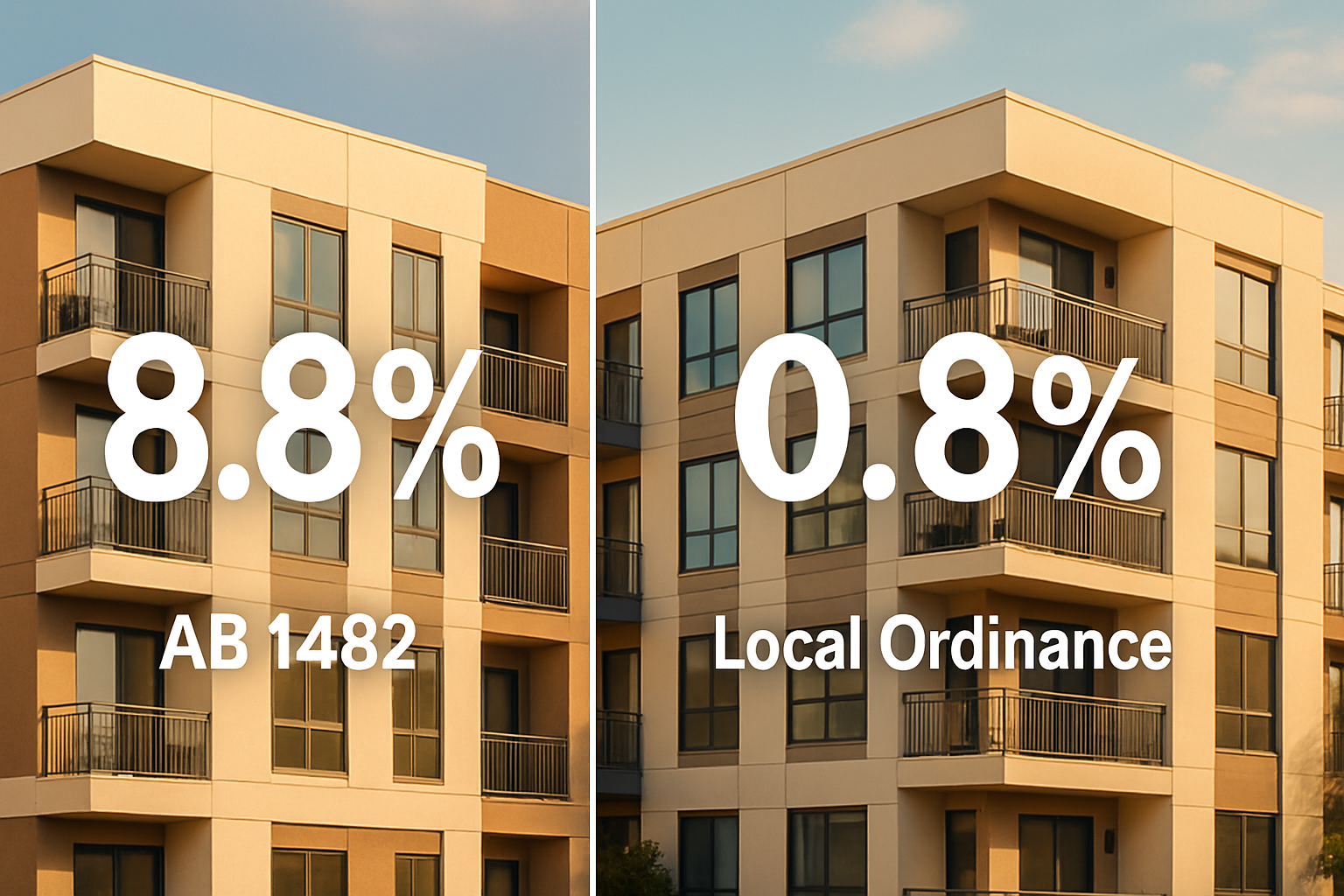

  • AB 1482 vs Local Rent Control: What Actually Applies to Your California Property

    AB 1482 vs Local Rent Control: What Actually Applies to Your California Property

    Key Takeaways

    • AB 1482 is the statewide floor — but local rent control ordinances override it whenever they are stricter
    • In cities like Oakland (0.8%), Berkeley (1.0%), and San Francisco (1.7%), tenants are protected well below the ~8% AB 1482 cap
    • Local ordinances often add just cause protections from day one, mandatory registration, relocation assistance, and rent banking restrictions that AB 1482 does not require
    • Construction year cutoffs vary widely — from 1978 (LA, SF) to no cutoff at all (East Palo Alto, Pomona)
    • If your city has no local ordinance, AB 1482 applies by default — and that still means a hard cap and just cause rules after 12 months

    AB 1482: The Statewide Baseline

    Assembly Bill 1482, the California Tenant Protection Act of 2019, caps annual rent increases at 5% + local CPI (maximum 10%) and requires just cause for evictions after 12 months of tenancy. It applies to most residential rental properties statewide and was extended through January 1, 2035 by AB 12 (2024).

    But AB 1482 was never intended to be the final word. The law explicitly defers to local ordinances when they are stricter. If you own property in a city with its own rent control program, the local rules almost certainly govern your property — not AB 1482. Understanding which law applies, and where the differences lie, is the single most important compliance question for California landlords with properties in multiple jurisdictions.

    For a full breakdown of AB 1482 on its own — CPI rates, exemptions, notice requirements, and penalties — see our AB 1482 Rent Cap Calculator and California Landlord Compliance Checklist.

    The Stricter-Rule-Applies Principle

    California’s approach to overlapping rent control is straightforward: the stricter rule wins. This principle is codified in Civil Code §1946.2(g), which states that AB 1482’s provisions do not supersede any local ordinance that is “more protective” of tenants.

    In practice, this means:

    • If your city caps rent increases at 3% and AB 1482 allows 8.7%, the 3% cap applies
    • If your city requires just cause eviction from day one (not after 12 months), the day-one requirement applies
    • If your city requires relocation assistance of two months’ rent (vs. AB 1482’s one month), the two-month requirement applies
    • If your city covers properties built before 1995 (narrower than AB 1482’s 15-year rolling window), AB 1482 may still cover newer properties that fall outside the local ordinance

    This last point is critical. The two laws can apply to different units within the same city. A building constructed in 1990 in San Francisco is covered by the local ordinance. A building constructed in 2005 in San Francisco falls outside the local ordinance (which only covers pre-1979 construction) but is covered by AB 1482 — as long as it is more than 15 years old.

    Rent Cap Comparison: Every Major California Jurisdiction

    The following table compares current local rent caps against the AB 1482 statewide cap for all major rent-controlled jurisdictions in California. Local caps shown are the most recently published allowable annual increase as of mid-2026. AB 1482 caps vary by CPI region.

    City Local Cap AB 1482 Cap (Regional) Which Applies
    Oakland 0.8% ~8.5% Local (0.8%)
    Berkeley 1.0% ~8.5% Local (1.0%)
    San Francisco 1.7% ~8.5% Local (1.7%)
    LA County (Unincorporated) 1.93% ~8.8% Local (1.93%)
    East Palo Alto 2.2% ~8.5% Local (2.2%)
    West Hollywood 2.25% ~8.8% Local (2.25%)
    Pasadena 2.25% ~8.8% Local (2.25%)
    Santa Monica 2.3% ~8.8% Local (2.3%)
    Santa Ana 2.42% ~8.8% Local (2.42%)
    Mountain View 2.7% ~8.5% Local (2.7%)
    Los Angeles 3.0% ~8.8% Local (3.0%)
    Beverly Hills 3.0% ~8.8% Local (3.0%)
    San Jose 5.0% ~8.5% Local (5.0%)

    Note: Local caps shown are the most recent published rates. These change annually based on each city’s formula (typically CPI-based). The AB 1482 “regional” column reflects the approximate 5% + CPI cap for each city’s BLS region. In every case above, the local cap is significantly stricter than AB 1482.

    Want to calculate the exact cap for your property? Use our city-specific calculators: Los Angeles, San Francisco, Oakland, Berkeley, or San Jose. For AB 1482 statewide calculations, use the AB 1482 Calculator.

    Beyond Rent Caps: Where Local Ordinances Diverge from AB 1482

    The rent cap comparison is the most visible difference, but it is far from the only one. Local rent control ordinances impose requirements that AB 1482 does not — and in some cases, the gap is enormous.

    Just Cause Eviction: Day One vs. 12 Months

    Under AB 1482, just cause eviction protections kick in after a tenant has occupied a unit for 12 months. During that first year, a landlord can terminate a month-to-month tenancy with proper notice and no stated reason.

    Most local rent control ordinances do not give landlords that grace period. In San Francisco, Oakland, Berkeley, Los Angeles, Santa Monica, West Hollywood, and East Palo Alto, just cause protections apply from the first day of tenancy. You cannot terminate a tenancy without a legally recognized reason — not even during the first month.

    This distinction catches landlords who move from AB 1482-only cities to local rent control jurisdictions. A practice that was perfectly legal in Sacramento (giving a 60-day no-cause notice to a month-to-month tenant in their eighth month) would be an illegal eviction in San Francisco.

    Relocation Assistance

    AB 1482 requires one month’s rent in relocation assistance for no-fault evictions (owner move-in, Ellis Act withdrawal, substantial remodel). Local ordinances often require significantly more:

    • San Francisco: Relocation payments can exceed $7,000 per tenant, with additional amounts for elderly, disabled, and families with minor children
    • Los Angeles: Relocation assistance ranges from approximately $8,000 to $22,000+ depending on unit size, tenant age, disability status, and length of tenancy
    • Santa Monica: Relocation fees are among the highest in the state, with additional protections for long-term tenants
    • Berkeley: Relocation assistance is required for most no-fault evictions, with amounts indexed to the rental market

    If your property is in a city with local rent control, the local relocation assistance requirement applies — not AB 1482’s one-month figure.

    Registration and Fee Requirements

    AB 1482 does not require landlords to register their properties or pay any fees to the state. Many local ordinances do:

    Failure to register can result in fines, inability to collect rent increases, and in some cities, a presumption that the tenant’s reported rent is accurate in any dispute.

    Rent Banking Restrictions

    “Rent banking” refers to the practice of accumulating unused allowable increases and applying them in a future year. For example, if you are allowed a 3% increase but only raise rent by 1%, can you apply the remaining 2% next year on top of next year’s allowable increase?

    AB 1482 does not address rent banking — it simply caps each year’s increase independently. Local ordinances vary:

    • Oakland: Rent banking is prohibited. You can only apply the current year’s allowable increase.
    • San Francisco: Rent banking is allowed. Landlords can accumulate and apply unused increases.
    • Berkeley: Rent banking is prohibited.
    • Los Angeles: Rent banking is allowed, subject to certain limits.
    • San Jose: Rent banking is allowed, with a cap on cumulative banked increases.

    If you own properties in multiple cities, you need to track these rules individually. Applying a banked increase in Oakland is a violation; the same action in San Francisco is perfectly legal.

    Construction Year Cutoffs: Which Buildings Are Covered

    One of the most confusing aspects of California rent control is the patchwork of construction year cutoffs. These cutoffs determine which buildings fall under the local ordinance based on when they were built.

    Why Construction Cutoffs Exist

    The Costa-Hawkins Rental Housing Act (1995) prohibits local governments from applying rent control to buildings that received their certificate of occupancy after the date the local ordinance was adopted. This means older ordinances cover fewer buildings, while newer ordinances can cover more recent construction.

    Cutoff Dates by City

    City Construction Cutoff Notes
    Los Angeles October 1, 1978 Certificate of occupancy before this date
    San Francisco June 13, 1979 Buildings with first certificate of occupancy before this date
    San Jose September 7, 1979 Based on date of ordinance adoption
    West Hollywood July 1, 1979 Based on date of city incorporation and ordinance
    Hayward July 1, 1979 Rent stabilization ordinance adoption date
    Berkeley June 1980 Based on original ordinance passage
    Oakland January 1, 1983 Buildings with certificate of occupancy before this date
    Richmond December 31, 1995 Newer ordinance allows broader coverage under Costa-Hawkins
    Mountain View December 31, 1995 Community Stabilization and Fair Rent Act (2016)
    East Palo Alto No cutoff Ordinance predates Costa-Hawkins; covers all rental housing
    Pomona No cutoff Covers all multifamily rental housing regardless of build date

    What This Means for Your Property

    If your building was constructed after the local cutoff date but is more than 15 years old, it falls outside the local ordinance but is still covered by AB 1482. This creates a middle tier of properties that are subject to the statewide cap (5% + CPI) but not the typically stricter local cap.

    Example: A building in Los Angeles with a certificate of occupancy dated March 1985. It was built after the October 1978 cutoff, so it is not covered by the LA Rent Stabilization Ordinance. However, it is more than 15 years old, so it is covered by AB 1482. The landlord can raise rent up to 8.8% (AB 1482 cap for the LA region) rather than being limited to the 3% LA local cap.

    A building in the same neighborhood with a certificate of occupancy dated June 1975 is covered by both the LA RSO and AB 1482 — and the stricter local 3% cap applies.

    How to Determine Which Law Applies to Your Property

    Follow this decision tree to determine the governing rent control law for your property:

    Step 1: Is your property exempt from all rent control?

    Check the AB 1482 exemptions first:

    • Is the property a single-family home or condo owned by a natural person (not a corporation, REIT, or LLC with a corporate member) and have you provided the required exemption notice? → Exempt from AB 1482 (but check whether a local ordinance still applies — some local ordinances cover single-family homes)
    • Was the property built within the last 15 years? → Exempt from AB 1482 and likely exempt from local ordinances (Costa-Hawkins)
    • Is it an owner-occupied duplex? → Exempt from AB 1482 (check local ordinance for its own owner-occupied exemption)

    Step 2: Does your city have a local rent control ordinance?

    If your city is not on the list of rent-controlled jurisdictions, AB 1482 is the governing law. This includes Sacramento, San Diego, Fresno, Bakersfield, Stockton, Modesto, Riverside, and most other California cities.

    Step 3: Was your property built before the local cutoff date?

    If your city has local rent control, check whether your building’s certificate of occupancy date falls before the local cutoff. If it does, the local ordinance governs your property (with its stricter caps, registration requirements, and additional protections).

    If your building was constructed after the local cutoff, it falls outside the local ordinance. In that case, check whether it is more than 15 years old — if so, AB 1482 applies. If it is fewer than 15 years old, neither law applies and there is no rent cap.

    Step 4: Apply the stricter rule

    For properties covered by a local ordinance, remember that both the local ordinance and AB 1482 can technically apply simultaneously. The stricter provision in each category wins:

    • Rent cap: use the lower percentage
    • Just cause: use the one that applies earlier (day one vs. 12 months)
    • Relocation assistance: use the higher amount
    • Notice requirements: use the longer notice period

    When Your City Has No Local Rent Control

    The majority of California cities do not have their own rent control ordinances. In these cities, AB 1482 is the only rent regulation that applies. This includes major cities and regions such as:

    • Sacramento — The state capital has the Tenant Protection Program (TPP), which mirrors AB 1482’s formula (5% + CPI, max 10%) rather than imposing a stricter local cap
    • San Diego — No local rent control; AB 1482 governs
    • Fresno — No local rent control; AB 1482 governs
    • Bakersfield, Stockton, Modesto — No local rent control
    • Riverside, San Bernardino — No local rent control
    • Most Central Valley and Inland Empire cities — No local rent control

    If you own properties exclusively in these areas, your compliance obligation is simpler: follow AB 1482. Track the annual CPI for your region, calculate your maximum 5% + CPI increase (capped at 10%), serve proper notice, and comply with just cause requirements after 12 months of tenancy. Use the AB 1482 Calculator to stay current.

    Sacramento’s Tenant Protection Program: Same Formula, Separate Law

    Sacramento is a special case worth understanding. The city adopted its own Tenant Protection Program (TPP) in 2019, but it deliberately mirrors AB 1482’s rent cap formula: 5% + CPI, maximum 10%.

    So why does it matter? Because the Sacramento TPP has its own enforcement mechanisms, its own administrative processes, and — critically — it could be amended independently of AB 1482. If the Sacramento City Council decides to lower the cap to 3% + CPI, that would be a local ordinance change that AB 1482 would defer to under the stricter-rule-applies principle.

    For now, the practical effect is the same: Sacramento landlords follow the 5% + CPI formula regardless of whether they think of it as “AB 1482” or “the TPP.” But staying aware of local council activity is important — a change could come at any time.

    Multi-City Landlords: Managing Compliance Across Jurisdictions

    If you own properties in multiple California cities — say, one in Oakland, one in Sacramento, and one in San Jose — you are operating under three different regulatory frameworks simultaneously:

    • Oakland: 0.8% annual cap, just cause from day one, no rent banking, mandatory registration with the Rent Adjustment Program, relocation assistance for no-fault evictions
    • Sacramento: ~7.7% annual cap (5% + 2.7% CPI), just cause after 12 months, no separate registration
    • San Jose: 5.0% flat cap, just cause from day one, rent banking allowed, mandatory registration with the Rent Stabilization Program

    Treating all three properties the same is a compliance failure waiting to happen. Each property needs its own rent increase calendar, its own notice procedures, and its own documentation trail. This is one of the strongest arguments for using automated compliance tracking rather than spreadsheets — the rules are too varied and change too frequently for manual tracking to be reliable.

    “The landlords who get into trouble aren’t the ones who ignore rent control entirely — it’s the ones who know about AB 1482 but don’t realize their city has a stricter local ordinance. They calculate 8% when the legal max is 1.7%. That’s the gap that creates real liability.”

    Rachid Abadli, Founder & CEO at LeaseBase, California landlord and compliance technology builder

    Recent and Upcoming Changes to Watch

    California’s rent control landscape is not static. Several developments are worth monitoring:

    • AB 12 extension (2024): Extended AB 1482 through January 1, 2035, making it a long-term compliance requirement rather than a temporary measure
    • New local ordinances: Cities like Pasadena, Pomona, and Santa Ana adopted rent stabilization ordinances in 2023–2024. More cities may follow as housing costs continue to rise.
    • Costa-Hawkins reform attempts: Multiple ballot initiatives and legislative proposals have sought to repeal or amend the Costa-Hawkins Act, which would allow cities to apply rent control to newer buildings and single-family homes. While these have not passed as of 2026, they remain active policy discussions.
    • CPI volatility: Inflation fluctuations directly affect both AB 1482 and local caps that use CPI-based formulas. The 2022–2023 inflation spike produced some of the highest allowable increases in years, while the subsequent cooldown has lowered caps in many regions.

    Frequently Asked Questions

    Does AB 1482 apply if my city has rent control?

    AB 1482 applies statewide, but if your city has a local ordinance that is stricter, the local ordinance governs. In practice, this means the local rent cap, just cause rules, and other protections override AB 1482’s provisions. However, AB 1482 can still cover properties that fall outside the local ordinance’s scope — for example, buildings constructed after the local cutoff date but more than 15 years ago.

    How do I know if my city has a local rent control ordinance?

    The major rent-controlled cities in California include Los Angeles, San Francisco, Oakland, Berkeley, San Jose, Santa Monica, West Hollywood, Beverly Hills, East Palo Alto, Mountain View, Richmond, Hayward, Pasadena, Pomona, Santa Ana, and unincorporated LA County. Check your city’s housing department website or contact your local rent board. If your city is not on this list, AB 1482 is likely the governing law.

    Can I use the AB 1482 rent cap if it is higher than my local cap?

    No. The stricter-rule-applies principle means you must use whichever cap is lower. If your local ordinance caps increases at 1.7% and AB 1482 allows 8.5%, your legal maximum is 1.7%. Charging above the local cap — even if you are within AB 1482’s limit — is a violation of local law and exposes you to penalties, rent refunds, and potential legal action.

    My property was built in 1985. Which law applies in Los Angeles?

    The LA Rent Stabilization Ordinance (RSO) covers buildings with a certificate of occupancy before October 1, 1978. Since your building was constructed in 1985, it falls outside the RSO. However, it is more than 15 years old, so AB 1482 applies. You would follow the AB 1482 cap (~8.8% for the LA region) rather than the LA RSO’s 3% cap. You would also follow AB 1482’s just cause rules (12-month threshold) rather than the RSO’s day-one just cause requirement.

    Do I need to register my property if I am only subject to AB 1482?

    No. AB 1482 does not require any registration or fees. Registration requirements come exclusively from local rent control ordinances. If your property is subject only to AB 1482 (because your city has no local ordinance or your building falls outside the local ordinance’s scope), there is no registration obligation.

    What is rent banking, and does AB 1482 allow it?

    Rent banking is accumulating unused allowable rent increases to apply in future years. AB 1482 does not explicitly address rent banking — each year’s cap is calculated independently. Local ordinances vary: San Francisco and Los Angeles allow it (with limits), while Oakland and Berkeley prohibit it. Check your specific city’s rules.

    What happens if I accidentally exceed the local rent cap?

    The tenant can file a complaint with the local rent board (if one exists), demand a refund of excess rent paid, and potentially recover additional damages. In cities with administrative enforcement (LA, SF, Oakland, Berkeley), the rent board can order a rollback and impose penalties. Under AB 1482, tenants can also recover excess rent plus punitive damages and attorney’s fees through civil litigation.

    Can a city adopt rent control that is less strict than AB 1482?

    A city could adopt its own ordinance with a higher cap than AB 1482, but it would be irrelevant for most practical purposes — AB 1482 would still cap increases at the statewide level. The city’s ordinance would only matter if it contained provisions not addressed by AB 1482 (such as registration requirements or specific eviction procedures). The stricter rule always applies in each category.

    Does Costa-Hawkins still limit local rent control?

    Yes. The Costa-Hawkins Rental Housing Act still prohibits local governments from applying rent control to single-family homes, condos, and buildings constructed after the date the local ordinance was adopted. This is why construction cutoff dates exist. Efforts to repeal Costa-Hawkins (Proposition 10 in 2018, Proposition 21 in 2020) have failed at the ballot, but remain active policy discussions.

    Stay Compliant Across Every Jurisdiction

    Managing rent control compliance across multiple California jurisdictions is complex. The rules change annually, vary by city, and depend on your property’s construction date, ownership structure, and tenant tenure. Getting it wrong exposes you to rent refunds, penalties, and costly litigation.

    LeaseBase tracks rent control compliance automatically for each of your properties — whether they fall under AB 1482, a local ordinance, or both. You see the correct maximum allowable increase for every unit, calculated against the right law, with the right CPI, every year. No spreadsheets, no guessing, no accidental violations.

    Related Reading

    Disclaimer: This article is for informational purposes only and does not constitute legal advice. Laws and regulations change frequently. Consult a licensed attorney for advice specific to your situation.

  • How to Screen Tenants in California: The Complete Step-by-Step Guide

    How to Screen Tenants in California: The Complete Step-by-Step Guide

    Excerpt: Navigate California’s complex tenant screening laws with this comprehensive guide. Learn how to set criteria, collect applications, verify information, and make legal decisions to protect your rental property.

    Slug: how-to-screen-tenants-california-guide

    Imagine this: You’ve just listed your beautifully maintained 2-bedroom unit in Sacramento, and within hours, your inbox is flooded with inquiries. Great! But among those 20-30 interested parties, how do you find the one, reliable tenant who will pay rent on time, treat your property with respect, and stay long-term? This isn’t just about finding a good person; it’s about navigating California’s intricate tenant screening laws to protect yourself from costly legal disputes. According to a 2022 survey by the National Association of Realtors, finding qualified tenants is a top challenge for landlords. For independent landlords in California, missing a crucial step can lead to significant fines and headaches. Let’s dive into the complete step-by-step guide to screening tenants legally and effectively in the Golden State.

    Setting Screening Criteria Before You List (and Why It’s Required)

    Before you even think about advertising your rental, you absolutely must define your tenant screening criteria. This isn’t just good practice; it’s your first line of defense against fair housing claims. California law, particularly the Fair Employment and Housing Act (FEHA), prohibits discrimination based on protected characteristics like race, religion, sex, sexual orientation, disability, familial status, and more. Having pre-defined, objective criteria ensures you apply the same standards to every applicant, demonstrating non-discriminatory practices.

    Think of your criteria as a checklist. Here are the common categories you should consider:

    • Income: A standard benchmark is that an applicant’s gross monthly income should be at least 2.5 to 3 times the monthly rent. For example, if your rent is $2,000, you’d look for an applicant earning $5,000 to $6,000 per month. Be consistent!
    • Credit Score: What minimum credit score are you comfortable with? A common range is 620-650, but you might adjust this based on the market or if you’re willing to accept a higher security deposit for a lower score.
    • Rental History: How many years of verifiable rental history do you require? Are you looking for no evictions, no late payments, or no breaches of lease terms?
    • Criminal History: What types of convictions are disqualifying? Be very cautious here. Blanket bans on all criminal history can be discriminatory. Focus on convictions that demonstrate a direct threat to property or other tenants, and consider the nature, severity, and recency of the offense. California law (AB 256) also limits how landlords can consider certain criminal records.
    • Occupancy Limits: How many people can legally and comfortably live in the unit? California generally follows the “2 people per bedroom plus one” rule, but check local ordinances.

    Example Scenario: You’re renting a 1-bedroom apartment for $1,800/month in Los Angeles. Your pre-set criteria might be: “Gross monthly income of at least $4,500, credit score of 650+, 2 years of verifiable rental history with no evictions, and no violent felony convictions in the past 7 years.” Write this down, and stick to it for every applicant.

    “Fair housing violations can be incredibly costly. The U.S. Department of Housing and Urban Development (HUD) sets civil penalties, which can be as high as $23,431 for a first offense of discrimination.”

    The Application: What You Can and Cannot Ask in California

    Once your criteria are set, it’s time for the application. This is where you gather the information needed to evaluate candidates against your criteria. Your rental application form should be comprehensive but also legally compliant.

    What you MUST include:

    • Applicant’s full legal name and contact information.
    • Current and previous addresses.
    • Employment history and income verification (employer, salary, pay stubs).
    • Rental history (previous landlords’ contact info).
    • Consent to run credit and background checks.
    • Emergency contact information.
    • Number of occupants and relationship to applicant.

    What you CANNOT ask (or should avoid):

    • Questions about protected characteristics (race, religion, national origin, gender, marital status, sexual orientation, disability, familial status, etc.).
    • “Are you pregnant?” or “Do you plan to have children?”
    • “What is your native language?” (unless it’s for communication purposes and applied universally).
    • “Are you a U.S. citizen?” (You can ask if they have legal residency status, but not about citizenship directly).
    • Specific questions about disabilities or medical conditions.

    Application Fees: California has strict rules about application fees. As per California Civil Code Section 1950.6 (often referred to in the context of AB 2559), you can only charge an application fee that covers your actual out-of-pocket costs for screening, such as credit reports and background checks. This fee cannot be more than $30, adjusted annually for inflation. For 2024, this amount is around $62.62. Always give a receipt for the fee and return any unused portion if you don’t screen the applicant.

    For a smooth application process, consider using digital tools for collecting applications and processing payments. Many platforms, including LeaseBase’s lease operations tools, can streamline this step.

    Credit, Background, and Income Verification — What the Numbers Mean

    This is the investigative phase. You’ll need reliable reports to verify the information provided on the application.

    1. Credit Check: This report gives you a snapshot of an applicant’s financial responsibility. Look for:

    • Credit Score: Does it meet your pre-defined minimum?
    • Payment History: Are there consistent late payments, collections, or bankruptcies?
    • Debt-to-Income Ratio: While not always provided directly, high existing debt can impact their ability to pay rent.
    • Public Records: Eviction filings (though these often show up more clearly on background checks).

    2. Background Check: This typically includes:

    • Criminal History: As discussed, be judicious. Look for relevant convictions that pose a direct threat.
    • Eviction History: Crucial for identifying previous problematic tenancies. An eviction on an applicant’s record is a major red flag.
    • Sex Offender Registry: Important for safety, especially in family-friendly neighborhoods.

    3. Income Verification: Don’t just take their word for it. Request:

    • Recent Pay Stubs: Typically 2-3 most recent.
    • Bank Statements: To verify deposits.
    • Employment Verification Letter: Directly from their employer.
    • Tax Returns: Especially for self-employed individuals (often the last two years).

    Example: An applicant states they make $6,000/month. Their pay stubs show $3,000 gross bi-weekly. This aligns with their stated income. Their credit score is 680, and the background check is clear of relevant criminal history or evictions. This applicant is looking good against your $2,000/month rent and $5,000 income criteria.

    Using a platform that integrates with credit and background check providers can simplify this process and ensure you’re getting reports from reputable sources. For managing rent payments efficiently once a tenant is approved, tools like LeaseBase’s rent payment system can be invaluable.

    Reference Checks That Actually Reveal Red Flags

    This is where you move beyond documents and speak to real people. Previous landlords and employers can offer invaluable insights that reports can’t.

    Previous Landlords:
    When calling previous landlords, focus on objective questions:

    • “Did they pay rent on time, consistently?”
    • “Did they give proper notice before moving out?”
    • “Did they leave the property in good condition?”
    • “Were there any lease violations (e.g., unauthorized pets, excessive noise complaints)?”
    • “Would you rent to them again?” (This is a key question that summarizes their experience).

    Be wary of: A current landlord who might give a glowing review just to get rid of a problematic tenant. Try to speak with a previous landlord (the one before the current one) for a more objective perspective.

    Employers:
    Verify employment and income. Stick to questions like:

    • “Is [Applicant Name] currently employed there?”
    • “What is their position?”
    • “What is their annual salary/hourly wage?”
    • “How long have they been employed?”

    Do NOT ask about their attendance, performance, or personality, as this can open you up to discrimination claims.

    Personal References:
    These are generally less reliable as they often come from friends or family who are biased. You can ask for them, but weigh them less heavily than landlord or employer references.

    Making the Decision: How to Approve or Deny Legally

    Now that you’ve gathered all the information, it’s time to make a decision. This must be based solely on your pre-established, objective screening criteria.

    Approval:
    If an applicant meets all your criteria, congratulations! Send them an approval letter and move forward with lease signing. Be prompt, as good tenants often have other options.

    Denial:
    If an applicant does not meet one or more of your criteria, you must deny them. Crucially, you must provide an “Adverse Action Notice.” This is required under the Fair Credit Reporting Act (FCRA) if you deny an applicant based on information from a credit report or background check. The notice must include:

    • The name and contact information of the consumer reporting agency (CRA) that provided the report.
    • A statement that the CRA did not make the decision to deny your application and cannot explain why the decision was made.
    • Your right to obtain a free copy of the report from the CRA within 60 days.
    • Your right to dispute the accuracy or completeness of any information in the report.

    Always document your reasons for denial. This is your legal shield. If you deny an applicant because their credit score was too low (below your stated 650 minimum), write that down. If it was due to an eviction on their record, document that. Consistency is key.

    California Specifics (AB 1482 & Just Cause): While not directly related to screening, remember that once a tenant is approved and moves in, California’s Tenant Protection Act of 2019 (AB 1482) imposes rent caps and “just cause” eviction requirements. Screening thoroughly upfront helps you avoid needing to rely on “just cause” later.

    Tenant Screening Decision Matrix (Example)
    Criteria Met? (Yes/No) Reason if No
    Gross Income (3x Rent) No Only 2.5x current rent
    Credit Score (650+) Yes 710
    Rental History (No Evictions) No Eviction filed 2 years ago
    Criminal History (No Violent Felonies) Yes Clear

    By following these steps, you not only protect your investment but also ensure you’re operating within California’s robust tenant protection laws. This systematic approach saves you time, money, and potential legal headaches down the road. For more resources on getting started as a landlord, check out LeaseBase’s getting started guide.

    Frequently Asked Questions

    What is the maximum application fee I can charge in California?

    In California, the maximum

    California Landlord Resources