Key Takeaways
- Good Cause Eviction is automatic in NYC but requires an opt-in vote by all other municipalities in New York State
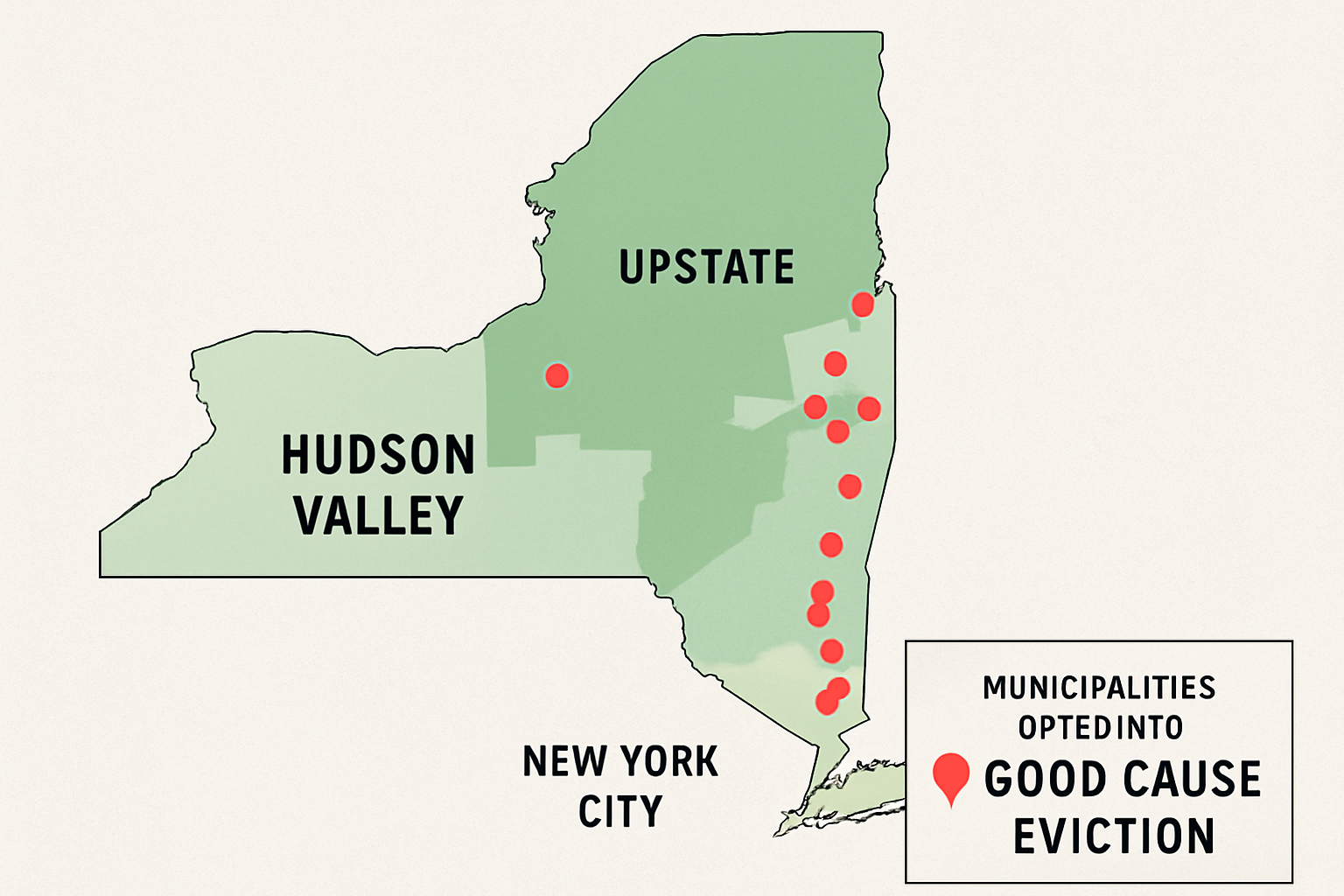
- Approximately 19 municipalities have opted in as of mid-2026, concentrated in the Hudson Valley, Capital Region, and Westchester County
- ETPA (Emergency Tenant Protection Act) is a separate opt-in program that extends rent stabilization — ~40 municipalities participate
- Some municipalities adopted stronger local versions of tenant protections before the state law passed
- The opt-in list is growing — several additional municipalities are actively considering adoption
How the Good Cause Eviction Opt-In Works
New York’s Good Cause Eviction (GCE) law took effect on April 20, 2024. In New York City, it applies automatically to all covered rental units. Outside NYC, the law does not apply unless the municipality passes a local law opting in.
This means that whether Good Cause Eviction affects your property depends entirely on where it is located. A 50-unit building in Kingston (opted in) is subject to GCE. An identical building in Saratoga Springs (not opted in) is not. The same state law, two completely different outcomes based on municipal action.
This tracker provides the current list of opted-in municipalities, the status of municipalities considering adoption, and context for how ETPA differs from GCE.
Municipalities That Have Opted In
The following municipalities have passed local laws adopting Good Cause Eviction as of mid-2026:
| Municipality | Type | County | Date Adopted | Notes |
|---|---|---|---|---|
| New York City | City | 5 boroughs | Automatic (April 2024) | No opt-in required; GCE applies to all covered units citywide |
| Albany | City | Albany | 2024 | State capital; among the first to adopt |
| Kingston | City | Ulster | 2024 | Had a local good cause eviction ordinance before the state law; local law may provide additional protections |
| Ithaca | City | Tompkins | 2024 | College town; tight rental market driven by Cornell and Ithaca College |
| Poughkeepsie | City | Dutchess | 2024 | City of Poughkeepsie (not Town of Poughkeepsie) |
| Beacon | City | Dutchess | 2024 | Hudson Valley arts community with rising rents |
| Newburgh | City | Orange | 2024 | Significant affordable housing concerns |
| Nyack | Village | Rockland | 2024 | Small Hudson Valley village |
| Hudson | City | Columbia | 2024 | Had prior local tenant protection measures |
| New Paltz (Town) | Town | Ulster | 2024 | College town (SUNY New Paltz) |
| New Paltz (Village) | Village | Ulster | 2024 | Both town and village adopted independently |
| Woodstock | Town | Ulster | 2024 | Tourist and arts community |
| Rochester | City | Monroe | 2025 | Largest opt-in city outside NYC; significant rental population |
| Hastings-on-Hudson | Village | Westchester | 2025 | Suburban Westchester community |
| Ossining | Village | Westchester | 2025 | Hudson Valley suburb |
| Peekskill | City | Westchester | 2025 | Northern Westchester |
| Mount Vernon | City | Westchester | 2025 | Southern Westchester; borders NYC |
| Port Chester | Village | Westchester | 2025 | Borders Connecticut |
| Saugerties | Town/Village | Ulster | 2025 | Hudson Valley community |
| Catskill | Village | Greene | 2025 | Growing tourism and second-home market |
Geographic Patterns
The opt-in municipalities cluster in three distinct regions:
Hudson Valley
The heaviest concentration of opt-ins is in the Hudson Valley, particularly Ulster, Dutchess, and Orange counties. These communities have experienced significant rent increases driven by NYC transplants (accelerated during and after COVID), short-term rental conversion (Airbnb), and second-home purchases that have tightened the year-round rental market.
Kingston, New Paltz, Woodstock, Saugerties, Beacon, Poughkeepsie, Newburgh, and Hudson form a corridor of opt-in municipalities running along the Hudson River and into the Catskills.
Westchester County
Several Westchester municipalities have adopted GCE, joining the approximately 16 Westchester towns and villages that already participate in ETPA (rent stabilization). Westchester’s proximity to NYC, high rents, and politically engaged tenant population have driven adoption.
Hastings-on-Hudson, Ossining, Peekskill, Mount Vernon, and Port Chester represent a growing Westchester presence. Additional Westchester municipalities are reportedly considering adoption.
Upstate Cities
Albany and Rochester are the two largest upstate cities to adopt GCE. Both have significant renter populations (Albany: ~60% renter-occupied, Rochester: ~60% renter-occupied) and active tenant advocacy organizations. Ithaca, while smaller, has an extremely tight rental market driven by its college student population.
Municipalities Considering Adoption
As of mid-2026, several additional municipalities have introduced or are considering Good Cause Eviction opt-in legislation. These include:
- Syracuse (Onondaga County) — Public discussions underway; significant renter population
- Buffalo (Erie County) — Advocacy groups pushing for adoption; city council has discussed the issue
- Yonkers (Westchester County) — Already an ETPA municipality; GCE would cover additional units
- White Plains (Westchester County) — ETPA participant; GCE discussions ongoing
- New Rochelle (Westchester County) — Under consideration
- Rhinebeck (Dutchess County) — Hudson Valley community with rising housing costs
- Saugerties (Ulster County) — Adopted in 2025
This list is not exhaustive. Any municipality in New York State (except NYC, where GCE is already in effect) can opt in by passing a local law. The trend has been toward expansion, not contraction.
How to Check If Your Municipality Has Opted In
If your rental property is outside New York City, you need to verify whether your municipality has adopted Good Cause Eviction. Here is how:
- Check your municipality’s website — Look for local laws or ordinances adopted in 2024 or later related to tenant protections, good cause eviction, or rent increase limits
- Contact the municipal clerk — The clerk’s office maintains records of all local laws and can confirm whether GCE has been adopted
- Check with your local apartment association — Organizations like the Apartment and Realty Owners Association (AROA) or local landlord groups track opt-in activity
- Use our calculator — The LeaseBase NY Good Cause Calculator maintains an updated database of opt-in municipalities
Important: Both the town and village must be checked separately. In New York, towns and villages are distinct municipalities even when they share a name (as with New Paltz). If the village has opted in but the town has not (or vice versa), the law applies only in the municipality that adopted it.
ETPA vs. GCE: Two Different Opt-In Programs
A common source of confusion is the difference between ETPA (Emergency Tenant Protection Act) and GCE (Good Cause Eviction). These are entirely separate programs with different requirements, different coverage, and different effects.
| Feature | ETPA (Rent Stabilization) | GCE (Good Cause Eviction) |
|---|---|---|
| What it does | Extends NYC rent stabilization to the municipality | Caps rent increases and requires just cause for eviction |
| Rent increase mechanism | RGB sets annual percentage | CPI + 5% or 10% (whichever is less) |
| Buildings covered | 6+ units built before 1974 | All covered units (subject to exemptions) |
| Registration required | Yes (annual DHCR registration) | No |
| Vacancy reset | No (HSTPA eliminated vacancy bonus/decontrol) | Yes — landlord sets rent for new tenant |
| Number of participating municipalities | ~40 (primarily Nassau, Westchester, Rockland, Ulster) | ~19 (plus NYC) |
| Counties available | Nassau, Westchester, Rockland, Ulster only | Any county statewide |
| Sunset | None (permanent under HSTPA) | June 15, 2034 |
Can a Municipality Have Both?
Yes. A municipality can participate in both ETPA and GCE. In that case:
- Buildings that qualify for rent stabilization (6+ units, pre-1974) follow rent stabilization rules under ETPA
- Buildings that don’t qualify for stabilization but are covered by GCE (not exempt) follow GCE rules
- Rent-stabilized units are explicitly exempt from GCE, so there is no overlap for any individual unit
The result is broader tenant protection: ETPA covers the larger, older buildings, while GCE covers the smaller and newer buildings that ETPA doesn’t reach.
ETPA Municipalities (For Reference)
The following municipalities participate in ETPA, which extends rent stabilization (not Good Cause Eviction) to qualifying buildings. This is a separate program from GCE:
Nassau County (~16 municipalities)
- Hempstead (Town, several incorporated villages), Long Beach, Glen Cove, Rockville Centre, Freeport, Garden City, Lynbrook, Floral Park, and others
Westchester County (~16 municipalities)
- White Plains, Yonkers, New Rochelle, Mount Vernon, Tarrytown, Mamaroneck (Town and Village), Ossining, Dobbs Ferry, Hastings-on-Hudson, Irvington, Pelham Manor, Greenburgh, Scarsdale, Port Chester, Rye, and others
Rockland County (~5 municipalities)
- Haverstraw (Town and Village), Spring Valley, Nyack, and others
Ulster County
- Several municipalities, including Kingston
ETPA municipalities have their own DHCR registration requirements and RGB-governed rent increases. For buildings in these municipalities, check whether the building is registered as rent-stabilized before evaluating GCE applicability. For a detailed comparison, see our guide on Rent Stabilization vs Good Cause Eviction.
What Opt-In Means for Landlords
If your municipality has opted in (or is considering doing so), here is what changes for you:
Before Opt-In
- You can raise rent to any amount at lease renewal (with proper notice)
- You can choose not to renew a lease for any reason (with proper notice)
- You can terminate a month-to-month tenancy for any reason (with proper notice)
- The only constraints are the general 30/60/90-day notice requirements under RPL 226-c
After Opt-In
- Rent increases above CPI + 5% (or 10%) are presumptively unreasonable and can be challenged
- You must have one of 11 enumerated just cause grounds to evict or non-renew
- You must still provide 30/60/90-day notice based on tenancy length
- Exemptions may apply (10-unit rule, 245% FMR, new construction, etc.) — see our exemptions guide
The Vacancy Reset Difference
One critical distinction from rent stabilization: under GCE, landlords can set any rent for a new tenant when a unit is vacated. The rent increase cap only applies to existing tenants during their tenancy. This means turnover remains an opportunity to adjust rents to market levels, which is not the case under rent stabilization (where HSTPA eliminated vacancy bonuses and decontrol).
Monitoring for Changes in Your Municipality
The opt-in landscape is dynamic. Municipalities can adopt GCE at any time by passing a local law. As a landlord with properties outside NYC, you need to monitor your municipality’s legislative activity, particularly:
- City/town/village board meetings — Tenant protection measures are typically discussed in public sessions before a vote
- Local news coverage — GCE adoption generates local media attention
- Tenant advocacy activity — Organized tenant groups (like the statewide Housing Justice for All coalition) often telegraph which municipalities they are targeting for opt-in campaigns
- Neighboring municipality actions — Opt-in tends to cluster geographically, as advocacy organizations work region by region
“The opt-in map is expanding. If your municipality has not adopted Good Cause Eviction yet, that does not mean it will not. The trend line is clear: more municipalities are opting in, not fewer. Prudent landlords are preparing for GCE compliance before their municipality acts, not after.”
— Rachid Abadli, Founder & CEO at LeaseBase
Frequently Asked Questions
Can a municipality opt out after opting in?
The state law does not explicitly address opt-out. A municipality that adopted GCE by local law could theoretically repeal that local law. However, no municipality has done so as of mid-2026, and the political dynamics make opt-out unlikely in most communities that have adopted the law.
If my town opts in, when does it take effect?
The effective date depends on the local law. Some municipalities adopt the law with immediate effect; others specify an effective date 30, 60, or 90 days after adoption. Check the specific local law for the effective date.
Does the county matter, or just the municipality?
Only the municipality matters. Counties cannot opt in or out of GCE — only cities, towns, and villages can. If Albany (the city) opts in, that does not affect the Town of Colonie or the Town of Guilderland in Albany County.
I own properties in multiple municipalities. What if some have opted in and some have not?
GCE applies on a property-by-property basis based on where each property is located. A building in an opt-in municipality is subject to GCE (unless exempt). A building in a non-opt-in municipality is not, regardless of your other properties. However, your statewide unit count across all properties still determines whether the 10-unit exemption applies.
Does GCE apply in Nassau and Suffolk counties?
As of mid-2026, no municipalities in Nassau or Suffolk County have opted into GCE. However, approximately 16 Nassau County municipalities participate in ETPA (rent stabilization), which provides similar protections for qualifying buildings. GCE would cover the gap — smaller buildings and newer construction that ETPA does not reach.
What about Long Island?
Long Island (Nassau and Suffolk counties) has not seen GCE opt-ins as of mid-2026. The rental market on Long Island is different from NYC and the Hudson Valley, with a higher proportion of single-family rentals and smaller buildings that may be exempt under the 10-unit rule. However, tenant advocacy is active in both counties, and future opt-ins are possible.
Stay Ahead of the Opt-In Trend
The Good Cause Eviction opt-in landscape changes regularly. New municipalities adopt the law, and the implications for your portfolio can change overnight. Staying informed is not just good practice — it is essential for compliance.
LeaseBase’s NY Good Cause Calculator maintains an updated database of opt-in municipalities and evaluates your properties against all GCE exemptions. When a new municipality opts in, you will know whether your properties are affected and what your compliance obligations are.
Related Reading
- New York Good Cause Eviction Law: The Complete Guide
- Is Your NY Rental Exempt from Good Cause?
- Rent Stabilization vs Good Cause Eviction: Which Law Applies?
- HSTPA Changed Everything: What NY Landlords Lost in 2019
- MCI and IAI Caps After HSTPA
- NYC Rent Freeze 2026-27: What the 0% RGB Increase Means
- NYC Security Deposits, Late Fees, and Application Fees