
NYC Security Deposits, Late Fees, and Application Fees: The $50/$20 Limits
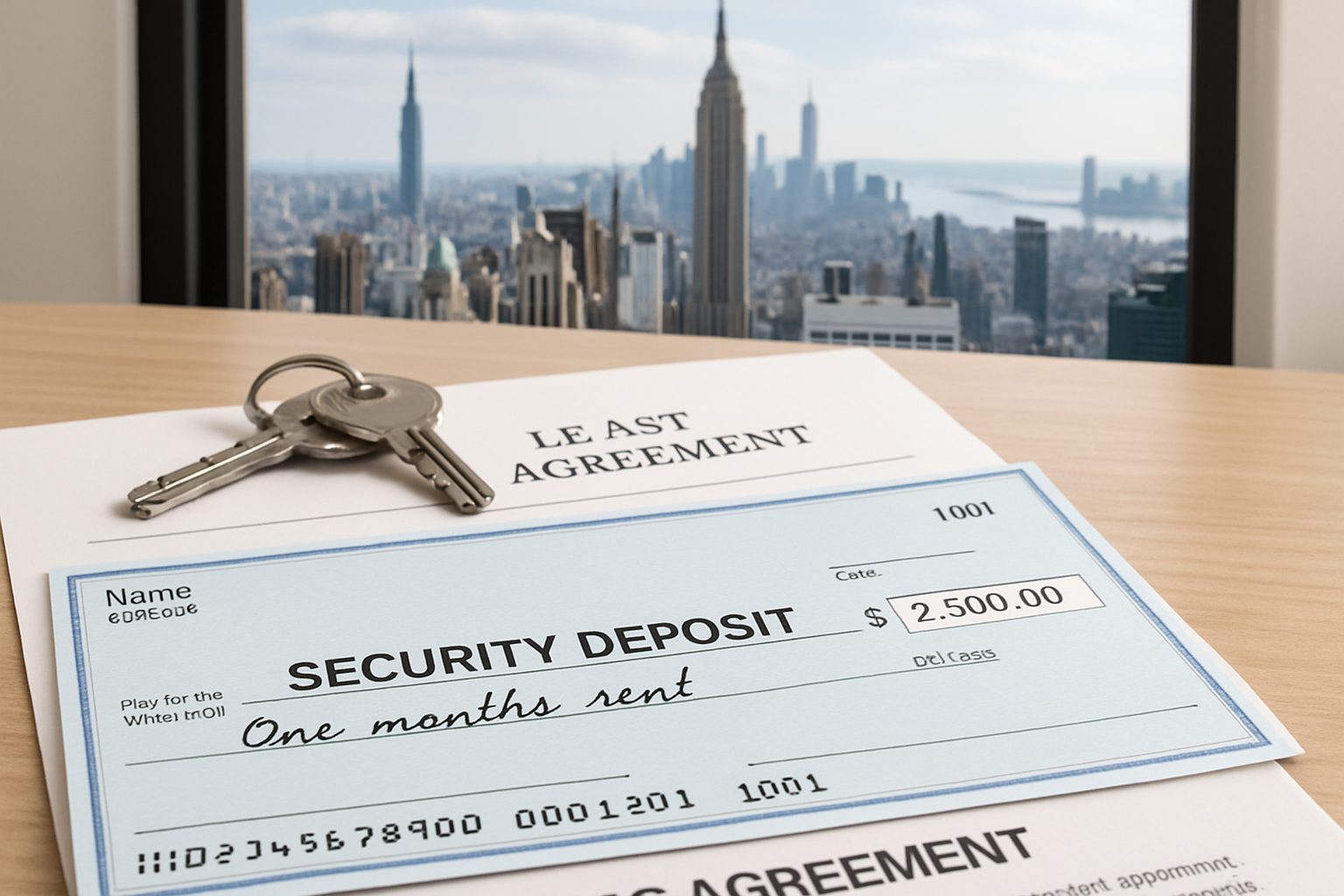
NYC Security Deposits Late Fees Limits

Key Takeaways

  • Security deposits are capped at 1 month’s rent — no pet deposits, last month’s rent, key deposits, or any other additional deposit is permitted
  • Deposits must be held in an interest-bearing account for buildings with 6 or more units, with annual interest paid to the tenant
  • Landlords must return the deposit within 14 days of move-out with an itemized statement of any deductions
  • Late fees are capped at $50 or 5% of monthly rent, whichever is LESS, and cannot be charged until rent is at least 5 days late
  • Application fees are capped at $20 total — this must cover background checks, credit checks, and all screening costs

The HSTPA Deposit and Fee Limits

The Housing Stability and Tenant Protection Act of 2019 (HSTPA) imposed strict new limits on security deposits, late fees, and application fees for all residential rentals in New York State. These rules apply to every residential rental — not just rent-stabilized apartments. Whether you own a stabilized building in Manhattan, a market-rate duplex in Buffalo, or a single-family rental in Ithaca, these limits apply to you.

Understanding these rules is not optional. Violations carry real penalties, including potential treble damages for overcharges, and can undermine your position in any eviction or nonpayment proceeding.

Security Deposits: One Month Maximum

The Rule

Under General Obligations Law Section 7-108 (as amended by HSTPA), landlords may collect a security deposit of no more than one month’s rent. This is a hard cap with no exceptions.

What You Cannot Collect

The one-month limit includes everything. You cannot collect any of the following in addition to the security deposit:

Prohibited Charge Pre-HSTPA Practice Current Status
Pet deposit Commonly $250-$500+ Prohibited — no additional deposit for pets
Last month’s rent (advance) Common for new tenants Prohibited — cannot collect last month’s rent in advance
Key deposit $25-$100 typical Prohibited — no separate charge for keys
Move-in fee Varies Prohibited if it functions as an additional deposit
Extra month for credit issues 2-3 months for tenants with poor credit Prohibited — 1 month maximum regardless of credit history
Furniture deposit $200-$500 for furnished units Prohibited — included in the one-month cap

The math is simple: If the monthly rent is $2,000, the maximum security deposit is $2,000. Period. No pet fee, no key fee, no last month, no extra deposit for any reason.

Interest-Bearing Account Requirements

For buildings with 6 or more residential units, security deposits must be held in an interest-bearing account at a banking institution in New York State. The requirements are:

  • The account must be separate from the landlord’s personal or operating funds
  • The landlord must notify the tenant of the bank name, account type, and amount deposited
  • Interest earned belongs to the tenant (minus 1% annual administrative fee the landlord may retain)
  • The landlord must either pay the interest to the tenant annually or credit it against rent

For buildings with fewer than 6 units, there is no statutory requirement to place the deposit in an interest-bearing account, but it must still be held in a legitimate account (not commingled with the landlord’s personal funds in NYC).

Returning the Deposit: 14 Days

When a tenancy ends, the landlord must return the security deposit (or the balance after lawful deductions) within 14 days of the tenant’s move-out. The return must include:

  • An itemized statement describing each deduction, the amount, and the reason
  • Receipts or evidence for repair costs deducted (if deductions are for damage)
  • The remaining balance of the deposit

What you can deduct:

  • Unpaid rent
  • Damage beyond normal wear and tear (with documentation)
  • Reasonable cleaning costs if the unit was left in an unreasonable condition

What you cannot deduct:

  • Normal wear and tear (faded paint, worn carpet, minor scuffs)
  • Pre-existing damage that was not documented at move-in
  • Charges for improvements or upgrades (painting the entire apartment is the landlord’s responsibility)

Penalties for Violations

If a landlord fails to return the deposit within 14 days or fails to provide an itemized statement:

  • The tenant can sue for the full deposit amount
  • Courts may award punitive damages up to twice the deposit amount
  • The landlord loses the right to assert any deduction claims
  • Attorney’s fees may be awarded to the prevailing tenant

If a landlord collects more than one month’s rent as a security deposit, the tenant can file an overcharge claim. Under HSTPA’s expanded enforcement provisions, overcharges can result in treble damages (three times the overcharge amount) if found to be willful.

Late Fees: $50 or 5%, Whichever Is Less

The Rule

Under Real Property Law Section 238-a (as amended by HSTPA), late fees for residential rentals are capped at the lesser of $50 or 5% of the monthly rent. Additionally, no late fee can be charged until the rent is at least 5 days past due.

How the Cap Works

Monthly Rent 5% of Rent $50 Cap Maximum Late Fee
$800 $40 $50 $40 (5% is less)
$1,000 $50 $50 $50 (equal)
$1,200 $60 $50 $50 ($50 is less)
$1,500 $75 $50 $50 ($50 is less)
$2,000 $100 $50 $50 ($50 is less)
$3,000 $150 $50 $50 ($50 is less)

In practice, $50 is the maximum late fee for any unit renting at $1,000 or more per month, which covers the vast majority of apartments in New York City and most of the state. The 5% provision only matters for units renting below $1,000.

The 5-Day Grace Period

No late fee can be assessed until the rent is at least 5 days past due. If rent is due on the 1st of the month, the earliest a late fee can be charged is the 6th. This is a statutory grace period — you cannot shorten it in the lease.

What Your Lease Can and Cannot Say

  • Your lease can specify a late fee of $50 or less (or 5% if rent is under $1,000)
  • Your lease cannot specify a late fee exceeding these limits, even if the tenant agrees to it
  • Your lease cannot impose a late fee before the 5-day grace period expires
  • Your lease cannot impose compounding late fees, daily late charges, or interest on late rent (these exceed the statutory cap)

Pre-HSTPA Leases

If your existing lease has a late fee provision that exceeds the HSTPA limits (common in leases drafted before June 2019), that provision is unenforceable. The HSTPA limits apply regardless of what the lease says. You should update your lease to reflect the current law at the next renewal.

Application Fees: $20 Maximum

The Rule

Under Real Property Law Section 238-b, the maximum fee a landlord can charge for a rental application is $20. This $20 must cover all costs associated with the application, including:

  • Credit report
  • Background check
  • Eviction history search
  • Application processing

You cannot charge separate fees for each service. The total cannot exceed $20.

Practical Implications

Most credit reports and background checks cost $15-$30 per applicant from major screening services. The $20 cap means landlords typically cannot fully recover screening costs if they use premium services. Options include:

  • Use a screening service that fits within the $20 cap — Several services offer basic credit and background checks within or near this price point
  • Absorb the excess cost — Treat screening as a cost of doing business, which it is
  • Ask the tenant to provide their own report — Tenants can obtain their own credit report (free annually from AnnualCreditReport.com) and present it to you. You cannot charge for this.

What You Cannot Charge

Prohibited Charge Pre-HSTPA Practice Current Status
Application fee above $20 $35-$100+ common Prohibited
Separate credit check fee $25-$50 Included in $20 max
Separate background check fee $25-$75 Included in $20 max
“Administrative” fee $50-$200 Prohibited
Holding fee or reservation fee $200-$500 Prohibited if it functions as an additional deposit

Penalties

Charging more than $20 for an application exposes the landlord to liability for the overcharge amount plus potential damages. If a prospective tenant can demonstrate they were charged more than $20, they can seek recovery of the excess amount.

Overcharge Claims: The 6-Year Lookback

HSTPA expanded the lookback period for rent overcharge claims from 4 years to 6 years. This applies to all overcharges, including excessive security deposits, illegal fees, and above-guideline rent increases on stabilized units.

How Overcharge Claims Work

  1. A tenant (current or former) files a complaint with HCR or commences a court action
  2. The agency or court examines the rent history for the prior 6 years
  3. If an overcharge is found, the landlord must refund the excess amount
  4. If the overcharge is found to be willful, the landlord may owe treble damages (three times the overcharge)
  5. Additionally, if there is evidence of fraud, the lookback can extend beyond 6 years to the full rent history

Exposure Calculation

Consider a landlord who collected a $3,000 security deposit (1.5 months) on a $2,000/month apartment for the past 4 years:

Component Amount
Overcharge amount $1,000 ($3,000 collected minus $2,000 maximum)
Simple recovery $1,000
Treble damages (if willful) $3,000
Plus attorney’s fees $2,000-$10,000+
Total potential exposure $5,000-$13,000+

For a landlord with multiple units and systematic overcharges, the exposure can be catastrophic.

Compliance Checklist

Use this checklist to verify your compliance with HSTPA’s deposit and fee requirements:

  1. Security deposit: Verify that no tenant has paid more than one month’s rent as a security deposit. No pet deposits, key deposits, last month’s rent, or other additional deposits.
  2. Interest-bearing account (6+ units): Confirm deposits are in a separate, interest-bearing account at a NY bank. Notify tenants of the bank name and account information.
  3. Annual interest: Pay or credit tenant interest annually (minus 1% admin fee).
  4. Return timeline: Return deposits within 14 days of move-out with an itemized statement.
  5. Late fee provision: Update all leases to reflect the $50/5% cap (whichever is less) with a 5-day grace period.
  6. Application fee: Verify you are charging no more than $20 total for applications, including all screening costs.
  7. Move-in checklist: Document the condition of the unit at move-in (photos, written checklist) to support any future deductions from the deposit.
  8. Lease language review: Remove any lease provisions that conflict with HSTPA (excessive deposits, compounding late fees, application fees above $20).

“The deposit and fee rules are the most commonly violated provisions of HSTPA, largely because landlords are using lease templates from before 2019. If your lease says ‘two months security’ or charges a $75 application fee, you are out of compliance right now. Update your leases immediately.”

Rachid Abadli, Founder & CEO at LeaseBase

Frequently Asked Questions

Can I charge a pet deposit?

No. Under HSTPA, the maximum security deposit is one month’s rent, and no additional deposits of any kind are permitted. This includes pet deposits, pet fees, pet rent (if structured as a deposit), and any other charge that functions as a security deposit for pet-related damage.

Can I charge pet rent?

Pet rent (a monthly charge for having a pet) is a separate question from pet deposits. HSTPA prohibits additional deposits, but recurring monthly charges are governed by different rules. For rent-stabilized apartments, any charge must be part of the registered rent. For market-rate apartments, pet rent provisions in the lease may be enforceable, but this is an evolving area of law. Consult an attorney.

What if the tenant causes more damage than one month’s rent covers?

If the actual damage exceeds the deposit, you can retain the full deposit and pursue the tenant for the excess amount through small claims court or civil court. The one-month limit on the deposit does not limit your right to recover actual damages — it limits how much you can collect upfront.

Can I require renters insurance instead of a larger deposit?

You can require tenants to obtain renters insurance as a condition of the lease. This is not considered a deposit and is not subject to the one-month cap. Many landlords have adopted this approach as a way to shift some risk coverage to the tenant. However, renters insurance primarily covers the tenant’s property and liability, not damage to the landlord’s property (unless the policy includes specific landlord-benefit provisions).

What happens to existing deposits that exceed one month?

If you collected a deposit exceeding one month’s rent before HSTPA took effect, you should return the excess to the tenant. Holding an excessive deposit is a violation of current law, even if it was legal when collected. The tenant can demand the return of the excess amount at any time.

Can I charge a broker fee?

Broker fees in NYC are a separate and heavily litigated issue. The FARE Act (effective June 2025) generally shifts broker fees to the party who hired the broker. This is separate from HSTPA’s application fee cap. Broker fees are not deposits or application fees and are governed by their own rules.

How do I handle the deposit when rent increases?

The security deposit is based on the rent at the time of collection. If rent increases (e.g., through an RGB guideline increase on a stabilized unit), you cannot demand an additional deposit to match the new rent. The original one-month deposit stands for the duration of the tenancy.

Track Deposits and Fees Across Your Portfolio

For landlords with multiple units, tracking deposit amounts, interest payments, and move-out timelines can be complex. Missing the 14-day return deadline even once creates liability. Collecting even $1 over the $20 application fee cap creates an overcharge claim.

LeaseBase tracks security deposits, interest obligations, and fee compliance for every unit in your portfolio. You get alerts before move-out deadlines, automatic interest calculations for 6+ unit buildings, and compliant lease templates that reflect current HSTPA limits.

Related Reading

← New York Compliance Hub

Get weekly landlord tips

Practical advice on rent collection, compliance, and self-managing profitably.

Ready to self-manage your rentals without the chaos?

LeaseBase™ handles rent collection, maintenance, leases, compliance, and reporting — so you don’t have to.

Free for up to 3 units. No credit card required.

The Landlord Independence Platform™

Every month without a system is another month of unnecessary stress.

You’re already doing the work. Now do it with a system that keeps you organized, compliant, and profitable.

14-day trial. No credit card required.