Key Takeaways
- Rent-stabilized apartments are explicitly exempt from Good Cause Eviction — if your unit is stabilized, GCE does not apply
- Rent stabilization uses RGB-set annual increases; GCE uses a CPI + 5% or 10% formula (whichever is less)
- Under HSTPA (2019), rent stabilization is permanent — no more vacancy decontrol; GCE sunsets in 2034
- Some buildings have both stabilized and non-stabilized units — different laws apply to different apartments in the same building
- Unregulated apartments in NYC are now covered by GCE, closing the gap between stabilized and market-rate protections
Two Systems, One State: Understanding the Overlap
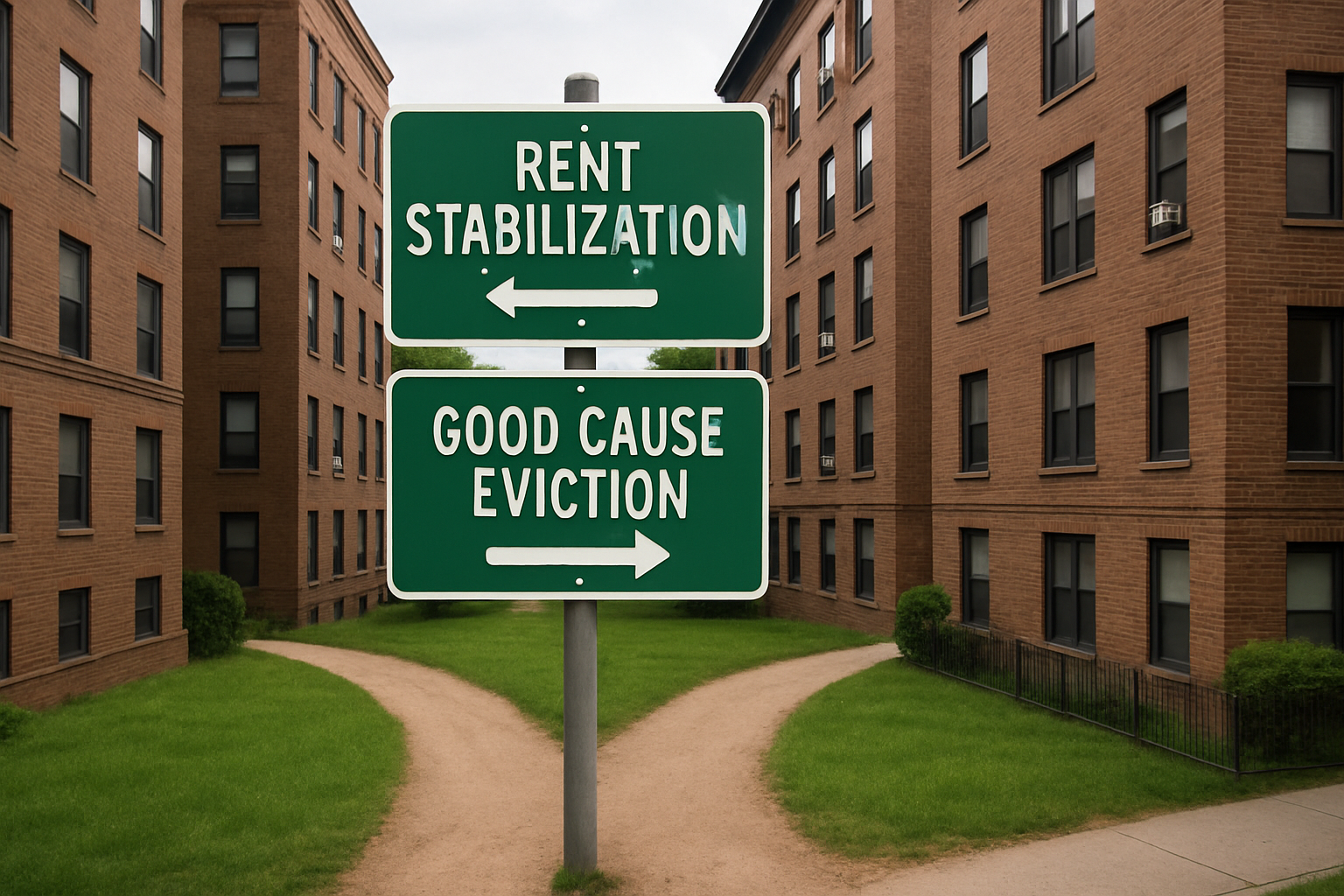
New York landlords now operate under two major tenant protection frameworks: rent stabilization (dating to 1969, expanded by HSTPA in 2019) and Good Cause Eviction (enacted in 2024). These are separate systems with different rules, different coverage, and different mechanisms for setting rent increases.
The single most important thing to understand is this: if your unit is rent-stabilized, Good Cause Eviction does not apply to it. Rent-stabilized units are explicitly exempt from GCE because they already have their own comprehensive tenant protections. The confusion arises because the two systems serve similar purposes but through different mechanisms.
This guide provides a clear decision tree for determining which law governs your building, a side-by-side comparison of both systems, and guidance for buildings that have units under different regulatory regimes.
The Decision Tree: Which Law Applies to Your Unit?
For each unit in your portfolio, work through these questions in order:
Step 1: Is the unit rent-stabilized or rent-controlled?
Check your building’s registration with HCR (Homes and Community Renewal). A unit is rent-stabilized if:
- The building has 6+ units and was built before January 1, 1974 (in NYC), OR
- The building received a tax abatement (421-a, J-51) that required rent stabilization, OR
- The building is in an Emergency Tenant Protection Act (ETPA) municipality outside NYC (Nassau, Westchester, Rockland, Ulster counties)
If yes: Rent stabilization governs. GCE does not apply. The Rent Guidelines Board sets your annual increase. Stop here.
If no: Proceed to Step 2.
Step 2: Is the unit exempt from Good Cause Eviction?
Check all GCE exemptions: 10-unit statewide count, 245% FMR threshold, new construction (30-year CoO), owner-occupied under 10 units, condo/co-op.
If exempt: Neither rent stabilization nor GCE applies. The unit is unregulated — you can set rents and terminate tenancies subject only to general landlord-tenant law (Real Property Law notice requirements).
If not exempt: Proceed to Step 3.
Step 3: Is the unit in NYC or an opt-in municipality?
If yes: Good Cause Eviction applies. Your rent increases are subject to the CPI + 5% or 10% presumptive cap, and you need just cause to evict or non-renew.
If no: GCE does not apply (municipality has not opted in). The unit is unregulated.
Side-by-Side Comparison
| Feature | Rent Stabilization | Good Cause Eviction | Unregulated |
|---|---|---|---|
| Rent increase mechanism | RGB sets annual percentage (voted each June) | CPI + 5% or 10%, whichever is less (rebuttable presumption) | No cap — market determines rent |
| 2026-27 increase | 0% (Order #58) | ~7-8.5% (depending on CPI) | Unlimited |
| Vacancy reset | No — HSTPA eliminated vacancy decontrol; rent carries over | Yes — landlord can set any rent for new tenant | Yes |
| Lease renewal right | Yes — mandatory renewal | Yes — unless just cause for non-renewal | No — lease expires per its terms |
| Eviction grounds | Specific grounds (non-primary residence, owner occupancy, etc.) | 11 enumerated grounds | Any lawful reason (with proper notice) |
| Notice to terminate | Building-specific (30-120 days depending on program) | 30/60/90 days by tenancy length | 30/60/90 days per RPL 226-c |
| Registration required | Yes — annual DHCR registration | No | No |
| Capital improvement recovery | MCI (2%/year, 30-year expiration) and IAI ($30K-$50K caps) | Can justify above-cap increase with documentation | No restrictions |
| Coverage area | NYC + ETPA municipalities (~40 towns in Nassau, Westchester, Rockland, Ulster) | NYC (auto) + ~19 opt-in municipalities | Everywhere else |
| Sunset date | None — permanent (HSTPA removed sunset) | June 15, 2034 | N/A |
| Overcharge penalties | Treble damages (6-year lookback under HSTPA) | Affirmative defense in eviction proceedings | N/A |
| Security deposit | 1 month max (General Obligations Law) | 1 month max (General Obligations Law) | 1 month max (General Obligations Law) |
Understanding HSTPA and Why Rent Stabilization Is Now Permanent
The Housing Stability and Tenant Protection Act of 2019 (HSTPA) fundamentally changed rent stabilization by eliminating every mechanism that had allowed units to exit the system:
- Vacancy decontrol (eliminated) — Previously, units could become deregulated when rent exceeded a threshold ($2,774.76) and the unit became vacant. This is gone.
- High-income deregulation (eliminated) — Previously, landlords could petition to deregulate a unit if the household income exceeded $200,000 for two consecutive years and the rent was above the threshold. This is gone.
- Vacancy bonus (eliminated) — Landlords could previously add a 20% vacancy increase when a unit turned over. This is gone.
- Preferential rent (locked) — Landlords who charged below the legal regulated rent now have that lower rent become the base for future increases.
The result: the rent-stabilized stock is permanent and growing. Units enter the system (through tax abatements or ETPA) but virtually never leave it. This is why approximately 1 million apartments remain rent-stabilized in New York City.
For the complete before-and-after breakdown, see our HSTPA guide.
When Buildings Have BOTH Systems
Some buildings have units under different regulatory regimes. This happens when:
Tax Abatement Buildings
Buildings that received 421-a tax abatements were required to register units as rent-stabilized for the duration of the abatement. After the abatement expires:
- Units occupied by tenants who were in place during the abatement period retain their rent-stabilized status (under HSTPA, they cannot be deregulated)
- Units that become vacant after the abatement expires may lose their stabilized status (this depends on the specific abatement terms and when it was granted)
- Non-stabilized units in the building could become subject to GCE
Mixed Pre-1974 and Post-1974 Construction
If a building was expanded — for example, additional floors added after 1974 to a pre-1974 building — the original units may be rent-stabilized while the newer units are not. The non-stabilized units could be subject to GCE if no other exemption applies.
Buildings With Fewer Than 6 Units
In NYC, rent stabilization generally applies to buildings with 6+ units built before 1974. A 4-unit building built in 1960 is not rent-stabilized. If the owner has more than 10 units statewide and the rent is below 245% FMR, those 4 units are subject to GCE.
The Practical Impact for Landlords
Rent-Stabilized Landlords
If all your units are rent-stabilized, GCE is not directly relevant to your operations. Your primary concern is the RGB annual vote and HSTPA’s restrictions on MCIs, IAIs, and preferential rent. See our guides on:
Market-Rate Landlords in NYC
If you own non-stabilized apartments in NYC (or an opt-in municipality) and don’t qualify for a GCE exemption, you now face rent increase constraints for the first time. The CPI + 5% or 10% cap is more generous than the RGB guidelines (which have ranged from 0% to 5.25% in recent years), but it is a meaningful change from the unrestricted market-rate increases you could previously charge.
Landlords With Mixed Portfolios
If you have both stabilized and non-stabilized units, you need to track two different systems:
| Unit Type | Rent Increase Governed By | Eviction Governed By | Registration |
|---|---|---|---|
| Rent-stabilized | RGB order | Rent Stabilization Code | Annual DHCR registration |
| Market-rate (GCE-covered) | CPI + 5% or 10% | GCE just cause grounds | None required |
| Market-rate (GCE-exempt) | No cap | General landlord-tenant law | None required |
ETPA vs. GCE: Outside NYC
Outside New York City, there are two separate opt-in programs that municipalities can adopt:
Emergency Tenant Protection Act (ETPA)
ETPA extends rent stabilization to municipalities outside NYC. Approximately 40 municipalities in Nassau, Westchester, Rockland, and Ulster counties have adopted ETPA. In ETPA municipalities, eligible buildings (6+ units, built before 1974) are subject to the same rent stabilization rules as NYC buildings, including RGB increases.
Good Cause Eviction (GCE) Opt-In
GCE is a separate opt-in. A municipality can adopt ETPA, GCE, both, or neither. They serve different populations: ETPA covers buildings that qualify for rent stabilization, while GCE covers everything else that doesn’t qualify for an exemption.
A municipality with both ETPA and GCE provides the broadest tenant protections: stabilized units follow RGB rules, and non-stabilized units are subject to GCE’s rent increase and eviction restrictions.
For the current list of GCE opt-in municipalities, see our Good Cause Eviction Opt-In Tracker.
“The question I hear most from New York landlords is: ‘Which law applies to my building?’ The answer is almost always one or the other — never both at the same time for the same unit. But for buildings with mixed unit types, you may need to manage both systems simultaneously. That operational complexity is real.”
— Rachid Abadli, Founder & CEO at LeaseBase
Frequently Asked Questions
Can a unit be subject to both rent stabilization and Good Cause Eviction?
No. Rent-stabilized units are explicitly exempt from GCE. A unit is governed by one system or the other, never both simultaneously.
Is GCE’s rent increase cap stricter than rent stabilization?
Generally, no. The RGB has set increases ranging from 0% to 5.25% in recent years. GCE’s presumptive cap of CPI + 5% (or 10%) typically allows larger increases than the RGB grants. However, GCE’s cap is a rebuttable presumption, while the RGB increase is a hard cap.
If my building exits a 421-a abatement, do the units become subject to GCE?
It depends. Units that retain rent-stabilized status after the abatement expires remain exempt from GCE. Units that lose stabilized status may become subject to GCE if no other exemption applies. The specifics depend on the abatement’s terms and the HSTPA deregulation rules.
My building has 4 apartments and was built in 1950. Is it rent-stabilized?
In NYC, rent stabilization generally applies to buildings with 6 or more units. A 4-unit building built in 1950 is not rent-stabilized (unless it received a tax abatement that triggered stabilization). However, if the owner has more than 10 units statewide and the property is in NYC or an opt-in municipality, GCE may apply.
What happens to GCE-covered units if the law sunsets in 2034?
If GCE expires and is not renewed, covered units revert to unregulated status. Landlords would regain full market-rate pricing power and traditional eviction rights (subject to general landlord-tenant law). However, most observers expect GCE to be renewed or made permanent before the sunset date.
Does GCE apply to Section 8 voucher tenants in market-rate buildings?
GCE applies to the unit, not the tenant. If the unit is in a building that is subject to GCE (not exempt), the GCE protections apply regardless of whether the tenant uses a Section 8 voucher. However, Section 8 has its own rules about rent reasonableness and inspection requirements that also apply.
Know Which System Governs Your Building
Managing compliance across two regulatory systems is operationally complex but necessary. The first step is always knowing which system applies to each unit in your portfolio.
LeaseBase’s NY Good Cause Calculator evaluates each property against all GCE exemptions and identifies whether rent stabilization, GCE, or neither applies. Our Rent Stabilization Calculator tracks RGB increases, legal rents, and MCI/IAI adjustments for stabilized units. Together, they give you a complete compliance picture across your entire portfolio.
Related Reading
- New York Good Cause Eviction Law: The Complete Guide
- Is Your NY Rental Exempt from Good Cause?
- HSTPA Changed Everything: What NY Landlords Lost in 2019
- NYC Rent Freeze 2026-27: What the 0% RGB Increase Means
- MCI and IAI Caps After HSTPA
- NYC Security Deposits, Late Fees, and Application Fees
- Good Cause Eviction Opt-In Tracker