Key Takeaways
- IAI Tier 1: Up to $30,000 over 15 years, added at 1/168th (35+ unit buildings) or 1/180th (under 35 units) per month — increases expire after 15 years
- IAI Tier 2: Up to $50,000 over 15 years for tenancies of 25+ years or vacancies between June 2022 and June 2024
- MCI increases are capped at 2% of the tenant’s rent per year and expire after 30 years
- Before HSTPA, IAIs were permanent (1/40th or 1/60th) and MCIs were permanent at 6% per year — the economics have fundamentally changed
- Strategic renovation planning is essential to maximize returns within the new caps
The New Economics of Building Improvements
Before the Housing Stability and Tenant Protection Act of 2019 (HSTPA), Individual Apartment Improvements (IAIs) and Major Capital Improvements (MCIs) were the primary mechanisms for landlords of rent-stabilized buildings to increase rents and recover capital expenditures. Both were permanent, and both could be substantial.
HSTPA dramatically changed both programs. IAI increases are now temporary (15 years) and calculated at a fraction of their former rate. MCI increases are now temporary (30 years) and capped at a much lower annual percentage. Understanding these new rules is essential for any landlord planning renovations or capital improvements on rent-stabilized property.
Individual Apartment Improvements (IAIs): The New Rules
An IAI is a renovation or improvement made to an individual apartment, typically during a vacancy. Examples include kitchen renovations, bathroom remodels, new flooring, new windows (in the apartment), new appliances, and rewiring.
IAI Tier 1: The Standard Cap
Tier 1 is the default IAI program available for most vacancy renovations:
- Maximum spending: $30,000 over any rolling 15-year period per apartment
- Monthly rent increase: 1/168th of the total improvement cost (buildings with 35+ units) or 1/180th (buildings with fewer than 35 units)
- Duration: 15 years from the date the increase takes effect — then the IAI portion is removed from the legal rent
- Documentation required: Receipts, invoices, and proof of payment for all work performed
IAI Tier 2: The Enhanced Cap
Tier 2 provides a higher spending cap for specific situations:
- Maximum spending: $50,000 over any rolling 15-year period per apartment
- Eligibility: Available only when the prior tenant occupied the unit for 25 or more years, OR the vacancy occurred between June 14, 2022, and June 15, 2024
- Monthly rent increase: Same formula — 1/168th (35+ units) or 1/180th (under 35 units)
- Duration: 15 years
How to Calculate Your IAI Rent Increase
The formula is straightforward but the numbers are smaller than what landlords were accustomed to under the old system:
| Renovation Cost | Building Size | Monthly Increase | Annual Increase | 15-Year Total Recovery | ROI (%) |
|---|---|---|---|---|---|
| $10,000 | 35+ units (1/168th) | $59.52 | $714.29 | $10,714 | 107% |
| $10,000 | Under 35 units (1/180th) | $55.56 | $666.67 | $10,000 | 100% |
| $15,000 | 35+ units | $89.29 | $1,071.43 | $16,071 | 107% |
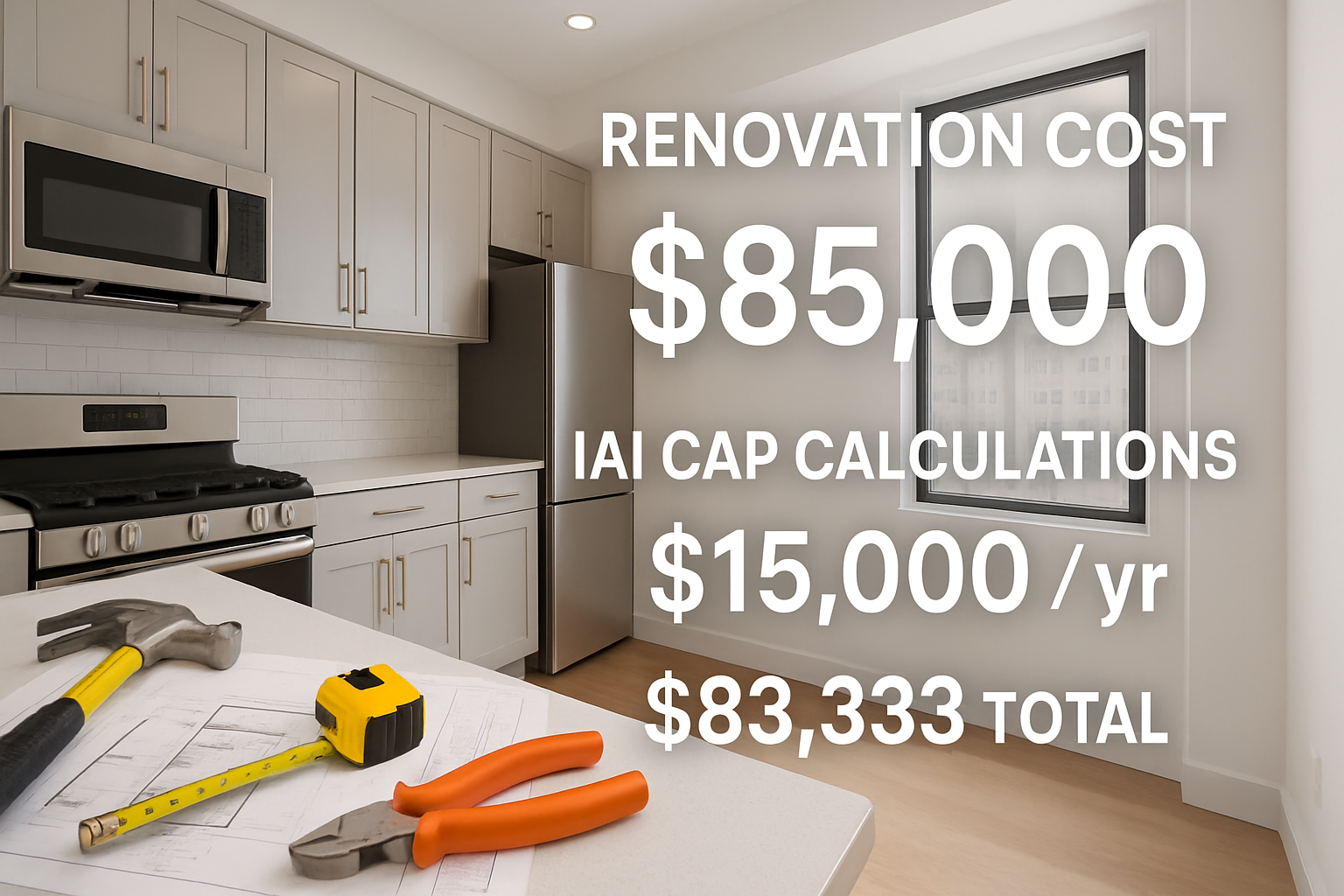
| $15,000 | Under 35 units | $83.33 | $1,000.00 | $15,000 | 100% |
| $25,000 | 35+ units | $148.81 | $1,785.71 | $26,786 | 107% |
| $25,000 | Under 35 units | $138.89 | $1,666.67 | $25,000 | 100% |
| $30,000 (Tier 1 max) | 35+ units | $178.57 | $2,142.86 | $32,143 | 107% |
| $30,000 (Tier 1 max) | Under 35 units | $166.67 | $2,000.00 | $30,000 | 100% |
| $50,000 (Tier 2 max) | 35+ units | $297.62 | $3,571.43 | $53,571 | 107% |
| $50,000 (Tier 2 max) | Under 35 units | $277.78 | $3,333.33 | $50,000 | 100% |
Comparison: Old System vs. New System
Let’s compare a $25,000 kitchen renovation under the old and new rules for a building with fewer than 35 units:
| Feature | Before HSTPA (1/60th) | After HSTPA (1/180th) |
|---|---|---|
| Monthly rent increase | $416.67 | $138.89 |
| Annual rent increase | $5,000 | $1,666.67 |
| Duration | Permanent | 15 years |
| Total recovery (15 years) | $75,000 | $25,000 |
| Total recovery (30 years) | $150,000 | $25,000 (expires at year 15) |
The difference is stark: under the old system, a $25,000 renovation generated $416.67/month permanently. Under the new system, it generates $138.89/month for 15 years, then drops off. The 30-year revenue from the same renovation dropped from $150,000 to $25,000.
Worked Example: Strategic IAI Planning
Given the new economics, landlords must be strategic about which improvements to make and how to allocate the $30,000 cap.
Scenario: Vacant 1-BR in a 20-Unit Building (Under 35 Units)
Current legal rent: $1,400/month. The apartment needs updating. You have $30,000 to spend over 15 years.
| Improvement | Cost | Monthly Increase (1/180th) |
|---|---|---|
| Kitchen renovation (cabinets, counters, appliances) | $15,000 | $83.33 |
| Bathroom renovation (vanity, tile, fixtures) | $8,000 | $44.44 |
| New flooring throughout | $5,000 | $27.78 |
| New interior doors and hardware | $2,000 | $11.11 |
| Total | $30,000 | $166.67 |
New legal rent: $1,400 + $166.67 = $1,566.67/month
After 15 years, the $166.67 IAI increase expires. However, RGB guideline increases applied over those 15 years to the total rent (including the IAI portion) will have partially compounded the benefit. The exact impact depends on future RGB orders.
Maximizing ROI Within the Cap
Given the cap, prioritize improvements that:
- Reduce future maintenance costs — New plumbing, electrical, and HVAC improvements prevent expensive emergency repairs during the tenancy
- Attract reliable long-term tenants — A well-renovated apartment attracts tenants who stay longer, reducing turnover costs
- Address safety and code compliance — Lead paint abatement, window guards, smoke detectors, and ADA modifications are necessary regardless of IAI rules
- Provide the highest cost-per-dollar impact — Kitchen and bathroom renovations have the highest tenant satisfaction impact per dollar spent
Major Capital Improvements (MCIs): The New Rules
MCIs are building-wide capital improvements that benefit all tenants. Unlike IAIs (which are apartment-specific), MCIs apply to the entire building and the cost is spread across all units. Examples include new roofs, boilers, elevators, plumbing risers, windows, facades, and electrical systems.
Post-HSTPA MCI Rules
- Application required: Landlords must apply to HCR (Homes and Community Renewal) for approval before collecting any MCI increase
- Annual cap: MCI increases are limited to 2% of the tenant’s rent per year (down from 6% pre-HSTPA)
- Duration: MCI increases expire after 30 years (previously permanent)
- Phase-in: Because the annual cap is 2%, the full MCI increase takes longer to phase in than under the old 6% cap
- Retroactive to filing date: Once approved, the MCI increase is retroactive to the date of the application filing
MCI Calculation Example
A 30-unit building replaces its boiler at a cost of $300,000.
| Step | Calculation |
|---|---|
| Total improvement cost | $300,000 |
| Monthly increase per unit (approximate) | $300,000 / 30 units / 108 months (for buildings under 35 units) = $92.59 |
| Annual cap per tenant (at $1,500 rent) | 2% x $1,500 x 12 = $360/year = $30/month |
| Phase-in period | $92.59 / $30 = ~3.1 years to fully phase in |
| Duration | 30 years from full phase-in |
| Total recovery (30 years, all units) | $92.59/unit x 30 units x 12 months x 30 years = ~$999,972 |
Note: The actual MCI calculation is more complex than this simplified example. HCR uses a specific formula that accounts for building size, useful life of the improvement, and applicable regulations. The key takeaway is that the 2% annual cap significantly extends the phase-in period, and the 30-year expiration means the increase is not permanent.
MCI: Old System vs. New System
| Feature | Before HSTPA | After HSTPA |
|---|---|---|
| Annual cap | 6% of tenant’s rent | 2% of tenant’s rent |
| Duration | Permanent | 30 years |
| Phase-in speed | Faster (6% annual cap) | 3x slower (2% annual cap) |
| Processing time | 12-18 months typical | 12-24 months (increased application volume) |
| Retroactive to | Filing date | Filing date (unchanged) |
Strategic Considerations for Building Improvements
When IAIs Still Make Sense
Despite the reduced returns, IAIs remain worthwhile when:
- The apartment is in poor condition and cannot be rented at the current legal rent without renovation
- Long-term tenancy is expected — a 15-year IAI increase on a tenant who stays 10+ years generates significant cumulative revenue
- The renovation prevents costly future repairs — new plumbing and electrical prevent emergency service calls
- You are approaching the cap anyway — if you need to spend the money regardless, getting the IAI increase is better than not filing for it
When MCIs Still Make Sense
MCIs remain worthwhile when:
- The improvement is mandatory — a failed boiler, condemned elevator, or Local Law 11 facade work must be done regardless of the MCI recovery
- The building has high aggregate rents — the 2% cap is based on each tenant’s rent, so higher-rent buildings phase in faster
- Financing costs are manageable — if you can finance the improvement at a rate lower than the annualized MCI recovery, the improvement is self-funding
When Improvements May Not Make Financial Sense
The post-HSTPA economics mean that some discretionary improvements no longer generate a positive return:
- Luxury finishes that exceed the IAI cap without proportionally higher rent recovery
- Cosmetic MCIs (lobby renovations, common area upgrades) where the 30-year recovery at 2% per year does not cover the cost of financing
- Over-improvement of units in buildings where the stabilized rent is far below market — you cannot close the gap through IAIs alone
“The math has changed, but the need for capital investment has not. Buildings still need new roofs, boilers, and kitchens. The landlords who are succeeding post-HSTPA are the ones who plan improvements strategically — maximizing every dollar within the IAI cap and filing MCI applications promptly to capture the retroactive benefit.”
— Rachid Abadli, Founder & CEO at LeaseBase
Filing Your MCI Application
MCI applications are filed with HCR (Homes and Community Renewal). The process involves:
- Complete the improvement — The work must be finished and in service before filing
- Gather documentation — Contracts, invoices, proof of payment, permits, sign-offs from DOB (if applicable)
- File the application — Submit to HCR with all supporting documentation
- Tenant notification — All affected tenants are notified and given an opportunity to respond
- HCR review — HCR reviews the application, may request additional documentation or conduct an inspection
- Order issued — If approved, HCR issues an order specifying the rent increase per unit
- Collection begins — The increase takes effect retroactive to the filing date, phased in at 2% per year per tenant
Timing tip: File your MCI application as soon as the improvement is complete. Because the increase is retroactive to the filing date, every month of delay is a month of lost retroactive recovery.
Tracking IAI and MCI Increases
With 15-year IAI expirations and 30-year MCI expirations, accurate tracking is essential. You need to know:
- When each IAI increase was added and when it will expire
- The current phase-in status of each MCI increase
- How much of your current legal rent is composed of IAI and MCI additions (vs. base rent and RGB increases)
- When MCI increases will expire and what the legal rent will be afterward
Manual tracking across dozens or hundreds of units is error-prone and creates overcharge liability. LeaseBase’s NYC Rent Stabilization Calculator tracks every component of your legal rent, including IAI and MCI additions, their effective dates, and their expiration dates. You always know exactly what your legal rent should be.
Frequently Asked Questions
Can I do IAIs on an occupied unit?
Yes, but only with the tenant’s written consent and only if the work does not require the tenant to vacate. In practice, most IAIs are done during vacancies because it is simpler and avoids disputes. If done during occupancy, the improvement must genuinely benefit the tenant (not just increase the rent).
What happens if I spend more than $30,000 on an IAI?
Only the first $30,000 (or $50,000 for Tier 2) counts toward the rent increase. Any spending above the cap does not generate additional rent recovery. The cap is cumulative over a rolling 15-year period, so prior IAI spending within the last 15 years counts against the current cap.
Can I combine IAI and MCI increases on the same unit?
Yes. IAI and MCI increases are separate programs with separate caps. A unit can have both an IAI increase (from apartment-specific improvements) and an MCI increase (from building-wide improvements) applied simultaneously.
What qualifies as an MCI?
The improvement must be building-wide (benefiting all or substantially all tenants), depreciable (a capital expenditure, not routine maintenance), and required for the operation, preservation, or maintenance of the building. Common MCIs include: boiler replacement, roof replacement, elevator modernization, window replacement, plumbing risers, electrical rewiring, and facade restoration.
How long does HCR take to process an MCI application?
Processing times vary but typically range from 12 to 24 months. Complex applications or those requiring additional documentation can take longer. The increase is retroactive to the filing date, so delays in processing do not result in lost revenue — but they do delay cash flow.
Can tenants challenge an IAI or MCI increase?
Yes. Tenants can file objections with HCR during the MCI application review process. For IAIs, tenants can file rent overcharge complaints if they believe the IAI increase was improperly calculated or if the documentation is inadequate. Maintaining thorough records is the best protection against challenges.
Plan Your Improvements With Precision
Post-HSTPA, every dollar spent on building improvements must be strategic. The old approach of spending freely and recovering costs through generous IAI formulas no longer works. You need to know your cap, plan your spending, and file promptly.
LeaseBase’s NYC Rent Stabilization Calculator helps you plan IAI spending within the $30,000/$50,000 caps, calculate the resulting rent increase, and track expiration dates. For MCIs, it tracks the 2% annual phase-in and 30-year expiration for every unit in your building.
Related Reading
- HSTPA Changed Everything: What NY Landlords Lost in 2019
- NYC Rent Freeze 2026-27: What the 0% RGB Increase Means
- New York Good Cause Eviction Law: The Complete Guide
- Rent Stabilization vs Good Cause Eviction: Which Law Applies?
- NYC Security Deposits, Late Fees, and Application Fees
- Good Cause Eviction Opt-In Tracker