Key Takeaways
- Window guards are mandatory in NYC for all windows in units with children under 11 — NYC Health Code §131.15 requires landlords to install and maintain them regardless of lease terms or tenant preference
- You must provide guards at no cost to tenants — installing, repairing, and replacing window guards is a landlord expense and cannot be deducted from rent or security deposits
- HPD violations carry $500–$1,000 penalties per window — failure to install or maintain guards results in Class C violations; repeated violations trigger escalating fines and potential housing court action
- Tenants can request window guards in writing — you have 14 days to comply; failure to respond opens you to HPD complaints and tenant remedies including rent abatement claims
- Guards must meet specific performance standards — bars cannot exceed 4 inches apart, and guards must support 200 pounds of force without dislodging from the frame
- Inspections and violations are tracked by HPD — window guard defects appear on OATH (Office of Administrative Trials and Hearings) violations and impact your property's compliance record
What Are Window Guards and Why NYC Law Requires Them
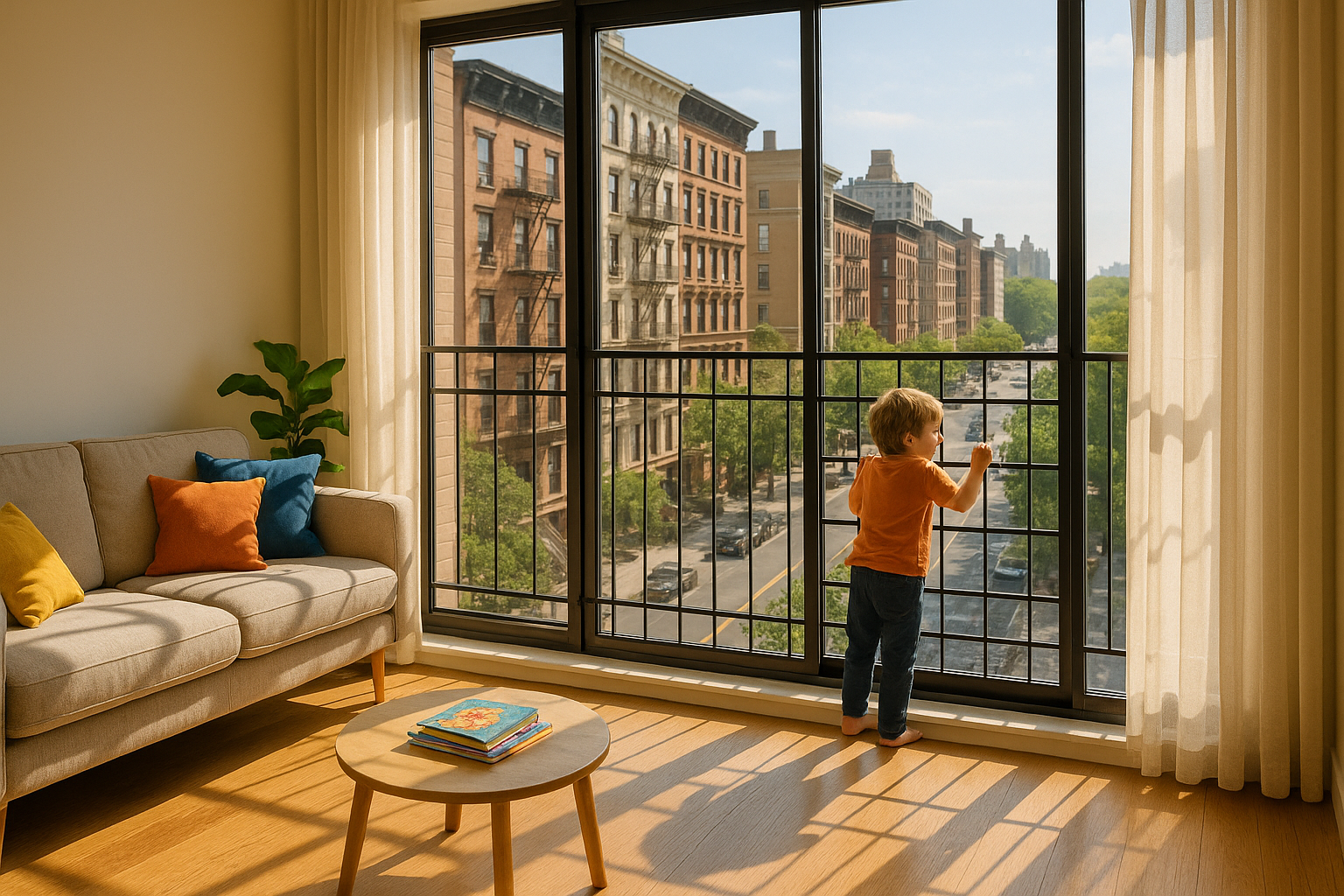
Window guards are metal bars or mesh screens installed on apartment windows to prevent accidental falls—particularly for young children. New York City recognizes that unguarded windows present a serious fall hazard: children between ages 2 and 10 account for the majority of fall-related injuries in residential settings. In 2024–2025, NYC reported over 150 pediatric window-related injuries annually, many of which were preventable.
NYC Health Code §131.15 treats window guards as a mandatory habitability requirement, not optional safety equipment. The law applies to:
- All windows in units where a tenant has a child under age 11
- All windows in units designated as housing for families with children (regardless of current occupancy)
- Windows in all dwelling units in multiple dwellings (apartment buildings with 3+ units)
- Ground-floor windows and any window above a fire escape, ledge, or other drop-off that creates a fall hazard
As a self-managing landlord, you are responsible for knowing whether your unit is occupied by or designated for children under 11. This information typically appears in your lease, rental application, or initial tenant communication. Even if a tenant doesn't disclose the presence of children, once you're notified (via written request, HPD complaint, or any other means), you must treat the unit as subject to the window guard requirement.
Legal Requirements Under NYC Health Code §131.15
Section 131.15 of the NYC Health Code establishes four core compliance requirements:
1. Installation Requirement
Landlords must install window guards on all windows in units with children under 11. The regulation does not provide exceptions for:
- High-floor units (guards are required on all windows, regardless of height)
- Windows with air conditioning units (window guards must still be installed)
- Historic or landmark buildings (NYC provides a variance process, but guards are still required unless a formal variance is granted)
- Tenant refusal (the tenant's preference does not override your legal obligation)
The law is strict: you cannot condition installation on tenant agreement, charge the tenant for installation, or delay installation based on tenant preference or lease terms.
2. Performance Standards
Window guards installed under §131.15 must meet these specifications:
| Specification | Requirement |
|---|---|
| Bar spacing | No more than 4 inches apart (measured horizontally and vertically) |
| Force requirement | Must support 200 pounds of outward force without dislodging from the frame |
| Material | Steel bars or approved mesh material (no deterioration or rust that compromises integrity) |
| Installation | Securely fastened to the window frame; cannot obstruct egress in case of fire |
| Quick-release mechanism | Approved guards may include a quick-release mechanism operable by adults to allow emergency egress |
HPD inspectors test window guard compliance by applying force and checking bar spacing. If bars exceed 4 inches apart or a guard fails the force test, it is cited as a violation.
3. Landlord Responsibility for Installation and Maintenance
Installation and maintenance are entirely the landlord's responsibility and expense. You cannot:
- Charge the tenant an installation fee or monthly surcharge for window guards
- Include window guard installation costs in rent
- Deduct installation or repair costs from the security deposit
- Require the tenant to arrange or pay for installation as a condition of occupancy
- Make window guard repairs contingent on the tenant's maintenance request (you have a proactive duty to maintain them)
If a guard becomes damaged, loose, or corroded, you must repair or replace it within 14 days of notice from the tenant or HPD. Delaying repairs to save money is a violation and can result in escalating fines.
4. Tenant Right to Request in Writing
Tenants have the right to request window guards in writing. Once a written request is received (email, letter, text message, or formal request through HPD's online portal), you have 14 calendar days to comply. The 14-day clock starts from the date the request is received by you or your designated agent.
If you fail to respond within 14 days, the tenant can file an HPD complaint, and you face:
- A Class C violation ($500–$1,000 per window)
- An additional violation for failure to respond to a tenant request (separate fine)
- Potential rent abatement claims if the tenant pursues a housing court defense
HPD Violations, Penalties, and Enforcement
Violation Classification
Window guard violations are classified as Class C violations under NYC Housing Maintenance Code violations. Here's the penalty structure:
| Violation Type | First Violation | Repeat Violation (within 3 years) |
|---|---|---|
| Missing or non-compliant window guard (per window) | $500–$1,000 | $1,000–$2,000 |
| Failure to respond to tenant request within 14 days | $250–$500 | $500–$1,000 |
| Damaged/deteriorated guard (non-functional) | $500–$1,000 | $1,000–$2,000 |
Violations are issued by HPD and adjudicated through OATH (Office of Administrative Trials and Hearings). If you do not contest a violation within 30 days, a default judgment is issued, and you must pay the full penalty.
Accumulation of Violations and Property History
Multiple window guard violations at the same property create a pattern that HPD uses to establish neglect of habitability standards. If your property accumulates three or more violations within 12 months, HPD may:
- Issue a formal notice of violation pattern
- Schedule compliance inspections more frequently
- Flag your property for third-party oversight or monitoring
- Pursue legal action against you in housing court
Violation history is also discoverable in tenant disputes, giving tenants evidence of your non-compliance in rent abatement or habitability claims.
Practical Compliance Checklist for Landlords
Step 1: Identify Units with Children Under 11 (Before and During Tenancy)
At move-in:
- Review the rental application and lease for disclosure of children under 11
- Ask the tenant directly (in writing) whether they have or plan to have children under 11 in the unit
- Document the tenant's response (keep the email or signed form)
During tenancy:
- If you become aware that a child under 11 is living in the unit (via tenant communication, observation, or any other means), treat the unit as requiring window guards immediately
- Do not wait for formal written notice; the moment you know, you have a legal obligation
Step 2: Measure and Assess Windows Before Installation
Before ordering guards, measure all windows in the unit:
- Identify window dimensions and frame type (wood, aluminum, vinyl)
- Note any windows with air conditioning units or obstructions
- Identify windows above fire escapes or ground-level windows with exterior hazards
- Check for historic or landmark building designation (which may require a variance)
Take photos of the windows for your records and to share with your vendor.
Step 3: Select Compliant Window Guards
Purchase guards that meet §131.15 specifications:
- Bar spacing: Verify that bar spacing is 4 inches or less (get written certification from the manufacturer)
- Force rating: Confirm the guard supports 200+ pounds of outward force (check product documentation)
- Installation: Ensure the guard can be securely fastened to your frame type
- Emergency egress: If using quick-release guards, verify the mechanism meets fire code requirements (NYC Building Code §1005.1)
Common compliant products include steel bar guards and mesh grille guards from vendors such as Mako Guards, FirstAlert Window Guard, and other HPD-approved manufacturers. Request compliance certificates from your vendor.
Step 4: Install Within Legal Timeframe
Proactive installation (no tenant request): Install within 30 days of learning the unit houses a child under 11.
Response to tenant request: Install within 14 calendar days of receiving written request.
Document the installation date with photos, work order, and contractor receipt. Save all documentation for HPD review if needed.
Step 5: Conduct Regular Maintenance Inspections
Inspect window guards at least twice annually (spring and fall):
- Check for rust, corrosion, or material deterioration
- Verify that bars are still spaced 4 inches or less apart
- Test fasteners to ensure guards are secure
- Confirm quick-release mechanisms (if applicable) still function
- Look for damage from weather, tenant use, or accident
Document inspections in writing (create a simple checklist or spreadsheet with date, unit number, condition, and any repairs needed).
Step 6: Respond Promptly to Maintenance Requests
If a tenant requests repair or replacement, respond within 7 days (well ahead of the 14-day legal requirement) with:
- Confirmation of the request and your timeline to repair
- Scheduled appointment or completion date
- Follow-up notification once repair is complete
Create a log of all tenant requests and your responses. This protects you if the tenant later claims you failed to respond.
How to Handle Tenant Disputes and Refusals
Tenant Refuses to Allow Installation
Some tenants resist window guard installation, claiming they obstruct views, block light, or violate their autonomy. Under NYC law, tenant preference is irrelevant. You must install window guards regardless of tenant objection.
How to proceed:
- Send the tenant a formal written notice (email or certified mail) stating that window guards are required under NYC Health Code §131.15 and will be installed on [specific date]
- Provide at least 24 hours notice (and preferably 48 hours) of entry to allow the tenant to arrange access
- Install the guards by the stated date, whether or not the tenant agrees
- Document the installation with photos and a work order
- If the tenant refuses entry, you may have grounds to pursue a lease violation; consult a tenant attorney before taking action
Tenant Disables or Removes Guards
If a tenant removes, disables, or tampers with window guards after installation, this is a lease violation and a safety hazard. Document the condition with dated photos and send the tenant a formal written notice:
- "Notice to Restore Window Guards"
- Identify the affected windows
- Explain the legal requirement and hazard
- Give the tenant 5 business days to restore the guards or allow you to restore them
- If the tenant refuses, you have grounds to pursue eviction for lease violation (consult an attorney)
In the interim, you may need to file an emergency violation with HPD to protect yourself legally, showing that you took corrective action and the violation was caused by the tenant, not landlord negligence.
Tenant Claims Disability Accommodation
Occasionally, a tenant may claim that window guards violate an ADA accommodation or create a safety issue for a disabled household member (e.g., a person using a wheelchair who needs unobstructed window access for emergency egress).
How to respond:
- Request a written explanation of the disability-related concern
- Consult with a disability rights attorney or property counsel before removing or delaying installation
- Explore alternative solutions (e.g., quick-release guards, window bars with larger spacing that still meet safety standards if approved by HPD)
- Document your good-faith engagement with the tenant
- Do not simply remove guards without legal guidance; this creates liability
Note: NYC Health Code §131.15 does not provide an exemption for disability accommodations, but an interactive process may reveal reasonable alternatives. Seek legal counsel to navigate this properly.
HPD Complaint Process and Your Defense
How Tenants File HPD Complaints
Tenants can file window guard complaints online through HPD's website (hpd.gov), by phone (311), or through community organizations. HPD will issue a complaint number and schedule an inspection within 5–10 business days.
What to expect:
- HPD inspector will measure bar spacing and test the guard's force resistance
- Inspector will photograph the window and take notes
- If a violation is found, you will receive a violation notice by mail
- The violation will include a case number, inspection date, and the specific finding (e.g., "Missing window guard" or "Bar spacing exceeds 4 inches")
- You have 30 days to respond or file a hearing request with OATH
Contesting a Violation
If you believe an HPD violation is incorrect, you can file a hearing request with OATH within 30 days of the violation notice. Bring:
- Proof of installation (contractor receipt, photos, work order)
- Manufacturer specifications showing compliance with the 4-inch bar spacing and 200-pound force requirements
- Photos of the guard in place (timestamped)
- Documentation of maintenance or repairs, if relevant
- Proof of tenant communication (lease, email, written request)
If you win the hearing, the violation is dismissed. If you lose, you must pay the fine within 30 days or request a payment plan from HPD.
Non-Payment Consequences
Failing to pay HPD violations within 30 days of an OATH judgment results in:
- Addition of interest and collection fees (10% per annum)
- Placement of a lien against your property (recorded with the NYC Department of Finance)
- Wage garnishment or bank account levy (in extreme cases)
- Suspension of your property from city housing programs or financing (if applicable)
- Increased scrutiny in future HPD inspections
Pay violations promptly to avoid compounding costs and legal complications.
Window Guards and Rent Abatement Claims
If a tenant discovers that your unit lacks window guards and you fail to install them, the tenant may pursue a rent abatement claim in housing court. The tenant argues that the unit is not fit for habitation under New York Real Property Law §235 and seeks a reduction of rent.
Courts have found that missing or non-functional window guards in units with children under 11 constitute a breach of the implied warranty of habitability. Judges may abate rent by 5–30% depending on:
- How long the condition persisted
- Whether the tenant gave you notice and you ignored it
- The severity of the safety hazard
- Your history of compliance violations
Example: A tenant with two children under 11 lives in a $2,000/month apartment. You fail to install window guards for four months despite the tenant's written request. A judge may order you to refund 20–30% of rent for those months ($400–$600/month × 4 = $1,600–$2,400 total), plus the tenant's attorney fees.
Preventing rent abatement claims by installing window guards proactively is far cheaper than defending a housing court lawsuit.
Special Situations and Exceptions
Historic Landmark Buildings
Landlords of historic landmark properties can request a variance from NYC's Landmarks Preservation Commission (LPC) if window guards are deemed incompatible with the building's historic character.
Important: A variance is not automatic. You must:
- File a variance application with the LPC
- Provide documentation showing why guards conflict with historic preservation
- Propose alternative safety measures (e.g., window locks, fixed screens, tenant education)
- Receive LPC approval before installing non-compliant alternatives
Until a variance is formally granted, you are still required to install compliant window guards. Do not delay installation while awaiting a variance decision.
Single-Family Homes and Small Buildings
NYC Health Code §131.15 applies to "multiple dwellings," which includes any building with 3 or more units. Single-family homes and 2-unit buildings are technically exempt from the Health Code requirement, but you should still consider window guards as a liability and habitability best practice if you house families with young children.
Air Conditioning Units and Window Obstruction
Window guards must be installed even if the window has an air conditioning unit. Install the guard on the interior side of the AC unit or select a guard design compatible with AC units. Do not skip windows because of AC units; HPD will still cite a violation for missing guards.
Integrating Window Guard Compliance into Your Leasing and Portfolio Management
Self-managing landlords typically track dozens of compliance obligations across multiple units. Centralizing window guard information—along with lease data, tenant contact info, and maintenance history—reduces the risk of missed deadlines.
Consider these management practices:
- Intake process: Add a question to your rental application asking whether the tenant has children under 11. Document the answer clearly and keep it with the lease.
- Lease addendum: Include a clause in your lease stating that window guards are required for units housing children under 11, they are provided at no cost, and the tenant should report any damage promptly.
- Maintenance tracking: Use a spreadsheet or property management log to track installation dates, maintenance schedules, and any tenant requests related to window guards.
- Annual audit: Every 12 months, review your portfolio to confirm that all units with children under 11 have current, compliant window guards.
- Vendor relationships: Develop a relationship with a reliable window guard installer who understands NYC compliance requirements and can respond to repair requests quickly.
For multi-unit portfolios, a compliance management system that flags tenant requests and tracks installation deadlines is invaluable. LeaseBase's compliance engine automatically tracks statutory deadlines and alerts you when action is needed, ensuring that critical habitability items like window guards don't slip through the cracks.
Frequently Asked Questions
Q1: Do I need window guards if the tenant doesn't have children currently but might have children in the future?
A: No, but you should be prepared to install them immediately if the tenant notifies you that a child under 11 is moving in or if the tenant requests them in writing. Your lease should clarify that if children under 11 move into the unit, window guards will be provided at no cost to the tenant and installed within 14 days of notice. Some landlords proactively install guards in family-designated units to avoid future delays.
Q2: Can I charge the tenant a monthly fee to maintain or replace window guards?
A: Absolutely not. Window guard installation, maintenance, and replacement are landlord responsibilities and cannot be passed to the tenant in any form—not as a monthly fee, a surcharge, a deduction from rent credits, or a security deposit deduction. Charging tenants violates §131.15 and gives the tenant grounds to file an HPD complaint and seek damages.
Q3: What if my tenant tampered with or removed the window guard?
A: Document the condition with timestamped photos and send the tenant a formal notice to restore the guard within 5 business days. If the tenant refuses, you can: (1) enter the unit yourself (with proper notice) and reinstall the guard; (2) pursue a lease violation charge; or (3) file a violation with HPD to establish that the landlord (you) is compliant and the violation is tenant-caused. Do not ignore the problem, as it opens you to liability and tenant complaints.
Q4: Do window guards need a quick-release mechanism for fire safety?
A: Quick-release mechanisms are optional but recommended. If you use them, verify that the mechanism complies with NYC Building Code §1005.1 (emergency egress requirements) and that the mechanism is located at adult height and operable without tools. Standard bar guards are compliant under §131.15 even without a quick-release, as long as they don't block emergency exits (e.g., windows serving as required fire escapes).
Q5: What should I do if HPD issues a violation for a window guard that was already in place?
A: Request an inspection record or violation photo from HPD to understand the specific finding (e.g., "Bar spacing exceeds 4 inches" or "Guard is corroded and non-functional"). If the guard was compliant when installed but degraded over time, you may need to replace it. File a hearing request with OATH, bring proof of prior installation and your compliance history, and explain any maintenance issues. If the guard met standards when installed and was damaged by tenant use or weather, you may successfully contest the violation or pursue the tenant for damage.
Key Takeaways for Your Compliance Calendar
| Action | Timeline | Consequence for Non-Compliance |
|---|---|---|
| Identify units with children under 11 | Before move-in and during tenancy | HPD complaint, violation, rent abatement claim |
| Install compliant window guards | 30 days after identifying a child under 11 | $500–$1,000 per window (Class C violation) |
| Respond to tenant written request | 14 calendar days | $250–$500 violation for failure to respond |
| Repair damaged or non-functional guards | 14 calendar days of notice | $500–$1,000 violation for non-functional guard |
| Conduct maintenance inspection | Twice yearly (spring and fall) | Early detection of damage; avoidance of HPD violations |
| Respond to HPD violation notice | 30 days (file hearing request or pay fine) | Default judgment, lien on property, wage garnishment |
Conclusion
Window guards are not optional in NYC. Health Code §131.15 is a strict liability statute: if a child under 11 lives in your unit, you must install, maintain, and repair compliant window guards at your expense. Violations carry $500–$1,000 per window penalties, expose you to rent abatement claims, and damage your property's compliance record.
The easiest compliance path is to:
- Know your tenants: identify children under 11 at move-in and remain alert during tenancy
- Act fast: install compliant guards within 30 days of learning a child is in the unit
- Maintain consistently: inspect guards twice yearly and respond to repair requests within 7 days
- Document everything: keep records of installation, maintenance, tenant requests, and responses
- Respond professionally: if a tenant requests guards, confirm receipt in writing and provide a completion date
For self-managing landlords juggling multiple units, integrating window guard requirements into your lease process and lease operations workflow