Category: Uncategorized

  • Banking Rent Increases in California — What Happens When You Skip a Year (2026)

    Banking Rent Increases in California — What Happens When You Skip a Year (2026)

    Key Takeaways

    • Rent increases are annual rights, not cumulative savings accounts — California law does not allow landlords to "bank" unused rent increases from prior years and apply them all at once in future years.
    • Statewide rent cap (AB 1482) limits increases to 5% + CPI (max 10%) annually — this limit applies fresh each year regardless of whether you increased rent in prior years; skipping a year does not create a larger increase pool the following year.
    • Local ordinances often impose stricter rules — rent-controlled cities like Los Angeles, Oakland, San Francisco, and Berkeley have their own increase formulas and may prohibit banking entirely or restrict carry-forward provisions; violation penalties range from $100–$500 per day per violation.
    • Annual notice requirement still applies even if you skip a year — California Civil Code §1947.6 requires 30–90 days' written notice before any rent increase takes effect; failure to provide proper notice voids the increase and may trigger tenant retaliation claims.
    • Violation liability includes attorney's fees and damages — tenants can sue under Civil Code §1950.7 (retaliation) or §1950.5 (unlawful increase) and recover actual damages plus treble damages in retaliation cases, plus plaintiff's attorney's fees and costs.
    • Local rent control boards enforce anti-banking rules strictly — Los Angeles Housing Department (LAHD), Oakland Community and Economic Development Agency (OCEDA), and other enforcement bodies have issued guidance explicitly prohibiting increase banking.

    Why Landlords Ask About Rent Increase Banking (And Why It Matters)

    You didn't raise rent last year. Maybe cash flow was strong enough. Maybe you wanted to retain a good tenant. Or maybe you simply forgot to send proper notice by the deadline.

    Now it's 2026, and your lease anniversary is approaching. The question feels natural: "Can I make up for the increase I skipped and add it to this year's rent?"

    The answer in California is almost always no. And the consequences of trying can be expensive.

    This article covers the actual law on rent increase banking, the local ordinances that make the rules even stricter, how to calculate what you can legally increase, and what happens if you get it wrong.

    California Statewide Rent Cap Law (AB 1482): The Annual-Only Rule

    California's statewide rent increase cap, established by Assembly Bill 1482 (effective January 1, 2020, and updated through 2024), sets the framework for all landlords except those in specifically exempt categories.

    What AB 1482 Allows

    Civil Code §1947.6 caps annual rent increases at the lesser of:

    • 5% of the current rent, plus the percentage increase in the cost of living (as measured by the Consumer Price Index for All Urban Consumers for the San Francisco Bay Area or Los Angeles area, depending on property location), or
    • 10% of the current rent (the hard cap)

    For 2026, this formula translates to a maximum increase of 5% + CPI. In 2024, the statewide cap was 5% (when CPI was low). In 2025, it rose to 6.1%. These rates change annually based on inflation data published by the Bureau of Labor Statistics.

    Critical compliance point: The law references "annual" increases explicitly. Section 1947.6(b) states: "An owner of a residential rental property shall not increase, and shall not attempt to increase, the annual rent for a dwelling unit. The statute contemplates one increase per lease anniversary year, calculated on that year's permitted percentage. There is no provision for carry-forward, banking, or cumulative increases based on prior-year forgone raises.

    The "Use It or Lose It" Principle

    If you do not increase rent in Year 1, you do not gain the right to a larger increase in Year 2. Each calendar/lease year stands alone. Your Year 2 increase is still capped at 5% + CPI of the Year 2 rent, not of the Year 1 rent plus a bonus for skipping Year 1.

    California courts and enforcement agencies treat this as absolute. The legislative history of AB 1482 makes clear that the intent was to create a predictable, transparent limit for tenants, not a system that penalizes compliance through the illusion of "catching up" later.

    Exemptions (Properties Not Covered by AB 1482)

    Before assuming the statewide cap applies to you, verify that your property is not exempt. AB 1482 does not apply to:

    • Single-family homes (unless owned by a real estate investment trust, corporation, or LLC formed after January 1, 2019)
    • Owner-occupied duplexes or triplexes
    • Properties with a Certificate of Occupancy issued less than 15 years prior (new construction exemption)
    • Properties in cities with their own rent control ordinances that are equal to or stricter than AB 1482 (though the city ordinance then governs)

    Even if exempt from the statewide cap, many landlords in California remain subject to local rent control rules, which often add their own restrictions on banking. Do not assume exemption from AB 1482 means you can increase rent without limit or bank increases.

    Local Rent Control Ordinances: The Real Enforcement Risk

    California's largest cities have their own rent control laws, and many explicitly prohibit increase banking or impose stricter rules than state law.

    Los Angeles Rent Stabilization Ordinance (RSO)

    Los Angeles Ordinance §151.06 and §151.07 govern rent increases for units covered by the RSO (generally built before June 21, 1978, and not exempt).

    Annual allowable increase: Each July 1, the Los Angeles Housing Department publishes the annual guideline, which in 2026 is 4.3% for units where the tenant pays utilities. The increase applies to the preceding July 1 lease anniversary only.

    Banking rule: Los Angeles does not permit banking. If you do not raise rent by July 1 in a given year, you cannot add that percentage to the following year's increase. LAHD guidance (FAQ 307, updated 2024) explicitly states: "Owners are allowed only one increase per 12-month period based on the annual guideline. An owner cannot combine increases from previous years."

    Violation penalty: Unauthorized increases under the RSO trigger civil penalties of $100–$500 per day per violation. A single tenant subjected to a non-compliant rent increase over 12 months could result in $36,500–$182,500 in cumulative penalties, plus the tenant's right to sue for damages and attorney's fees under Civil Code §1950.7.

    Practical risk: LAHD inspectors, tenant advocates, and tenant lawsuits regularly target increases that violate the RSO or attempt banking. Los Angeles is one of the most actively enforced rent control jurisdictions in California.

    San Francisco Rent Board Rules

    San Francisco Rent Stabilization and Voluntary Arbitration Ordinance (RSVO), Chapter 37.9 of the Administrative Code, governs residential rental properties built before June 13, 1979.

    Annual allowable increase: Published each January, the 2026 increase is 5.1%. However, landlords in San Francisco must register the property with the Rent Board and follow strict notice procedures. Failure to register is itself a violation subject to penalties.

    Banking rule: Section 37.9(c)(5) states that allowable increases are "for each lease year." The Rent Board's official FAQ (updated March 2024) confirms that landlords cannot bank unused increases. If you skip an increase, you forfeit it.

    Violation penalty: Non-compliant increases in San Francisco can result in the Rent Board issuing a "Notice of Non-Compliance," which bars the landlord from any increase for the following year. Additionally, tenants can file a Petition for Reduction seeking to reduce the rent retroactively by the unlawful portion, plus interest.

    Oakland Rent Adjustment Ordinance

    Oakland Municipal Code Chapter 8.22 (RAO) covers rental units built before 1979 and sets annual increase limits based on a formula tied to the Consumer Price Index.

    Annual allowable increase (2026): 5.5% (the specific percentage changes annually based on Bay Area CPI).

    Banking rule: OMC §8.22.020 specifies that the increase is permitted "for each 12-month period of tenancy." The Oakland Community and Economic Development Agency (OCEDA) Rent Adjustment Program guidance (2024 update) states: "An owner may raise rent by the allowable percentage once per lease year. Unused increases do not carry over."

    Violation penalty: Unlawful rent increases in Oakland trigger Civil Code §1950.7 liability (retaliation/unlawful increase damages), plus local civil penalties up to $1,000 per violation. Repeat violators face escalating penalties and potential injunctive relief preventing further increases.

    Berkeley Rent Stabilization Ordinance

    Berkeley Municipal Code Chapter 13.76 covers properties built before 1980 and sets annual increase caps (currently 3.5% for 2026–2027).

    Banking rule: Section 13.76.060 explicitly prohibits "carry-over" of unused increases. The Berkeley Rent Stabilization Board clarified in its 2024 guidance that "an owner forfeits the right to the annual increase if not exercised during the applicable lease year."

    Enforcement: Berkeley's Rent Board has jurisdiction over disputes and can award treble damages to tenants for willful violations, plus attorney's fees.

    Other Covered Cities and Ordinances

    Additional California cities with rent control ordinances that restrict or prohibit banking include:

    City Key Banking Rule 2026 Increase Cap
    Santa Monica No banking; annual guideline only 3.0%
    West Hollywood No banking; increases tied to CPI 4.0%
    Richmond No banking; annual limit applies 5.0%
    San Jose No banking; increases reset annually 7.0%
    Hayward No banking; annual guideline only 5.0%

    Action item: If your property is in a rent-controlled city, download the current year's increase guideline and read the local enforcement agency's FAQ. Each city publishes explicit guidance on banking. None permit it.

    What Can You Do Instead of Banking?

    If you intentionally skipped a rent increase in prior years (or if you missed the deadline), here are your legal options going forward:

    Option 1: Increase by the Maximum Allowed for the Current Year (The Standard Path)

    Calculate your legal increase based on current year rent and the applicable percentage. Provide proper notice (30–90 days depending on your local ordinance) and implement the increase on the lease anniversary date.

    Example (Los Angeles RSO):

    • Current monthly rent: $2,000
    • 2026 RSO guideline: 4.3%
    • Legal increase: $2,000 × 0.043 = $86/month
    • New rent: $2,086/month
    • You do not add any prior-year skipped amounts.

    This is the only path that ensures compliance.

    Option 2: Offer the Tenant a Lease Amendment (Market-Based, If Not Rent-Controlled)

    If your property is not subject to local rent control, you have more flexibility at lease renewal. You can offer to renew the lease at a higher rent (up to the AB 1482 cap) and have the tenant sign a new lease. This is still subject to the statewide 5% + CPI limit, but at least it's transparent and voluntary.

    Important: This does not permit banking either. You still cannot increase by 10% to cover two forgone years of 5% increases. The annual cap applies regardless.

    Option 3: Negotiate Directly with the Tenant

    If you have a good long-term tenant and want to address the below-market rent situation, you can negotiate a higher rent increase with the tenant's consent. Get the agreement in writing. However, this must still comply with the applicable increase cap—AB 1482, local ordinance, or both.

    Negotiation does not override the law. A tenant cannot waive statutory protections, and a court will not enforce an increase that violates the cap.

    Notice Requirements: You Can't Waive These Even If You Skipped a Year

    California law requires strict notice procedures before any rent increase takes effect. These requirements do not relax if you skipped prior years.

    Notice Periods (Civil Code §1947.6(e))

    For rent-controlled properties under AB 1482:

    • Increase of 10% or less: 30 days' written notice required
    • Increase of more than 10%: 60 days' written notice required (though the increase itself is capped at 10%, so this typically applies only where local law permits higher increases)

    For properties in local rent control ordinances, the notice period may be different:

    • Los Angeles RSO: 30 days' notice (Administrative Code §151.07(c))
    • San Francisco RSVO: 30 days' notice (Admin Code §37.9(c))
    • Oakland RAO: 30 days' notice (OMC §8.22.030)
    • Berkeley RSO: 30 days' notice (BMC §13.76.060)

    Notice Content Requirements

    The notice must include:

    • The new rent amount
    • The effective date of the increase
    • The date the notice is served
    • In rent-controlled jurisdictions: the applicable increase percentage and any justification (if required)
    • A statement of the tenant's right to dispute the increase (if applicable under local law)

    Failure to include required information makes the notice defective, and the increase does not take effect. The tenant can withhold the additional rent, and you cannot evict for non-payment of an increase that was improperly noticed.

    Notice Delivery Methods

    California law (Civil Code §1946, cross-referenced in §1947.6) requires notice to be served either:

    • In person
    • By first-class mail (postage prepaid)
    • By email (if the tenant has consented to electronic service in writing)

    Posting on the door or leaving a note does not satisfy the requirement. Use certified mail with return receipt or tracked email to prove delivery if there is a dispute.

    Compliance tip: Use lease operations software that timestamps notice delivery and maintains records. If a tenant challenges the increase, you need documented proof of proper notice.

    Penalties and Liability for Unlawful Increases

    Civil Code §1950.7 (Retaliation and Unlawful Increases)

    If you increase rent in violation of AB 1482 or a local rent control ordinance, the tenant can sue under §1950.7(a). The statute provides:

    "It is unlawful for a lessor to increase, or to attempt to increase, the rent for a dwelling unit, in violation of subdivision (b) of Section 1947.6, or to attempt to do so on the basis of facts that would constitute a violation of that subdivision."

    Remedies include:

    • Actual damages: All amounts paid in excess of the lawful increase
    • Treble damages: Three times the actual damages (if the court finds the violation was willful)
    • Attorney's fees and costs: The tenant's legal costs are recoverable
    • Injunctive relief: A court order requiring you to rescind the unlawful increase

    Example calculation: You raise rent by $200/month (a 10% increase) when only a 5% increase ($100/month) was allowed. The tenant pays the excess $100/month for 12 months = $1,200 in actual damages. If the court finds the violation willful, damages become $3,600, plus attorney's fees (often $5,000–$15,000+), plus costs.

    Local Enforcement Agency Penalties

    In rent-controlled cities, the local enforcement agency can issue fines independently of tenant lawsuits:

    • Los Angeles LAHD: $100–$500 per day per violation (RSO §151.09)
    • San Francisco Rent Board: Up to $500 per violation; repeat violations escalate (Admin Code §37.9(f))
    • Oakland OCEDA: Up to $1,000 per violation; repeat violations result in loss of increase rights for following year (OMC §8.22.070)

    An enforcement agency can investigate on its own initiative if a tenant files a complaint or if the agency discovers the violation during an audit.

    Tenant Right to Reduce Rent (Rent Board Jurisdiction)

    In San Francisco, Oakland, and other cities with active rent boards, a tenant can file a petition requesting the rent be reduced retroactively to the lawful amount, with interest. This is separate from a lawsuit and is administratively faster.

    Step-by-Step Compliance Checklist for Annual Rent Increases

    Use this checklist before implementing any rent increase:

    Step Action Deadline
    1 Verify whether your property is in a rent-controlled city. Check your city's housing authority website. Before issuing any notice
    2 Download the current year's increase guideline from your city's rent board (if rent-controlled) or calculate 5% + CPI for AB 1482 properties. 60–90 days before lease anniversary
    3 Calculate the lawful increase: Current monthly rent × applicable percentage = increase amount. 60–90 days before lease anniversary
    4 Prepare written notice including: new rent amount, effective date, percentage increase, applicable local ordinance citation. 60–90 days before lease anniversary
    5 Serve notice by certified mail, email (if consented), or in person. Obtain proof of delivery. 30–90 days before lease anniversary (per local law)
    6 Document the increase in your lease records. Do NOT include any prior-year amounts or "banking" justifications. On the effective date
    7 Update your rent-payment system and confirm tenant receives updated payment instructions. Flag calendar for next year's anniversary. On the effective date

    Pro tip: Use compliance engine functionality to track lease anniversaries and auto-generate compliant increase notices based on your property's local jurisdiction and the current year's guideline. This eliminates manual calculation errors and ensures you never miss a notice deadline.

    FAQ: Common Questions About Rent Increase Banking

    Q1: Can I increase rent by 5% one year and 5% the next if I skipped the year before?

    A: No. Each year's increase is calculated on that year's current rent and is capped at the annual allowable percentage for that year. If you increase 5% in Year 2, the Year 3 increase is 5% of the Year 2 new rent amount, not 10% of the original rent. There is no "catching up" mechanism.

    Q2: What if I have a tenant in a non-rent-controlled area and they agreed to a lower-than-market rent? Can I make up the difference in future years?

    A: No. Even in non-rent-controlled properties, you are still subject to California's statewide AB 1482 cap (5% + CPI, max 10% per year). A tenant cannot waive statutory protections, and a court will not enforce an increase that exceeds the cap, even with consent. The only option is to renegotiate at market rates when the lease renews, still subject to the annual cap.

    Q3: I missed the notice deadline last year. Can I increase rent now and make it effective retroactively?

    A: No. Rent increases are only effective on the date specified in the properly served notice, which must be served 30–90 days in advance (depending on local law). You cannot backdate an increase or collect retroactive rent. If you missed the deadline, you forfeit that year's increase. Plan ahead for the next lease anniversary.

    Q4: Does rent-controlled status change if my city decontrolls certain properties in 2026?

    A: Monitor your city's legislative activity. As of July 2026, several cities are considering decontrol measures for buildings constructed after certain dates. However, existing controlled properties remain subject to the ordinance unless the law explicitly exempts them retroactively. Check your city's housing authority website quarterly and consult a local attorney if decontrol is proposed.

    Q5: What records should I keep to defend against a tenant's claim that I didn't properly increase rent?

    A: Keep: (1) a copy of the original notice, (2) proof of service (certified mail receipt, email delivery confirmation, or signed acknowledgment), (3) the tenant's payment records showing they paid the new amount, (4) a copy of the lease showing the original rent, and (5) documentation of the applicable increase percentage and the calculation. Store these in portfolio management software with date stamps and access logs for audit purposes.

    How to Avoid This Compliance Problem Going Forward

    The risk of rent increase banking penalties is preventable with systems. Here's how:

    • Automate lease anniversary tracking: Set calendar reminders 90 days before each lease anniversary so you never miss the notice deadline.
    • Use location-aware increase calculators: Plug in your property's address and lease anniversary date, and a compliance system automatically retrieves the applicable increase guideline (AB 1482 or local ordinance) and calculates the lawful new rent.
    • Generate templated, legally compliant notices: Use lease operations software to auto-populate the property details, tenant name, old rent, new rent, and effective date into a compliant notice template specific to your jurisdiction.
    • Maintain an audit trail: Document every increase, notice, and payment change in a system with timestamps and access logs. If a tenant sues, you have immediate proof of compliance.
    • Schedule annual ordinance checks: Each January, verify your city's current increase guideline and check for any new local law changes. Many cities update guidelines in spring.

    The outcome: Know you're compliant before your tenant's attorney does. Avoid costly litigation, penalties, and the headache of retroactive rent refunds and treble damages.

    Special Situations: Non-Profit and Subsidized Housing

    If you manage subsidized housing, mobile home parks, or properties funded by non-profit grants, separate rules may apply:

    • HUD-subsidized units: Increases are subject to HUD regulations and may have different caps than state law. Do not assume AB 1482 applies.
    • Mobile home parks: Subject to Mobile Home Residency Law (Civil Code §798 et seq.), which has distinct increase rules and notice requirements.
    • Non-profit supportive housing: Some affordability covenants restrict increases below the state cap. Review your funding agreement.

    Consult a housing law attorney for these categories to ensure you understand the interaction between state, federal, and donor-imposed requirements.

    Key Takeaway: No Banking, Ever

    California landlord-tenant law does not recognize rent increase banking, whether under statewide AB 1482 or any local rent control ordinance. Each year is independent. The percentage allowed in Year 2 is calculated on Year 2 rent, not on a cumulative pool of foregone increases.

    Attempting to bank increases exposes you to:

    • Tenant lawsuits under Civil Code §1950.7 (actual, treble, attorney's fees)
    • Local enforcement agency fines ($100–$1,000+ per day)
    • Loss of the right to increase rent in following years (in some cities)
    • Negative tenant relations and potential retaliation claims

    The solution is simple: calculate the lawful increase for the current year, serve proper notice 30–90 days in advance, and implement the increase on the lease anniversary date. Repeat every year. Never try to add prior-year amounts.

    For landlords managing 2–75 units across multiple California jurisdictions, the complexity of tracking different local ordinances makes compliance software essential. The cost of a platform that auto-calculates increases and generates compliant notices is far lower than the cost of a single tenant lawsuit or enforcement action.

    ---

    Disclaimer

    This article is for informational purposes only and does not constitute legal advice. Landlord-tenant law varies by jurisdiction and changes frequently. Consult a qualified attorney licensed in California for guidance specific to your property, local ordinance, and situation before taking any rent increase action. LeaseBase does not provide legal advice and

  • AI Screening, Fair Housing, and the New Compliance Risks East Bay Landlords Cannot Ignore

    AI Screening, Fair Housing, and the New Compliance Risks East Bay Landlords Cannot Ignore

    Key Takeaways

    • AI screening tools can create Fair Housing liability even when removing human discretion — algorithmic systems trained on historical data inherit patterns correlated with race, national origin, and other protected characteristics
    • East Bay landlords operate under three simultaneous legal frameworks — federal FHA, California FEHA (including SB 329 source-of-income protections), and city-level ordinances in Oakland, Berkeley, Richmond, and Hayward
    • Oakland's Fair Chance Housing Ordinance breaks most AI screening workflows — criminal background checks cannot be run until after a conditional offer; most vendors do not support criminal-history-suppressed initial reports out of the box
    • Section 8 voucher income is routinely mishandled by screening software — tools that require W-2/pay-stub documentation or calculate income ratios against gross rent effectively discriminate by source of income under SB 329
    • Opacity is the primary risk factor — if you cannot explain, document, and defend every factor that influenced a screening decision, you are carrying liability you cannot quantify
    • The landlord — not the vendor — remains legally responsible — most screening vendor contracts disclaim Fair Housing liability; you own the exposure regardless of whose software produced the output

    East Bay landlords have always operated in one of the most legally dense rental markets in the country. Oakland's Just Cause for Eviction Ordinance predates AB 1482 by decades. Berkeley's Rent Stabilization Board has been litigating vacancy decontrol since the Dolan era. Richmond's Fair Rent, Just Cause for Eviction, and Homeowner Protection Ordinance added another layer when it passed in 2016. Hayward, Alameda, and Emeryville each brought their own rent stabilization frameworks. You already know this.

    What's changed in the past two years is a new source of liability that's emerging precisely where landlords think they're reducing risk: tenant screening. AI-powered screening tools have proliferated across property management software stacks, promising faster decisions, fewer human errors, and more consistent criteria. Adoption among professional property managers jumped from 21% to 34% between 2024 and 2026, according to National Apartment Association survey data. The pitch is compelling — remove subjectivity, standardize the process, get out of the business of making gut-call decisions that might look discriminatory after the fact.

    The problem is that algorithmic screening tools can create Fair Housing liability even when — sometimes especially when — they appear to be removing human discretion. This isn't hypothetical. HUD, the National Fair Housing Alliance, and state agencies are actively investigating how AI scoring systems function as a class. For East Bay operators, who already live at the intersection of three distinct layers of housing law, this is not a distant regulatory trend. It is arriving now.

    The Three-Layer Problem

    Most California landlords understand AB 1482. Fewer internalize that East Bay compliance actually requires reasoning across three separate legal frameworks simultaneously.

    Layer 1: Federal Fair Housing Act (FHA)
    The FHA prohibits discrimination based on race, color, national origin, religion, sex, familial status, and disability. Its reach extends to policies and practices with disparate impact — not just intentional discrimination. Under the Texas Department of Housing and Community Affairs v. Inclusive Communities Project (2015) ruling, a plaintiff does not need to prove discriminatory intent; they need to show a facially neutral policy produces a statistically disproportionate adverse effect on a protected class.

    Layer 2: California FEHA
    The Fair Employment and Housing Act extends federal protections and adds source of income, marital status, sexual orientation, gender identity, and immigration status as protected characteristics. California's definition of "source of income" is broad — SB 329, effective January 2020, specifically prohibits landlords from refusing to rent to applicants holding Section 8 vouchers. This means income ratio calculations that effectively screen out voucher holders — even without mentioning vouchers explicitly — can constitute source-of-income discrimination under state law.

    Layer 3: Local Ordinances
    Oakland, Berkeley, Richmond, and Hayward each add further requirements. Oakland's Fair Chance Housing Ordinance, passed in 2020, restricts when and how criminal history can be considered — landlords may not conduct criminal background checks until after a conditional offer of acceptance has been made, and must conduct an individualized assessment before any adverse action based on criminal history. Berkeley's tenant protections layer on additional just-cause requirements and, for rent-stabilized units, constrain denial criteria further. Richmond's ordinance ties fair-chance hiring principles to housing in ways that are still being litigated.

    When you adopt an AI screening tool, you are not adopting one policy. You are stacking an algorithmic decision layer on top of all three frameworks at once. Most screening vendors have optimized for federal compliance at best.

    How Algorithmic Scoring Creates Disparate Impact

    AI screening systems learn from historical data. That's the point — they're supposed to detect patterns that predict tenant success. But historical housing and financial data in the United States carries embedded patterns that correlate strongly with race, national origin, and other protected characteristics.

    Consider how a typical scoring model works. It might weight: credit score, debt-to-income ratio, rental history (including prior evictions), income verification, and employment stability. Each individual factor might appear neutral. The combined weight assigned to these factors — and the thresholds that produce "approve," "conditional," or "decline" outputs — is where disparate impact can emerge.

    A 2019 HUD charge against Facebook's housing ad targeting algorithm was an early signal that regulators were prepared to pursue tech-mediated discrimination. More directly relevant: the National Fair Housing Alliance's 2023 investigation of automated underwriting systems in the rental market documented consistent patterns where Black and Latino applicants received lower algorithmic scores despite equivalent financial profiles, because the models weighted eviction history heavily and eviction filings are themselves unevenly distributed by race due to decades of housing segregation.

    The mechanism matters here. Eviction filings — not eviction judgments, filings — disproportionately appear in records for Black and Latino renters, because landlords have historically filed evictions more frequently as a lease enforcement tool in communities of color. A model that penalizes any eviction filing history without distinguishing between a filed-but-dismissed case and an executed judgment is encoding that historical disparity into every future decision.

    Credit scores carry analogous problems. The Consumer Financial Protection Bureau and academic researchers at Stanford and UC Berkeley have documented persistent racial gaps in credit scores that are not explained by current financial behavior but instead reflect historical exclusion from mortgage and banking access. An AI model trained to optimize for creditworthiness using credit scores will inherit those gaps.

    For East Bay landlords, the exposure is particularly acute. Oakland and Berkeley have among the highest shares of Black and Latino renters in the state. If your screening tool produces statistically disparate outcomes across race or national origin, you are exposed to both FHA disparate impact claims and FEHA enforcement — regardless of your intent.

    Source-of-Income Protections and the Section 8 Scoring Problem

    SB 329 was clear: you cannot refuse to rent to a qualified applicant solely because they intend to pay with a Section 8 voucher. But AI screening tools introduce a subtler vector.

    Many tools calculate income verification by comparing stated income against a rent-to-income threshold — often 2.5x or 3x monthly rent. Section 8 vouchers subsidize rent directly, meaning a voucher holder's out-of-pocket contribution may be a small fraction of the full rent. If the model calculates income ratio using gross rent rather than the tenant's portion — or if it flags income verification as "incomplete" because voucher documentation doesn't conform to the expected W-2/pay-stub format — the system produces a lower score or an adverse flag for voucher holders, even though the landlord is fully covered on the rent.

    This is not a theoretical edge case. It is the default behavior of many widely-used screening platforms that were built before SB 329 or that have not been updated to handle voucher income correctly. The result is source-of-income discrimination produced by software, for which the landlord is liable.

    If you rent in Oakland, Berkeley, or Richmond and your screening vendor cannot explain precisely how voucher income is handled in the scoring model, you have an open compliance gap.

    Oakland's Fair Chance Housing Ordinance: Where AI Timing Creates Liability

    Oakland's Fair Chance Housing Ordinance (OMCC § 8.22.800 et seq.) imposes a specific procedural requirement: you cannot consider criminal history, conduct a criminal background check, or allow any screening service to run criminal history before you have extended a conditional offer of acceptance to the applicant.

    This timing requirement breaks most AI screening workflows. Standard screening tools run a comprehensive background check — which includes criminal history — as part of the initial screening package, producing a single score before any offer is made. In Oakland, that workflow is illegal. Running a criminal history check at the initial application stage, even as part of an automated bundle, violates the ordinance regardless of what you do with the information.

    After a conditional offer, if criminal history is returned, Oakland requires an individualized assessment. The assessment must consider: the nature and gravity of the offense, the time elapsed since the offense or completion of sentence, and the nature of the rental housing (e.g., proximity to schools, the position's duties if a live-in manager is involved). A blanket policy of declining applicants with any criminal record — which some AI tools effectively implement through score thresholds — does not satisfy the individualized assessment requirement.

    The practical implication for AI tools: you need a vendor that can segment the screening report, suppress criminal history from the initial application review, and provide compliant documentation flow for the post-offer individualized assessment. Most don't offer this out of the box.

    What to Ask Your Screening Vendor

    If you are currently using an AI screening tool, or evaluating one, these are not optional due diligence questions. They are the questions your attorney or a Fair Housing investigator would ask.

    1. How was the model trained, and on what data?

      Ask for a plain-language description of the training dataset and the outcome variable the model is trying to predict. "Predicts tenant success" is not an answer. What is the definition of success? Who was in the training data? What time period? Historical data from periods of discriminatory lending and rental practices will produce models that replicate those patterns.

    2. Has the model been tested for disparate impact across protected classes?

      Ask specifically: has the vendor conducted disparate impact analysis showing approval rates across race, national origin, sex, familial status, and disability? Will they share that analysis? A reputable vendor operating in California should be running these analyses internally and should be willing to share results under NDA if not publicly.

    3. How does the model handle Section 8 vouchers and other income subsidies?

      Ask for a specific walkthrough of how voucher income is scored. If the answer is "it's included as income," probe further: what documentation format does the model require, and what happens when that documentation differs from standard pay stubs?

    4. Can the tool produce a criminal-history-suppressed report for initial screening?

      For Oakland properties, this is a hard requirement. The vendor must be able to run a background check that excludes criminal history from the initial report and scoring, with criminal history only revealed after a conditional offer.

    5. What is the adverse action documentation?

      When the tool produces a decline recommendation, what documentation does it generate? You need a paper trail showing the specific, documented, consistent criteria applied — not just an AI score. Adverse action notices must state the specific reasons, and "the algorithm scored you low" is not a compliant reason.

    6. Who is liable when the model is wrong?

      Read the contract. Most screening vendors disclaim liability for Fair Housing violations that result from their model's outputs. You — the landlord — remain the responsible party. The vendor sells you a tool; the legal exposure is yours.

    When AI Screening Helps — and When It Creates Liability

    To be clear: automated screening tools are not inherently problematic. Used correctly, they can improve consistency, reduce the role of individual bias in decisions, and create better documentation trails. The goal is not to abandon technology but to deploy it in a way that is legally sound.

    AI screening genuinely helps when it is used to apply transparent, documented criteria consistently across all applicants — income verification against a published threshold, identity verification, rental history retrieval. These are administrative tasks where automation reduces error and improves speed.

    AI screening creates liability when the model is a black box producing opaque scores, when the training data is not disclosed or tested for disparate impact, when the workflow violates procedural requirements like Oakland's pre-offer criminal history ban, or when the tool cannot accommodate California-specific income definitions that include subsidies and housing vouchers.

    The critical question is not "does this tool use AI?" but "can I explain, document, and defend every factor that influenced this screening decision?" If the answer is no — if the output is a number and you don't know what produced it — you are carrying liability you cannot quantify.

    The UC Berkeley Terner Center's research on automated decision-making in housing has consistently found that opacity is the primary risk factor. Landlords who adopt AI tools without understanding their mechanics are not reducing their decision-making exposure; they are outsourcing it to a vendor who has disclaimed responsibility for outcomes.

    For a deeper look at how California's layered compliance environment affects your operations, the California Landlord Compliance Report 2026 maps state and local requirements across the major markets. If you want to run your current screening criteria against East Bay-specific requirements, the LeaseBase Compliance Check walks through the framework interactively.

    Compliance Audit Checklist: AI Screening Practices

    Use this checklist to evaluate your current screening workflow. For properties in Oakland, Berkeley, Richmond, or Hayward, each item represents a distinct compliance vector.

    Vendor Due Diligence

    • Obtained written disclosure of training data sources and model methodology
    • Confirmed vendor has conducted and will share disparate impact analysis by race, national origin, sex, familial status, and disability
    • Confirmed vendor's income scoring correctly handles Section 8 vouchers and other housing subsidies under SB 329
    • Confirmed vendor can produce criminal-history-suppressed reports for initial pre-offer screening (Oakland requirement)
    • Reviewed vendor contract for liability allocation and indemnification provisions

    Written Screening Criteria

    • Screening criteria documented in writing before advertising any unit
    • Criteria applied identically to every applicant for the same unit
    • Income threshold defined in writing and applied consistently (including how voucher income is calculated)
    • Criteria available to applicants upon request
    • Criteria reviewed by a California-licensed attorney familiar with East Bay local ordinances within the past 12 months

    Criminal History (Oakland / Fair Chance)

    • No criminal background check initiated before conditional offer of acceptance is extended
    • Conditional offer process documented in writing with date stamps
    • Post-offer criminal history individualized assessment process defined in writing
    • Individualized assessment considers: nature and gravity of offense, time elapsed, nature of housing
    • No blanket policy of declining applicants based solely on criminal record

    Adverse Action Documentation

    • Every decline decision documented with specific, articulable reasons tied to written criteria
    • Adverse action notices sent to every declined applicant with specific reasons
    • Documentation retained for minimum three years
    • Declined applicants informed of their right to dispute inaccurate background check information (FCRA requirement)

    Source of Income (SB 329)

    • Written policy explicitly prohibits rejection of applicants based solely on use of Section 8 or other housing vouchers
    • Staff and screening tool both confirmed to process voucher income documentation correctly
    • Income verification workflow does not require documentation formats that voucher holders cannot provide

    Ongoing Monitoring

    • Approval and decline rates tracked and periodically reviewed by applicant demographics
    • Vendor agreement includes audit rights and annual disparate impact reporting
    • Screening criteria reviewed whenever local ordinances are amended (Berkeley, Oakland, Richmond all update regularly)
    • EBRHA membership and legal updates monitored for regulatory changes

    The East Bay regulatory landscape will not get simpler. The trajectory of Oakland, Berkeley, and Richmond ordinances over the past decade — and the state's evident willingness to layer additional protections through FEHA and targeted legislation like SB 329 — points toward continued expansion. The arrival of AI tools in the screening stack adds a new dimension of liability that most property management software was not designed to handle at the level California law requires.

    The landlords who navigate this well will be the ones who understand the tools they're using well enough to explain and defend every output, who apply documented criteria with genuine consistency, and who build vendor relationships that include accountability for compliance — not just disclaimers.


    Disclaimer: This article is for informational purposes only and does not constitute legal advice. Consult a qualified attorney licensed in California for guidance specific to your situation and jurisdiction. Fair Housing law is complex and enforcement in the East Bay is active. When in doubt, seek counsel before making tenant screening decisions. Sources: HUD Memorandum on Artificial Intelligence and the Fair Housing Act (2023); National Fair Housing Alliance, "Technology and the New Housing Discrimination" (2023); UC Berkeley Terner Center for Housing Innovation, "Algorithmic Accountability in Rental Housing" (2024); California Department of Fair Employment and Housing guidance on SB 329; City of Oakland Municipal Code § 8.22.800 (Fair Chance Housing Ordinance); National Apartment Association 2026 Operations Survey.

  • What Rural and Small-Market California Landlords Get Wrong About AB 1482 and the Exemptions That Actually Apply

    What Rural and Small-Market California Landlords Get Wrong About AB 1482 and the Exemptions That Actually Apply

    Key Takeaways

    • AB 1482 applies statewide — including Chico, Redding, Oroville, and Red Bluff — it is not a Bay Area or LA-only law; the misconception that rural landlords are automatically exempt has real legal consequences.
    • Unit count does not determine AB 1482 coverage — there is no portfolio-size exemption; individual properties are evaluated by property type and ownership structure, not how many rentals you own.
    • The single-family home exemption is real but requires written notice to the tenant — without the exact statutory language from Civil Code 1946.2 and 1947.12 in the lease or served separately, the exemption does not protect you even if the property qualifies.
    • Owner-occupied duplexes are exempt, but only while you live there — the moment you vacate your unit, the exemption ends; keep utility bills and voter registration as documentation of primary residence.
    • AB 2801 photo requirements apply to all landlords regardless of exemption status — timestamped move-in and move-out photos are now required before any security deposit deduction; no photos means no legal basis to withhold.
    • Chico landlords face an additional local just-cause ordinance on top of state law — a state-level exemption from AB 1482 does not automatically exempt you from Chico's local ordinance; the two frameworks are separate and must both be evaluated.

    If you own a rental in Chico, Redding, Paradise, Oroville, or anywhere else in the Northern Sacramento Valley, you've probably heard the name AB 1482 more times than you'd like. Maybe you've waved it off — "That's an LA and Bay Area thing." Maybe someone told you that small landlords are exempt. Maybe you've just decided not to think about it until a tenant brings it up.

    Here's the honest truth: some of that thinking is right, and some of it will cost you. The exemptions under AB 1482 are real and meaningful — but they're not automatic, and they're not based on how many units you own. Getting this wrong means operating without protections you're entitled to, or assuming you have protections you don't.

    This article is for the mom-and-pop landlord with one to five properties in Northern California. Let's walk through what actually applies to you, what doesn't, and — critically — what you have to do to claim an exemption when you're entitled to one.

    First, What Is AB 1482?

    AB 1482, the Tenant Protection Act of 2019, does two things:

    1. Caps rent increases at 5% plus local CPI (or 10%, whichever is lower) for covered units
    2. Requires just-cause for eviction after a tenant has lived in a unit for 12 months

    The law applies statewide. It is not a Bay Area ordinance. It is not a Los Angeles law. It applies in Chico, in Redding, in Red Bluff, in Oroville — everywhere in California, unless a specific exemption applies to your property.

    The Myth: "I Only Have Two Rentals, So I'm Exempt"

    This is the most common misconception we hear from small landlords in Northern California, and it's simply not how the law works.

    Unit count does not determine AB 1482 coverage. There is no exemption for portfolios under a certain size. Whether you own 1 rental or 15 rentals, your individual properties are evaluated based on property type and ownership structure — not the total number of units you own.

    A duplex you don't live in? Likely covered. A single-family home where you gave your tenant proper written notice of the exemption? Likely exempt. The same single-family home where you forgot to send that notice? Covered.

    The distinction matters because the remedies for violations are significant. A tenant who was wrongfully evicted or who received an unlawful rent increase can pursue damages, and in some cases attorney's fees.

    The Single-Family Home Exemption — When It Applies and What You Must Do

    Single-family homes are exempt from AB 1482 rent caps and just-cause requirements — but only under specific conditions.

    The property must actually be a single-family home. This sounds obvious, but it means a standalone residence, not a unit within a larger building.

    The landlord must not be a corporation, REIT, or LLC with a corporate member. If you own your rental through a standard LLC (common for liability protection), you are generally still eligible, as long as the LLC is not a corporate entity and does not have a corporate member. However, this is worth verifying with your attorney because the structure of your LLC matters.

    You must provide written notice to your tenant. This is the part many landlords skip — and it's the part that blows up the exemption.

    California Civil Code 1946.2 requires that landlords claiming the single-family home exemption include specific language in the lease or in a written notice served on the tenant. The required language is:

    "This property is not subject to the rent limits imposed by Section 1947.12 of the Civil Code and is not subject to the just cause requirements of Section 1946.2 of the Civil Code. This property meets the requirements of Sections 1947.12 (d)(5) and 1946.2 (e)(8) of the Civil Code and the owner is not any of the following: (1) a real estate investment trust, as defined by Section 856 of the Internal Revenue Code; (2) a corporation; or (3) a limited liability company in which at least one member is a corporation."

    If your current leases or rental agreements don't include this language, or if you never sent this notice to existing tenants, the exemption does not protect you — even if the property itself qualifies.

    Action step: Review every lease on every single-family rental you own. If the notice language is missing, serve it on your tenant in writing now. For future leases, include it directly in the agreement.

    The Owner-Occupied Duplex Exemption

    If you live in one unit of a duplex and rent the other, you are exempt from AB 1482 — both the rent cap and the just-cause eviction requirement — for the unit you rent out.

    This exemption also requires that you actually occupy the unit as your primary residence. If you move out and start renting both units, the exemption no longer applies.

    For many rural and small-market Northern California landlords, this is the most natural ownership structure. You bought a duplex, you live on one side, you rent the other to cover the mortgage. This is a legitimate and lawfully exempt arrangement — no special notice required under the duplex exemption specifically — but keep documentation showing that your unit is your primary residence (utility bills, voter registration, driver's license address).

    Chico's Local Just-Cause Ordinance: A Layer Many Landlords Don't Know About

    After the Camp Fire in 2018, Chico's rental market was overwhelmed. Thousands of Paradise residents displaced overnight, a sudden surge in demand, and rental prices that shot up accordingly. In response to the housing crisis, Chico passed a local just-cause eviction ordinance.

    This matters because local ordinances can be stricter than state law, and they apply on top of AB 1482 — not instead of it.

    If you own rentals in Chico, you need to understand both the state rules and the local rules. An exemption from AB 1482 at the state level does not automatically mean you're exempt from Chico's local ordinance. The two frameworks are separate.

    If you're a Chico landlord, this is worth a direct conversation with a local landlord association or a real estate attorney who practices in Butte County. The Northern Valley Property Owners Association is a good starting point for connecting with others who have navigated this.

    Redding, Red Bluff, and Oroville operate under state law without additional local just-cause overlays as of this writing — but laws change, and it's worth confirming the current status in your specific city each year.

    AB 2801 Photo Requirements Apply to Everyone — Even Exempt Landlords

    Here's something many landlords in rural markets don't realize: AB 2801 applies regardless of whether your property is exempt from AB 1482.

    AB 2801, effective July 1, 2025, requires landlords to take timestamped photographs of the rental unit:

    • At or near the time of move-in (before the tenant takes possession)
    • At or near the time of move-out (after the tenant vacates)
    • Before and after making any deductions from the security deposit for repairs or cleaning

    These photos must be provided to the tenant along with the security deposit itemization. If you don't have them, you cannot legally withhold from the security deposit for those items.

    For rural landlords with older housing stock — and a lot of Northern California rentals are older — this matters especially for move-out disputes. If you charged a tenant $500 to replace carpet and you don't have move-in photos showing the carpet's condition at the start of the tenancy, that deduction is on shaky legal ground.

    The practical fix is simple: create a move-in and move-out checklist, take photos of every room and every appliance on the day possession changes hands, date-stamp them, and keep them in your records. Do this for every tenancy, on every property, regardless of whether you think you're exempt from rent control.

    AB 628: Appliance Habitability and Why Older Rural Properties Need to Pay Attention

    AB 628 reinforces California's existing habitability standards as they relate to major appliances — specifically that landlords must ensure working heating, functioning plumbing, and adequate weatherproofing, among other requirements.

    This is not a new legal concept, but the law strengthens tenant remedies and clarifies landlord obligations. For landlords in Redding, Oroville, and the rural foothills, where rental housing stock often includes older construction — 1950s and 60s homes, manufactured housing, older farm properties — this deserves attention.

    An old wall heater that "sort of works" is not the same as a functional heating system. A water heater that takes three days to recover is a habitability question. Before your next lease renewal, it's worth walking each property with habitability standards in mind.

    SB 1079 and the Corporate Ownership Restriction

    SB 1079 is a separate but related law that restricts the ability of corporations to purchase single-family homes and small residential properties at foreclosure sales. It gives tenants and certain nonprofits the right of first refusal in those situations.

    For individual landlords in Northern California — people who own their rental in their own name or through a simple family LLC — SB 1079 is mostly relevant as context: it reflects California's broader policy direction of limiting corporate ownership of residential housing. What it means for you directly is that if you do hold your properties through an LLC, the structure of that LLC matters for whether you can claim the AB 1482 single-family exemption. A corporate member in your LLC can disqualify you.

    If you're not sure how your LLC is structured, your accountant or attorney can clarify this in about fifteen minutes.

    The Reality of Small Portfolio Landlording in California

    Roughly 80% of individually-owned rental properties in California are managed by the owner. In markets like Chico, Redding, and the surrounding rural areas, that number is likely higher. The reason? About 54% of self-managing landlords cite the cost of professional property management as the primary reason they handle it themselves.

    That means the typical NVPOA member is not a passive investor. You're the one fielding the maintenance call at 10pm, writing the lease, handling the move-out walkthrough, and navigating all of this legal complexity without a team of attorneys. The regulations discussed in this article weren't written with you in mind — they were written in response to large corporate landlords in urban markets. But they apply to you anyway.

    That's not a reason to despair. It is a reason to get organized, document carefully, and know your exemptions cold.

    For a more complete picture of how California landlord law applies to properties like yours, the California Landlord Report 2026 covers current statewide compliance requirements with specific attention to smaller portfolios.

    Your AB 1482 Exemption Checklist

    Use this checklist for each rental property you own.

    Single-Family Home Exemption

    • Property is a standalone single-family home (not a unit in a multi-unit building)
    • I do not own the property through an LLC with a corporate member, a REIT, or a corporation
    • My current lease OR a written notice served on the tenant includes the exact statutory exemption language from Civil Code 1947.12 and 1946.2
    • If I have not yet served written notice, I have added this to my immediate to-do list

    Owner-Occupied Duplex Exemption

    • I live in one of the two units as my primary residence
    • I have documentation of my occupancy (utility bills, voter registration, license address)
    • I understand that if I vacate my unit, the exemption no longer applies

    For All Properties, Regardless of Exemption Status

    • I have a move-in photo record for every current tenancy (timestamped, before tenant possession)
    • I have a plan to take move-out photos on the day each tenant vacates
    • I will provide photos alongside any security deposit itemization
    • My rental units have functional heating, plumbing, and weatherproofing (AB 628 habitability baseline)

    For Chico Landlords Specifically

    • I have confirmed whether my property is subject to Chico's local just-cause ordinance
    • I understand that local ordinances layer on top of state law, not instead of it

    Ownership Structure

    • I know whether my LLC (if applicable) has any corporate members
    • If unsure, I have flagged this to review with my accountant or attorney

    If you want to see how your specific properties map against current California requirements, the LeaseBase Compliance Check lets you enter your property address and get a summary of what applies in your jurisdiction — including local ordinances where we have data.

    The regulations are genuinely complicated, and no article can substitute for a conversation with a qualified attorney when the stakes are high. But knowing your exemptions, documenting them correctly, and keeping current on the handful of laws that apply universally — regardless of exemption status — puts you in a much stronger position than most small landlords in California.

    That's a real advantage, and it's one you can build with a few hours of focused attention.


    Disclaimer: This article is for informational purposes only and does not constitute legal advice. AB 1482 exemptions depend on specific facts about your property, ownership structure, and compliance with notice requirements. Consult a licensed California real estate attorney to evaluate your individual situation before making decisions about rent increases, evictions, or exemption claims.

  • What Orange County Apartment Owners Need to Know About Californias 2026 Regulatory Wave

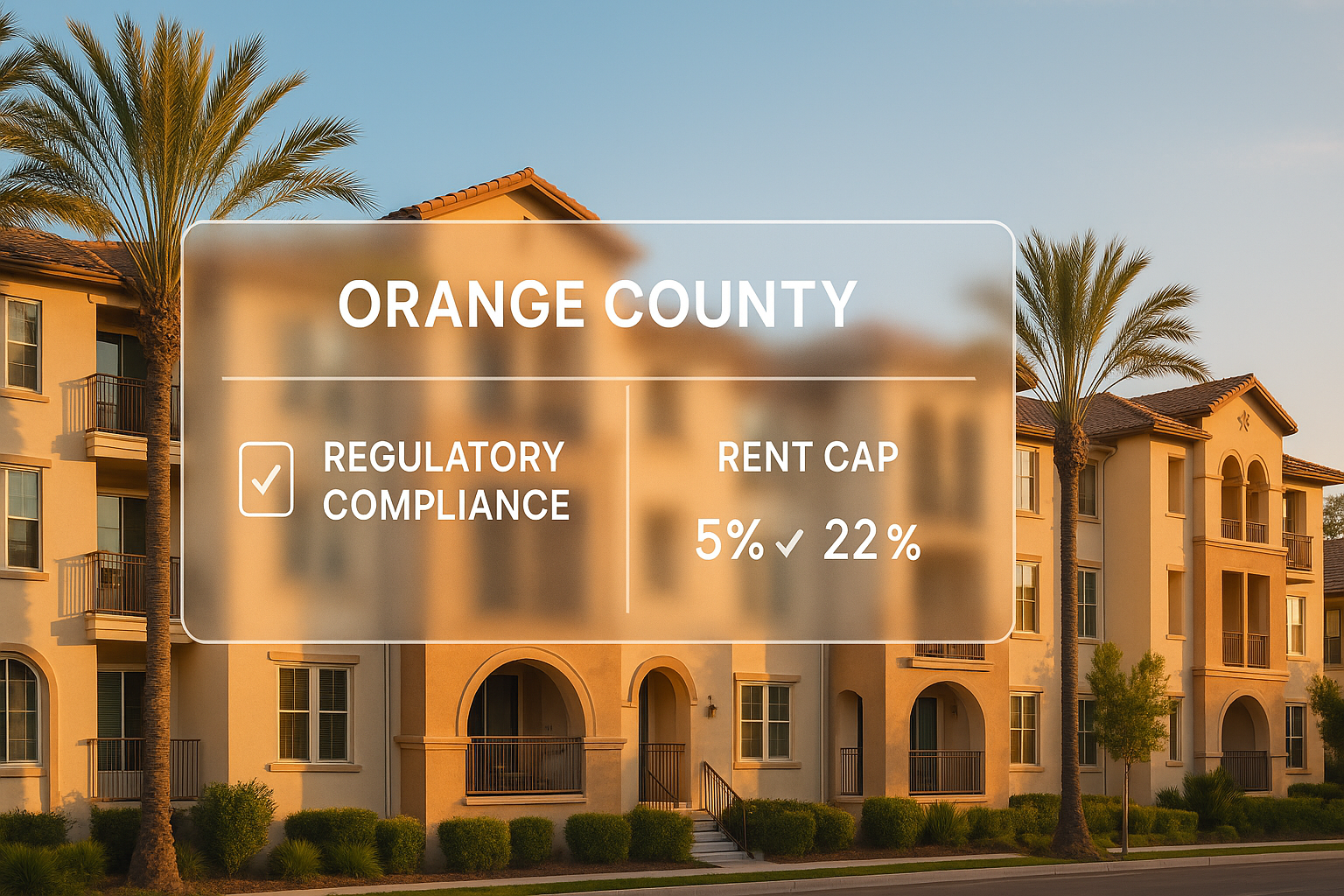
    What Orange County Apartment Owners Need to Know About Californias 2026 Regulatory Wave

    Key Takeaways

    • AB 1482 applies to most OC multifamily owners regardless of local rent control status — the 2026 Southern California CPI adjustment puts the Orange County cap at approximately 8.8% for covered units, and just-cause eviction requirements kick in after 12 months of tenancy
    • Single-family and condo owners must actively claim their AB 1482 exemption in writing — if you have not served the Civil Code § 1946.2(e) notice, your property may be inadvertently subject to both the rent cap and just-cause protections
    • AB 2801 now requires timestamped photos at move-in, move-out, and post-repair — landlords without documentation are losing security deposit disputes they would have won under the prior law
    • The lowest-rent-in-12-months trap is catching owners who gave concessions — any temporary rent reduction resets your AB 1482 baseline downward, potentially below what you were collecting before the concession
    • Santa Ana operates its own ordinance with a 3% annual cap, rent registry, and relocation assistance requirements — stricter on every dimension than AB 1482; if you own there, the local ordinance is your primary constraint
    • Anaheim has no local ordinance today but council activity is increasing — owners with significant exposure should monitor proceedings through 2026 and into 2027 as the regulatory environment shifts county-wide

    Orange County landlords have long operated under a different set of assumptions than their counterparts in Los Angeles or the Bay Area. No local rent control. No just-cause-at-will. Cities like Irvine, Anaheim, and Huntington Beach have historically kept their hands off the landlord-tenant relationship in ways that Sacramento and San Francisco simply have not. If you own apartments in OC, that mindset is largely still correct — but the word "largely" is doing a lot of work in 2026.

    Three significant state laws took effect or are now being enforced more aggressively this year. One OC city has already passed its own rent stabilization ordinance. Another is watching legislation closely. And the statewide regulatory pipeline is fuller than it has been in a decade: as of mid-2026, California has 191 active rent control and tenant protection bills moving through the legislature. Not all will pass. But the direction of travel is clear.

    This article covers what OC apartment owners need to understand right now — not eventually, not when it affects you — now.

    AB 1482 Applies to You. Yes, You.

    The most common misconception among Orange County owners is some version of: "We don't have rent control here." And that's mostly true at the local level. But AB 1482 — the Tenant Protection Act of 2019 — is a state law, and it applies across California regardless of what your city council has or hasn't done.

    Under AB 1482, if your property is covered:

    • Annual rent increases are capped at 5% plus local CPI, with a hard ceiling of 10%. For 2026, the Southern California CPI adjustment puts the OC cap at approximately 8.8% for most covered units. That number changes annually.
    • Just-cause eviction is required after a tenant has lived in the unit for 12 months. You cannot end a tenancy without one of the enumerated reasons — non-payment, lease violation, owner move-in, substantial remodel, etc.

    Both provisions apply together. You don't get one without the other.

    What's covered: Multifamily buildings with 15 or more units, condos, and single-family homes owned by corporations or LLCs where the owner is not an individual. Buildings constructed within the past 15 years are exempt. The 15-year rolling window means a building that was exempt last year may be covered this year.

    What's not covered: Single-family homes and condos owned by individual landlords — but only if you've served the proper written exemption notice. More on that below.

    The Single-Family Exemption: You Have to Claim It

    This is the mistake that catches OC landlords off guard more than any other.

    If you own a single-family home or condo and rent it out as an individual (not through a corporate entity), AB 1482 provides a full exemption — from both the rent cap and just-cause requirements. But the exemption is not automatic. California requires that you serve tenants with a written notice stating that the property is exempt.

    The required language is specified in Civil Code Section 1946.2(e):

    "This property is not subject to the rent limits imposed by Section 1947.12 of the Civil Code and is not subject to the just cause requirements of Section 1946.2 of the Civil Code. This does not affect any local jurisdiction's ability to adopt or maintain any rent control ordinance."

    If you have not served this notice, and you've been operating under the assumption that your single-family rental is automatically exempt, you may have inadvertently subjected yourself to AB 1482's protections without knowing it. Tenants can and do raise this in eviction proceedings.

    What to do: If you haven't served the exemption notice, serve it now with a lease amendment or addendum. For new tenants, include it in the lease itself. This is not optional paperwork — it is the legal mechanism for claiming the exemption.

    The "Lowest Rent in 12 Months" Trap

    Here is one of the most consequential traps in AB 1482 for owners who've been raising rents irregularly.

    The rent cap calculation doesn't use whatever rent you're currently charging. It uses the lowest rent charged in the preceding 12 months. If you gave a tenant a concession, a temporary reduction, or a COVID-era discount at any point in the last year, that lower number becomes your baseline for the cap calculation — not the amount you've actually been collecting.

    Example: Your unit normally rents for $2,400. In January, you gave the tenant a $300 rent reduction for two months because they lost work. By July, you want to raise rent. Your AB 1482 cap calculation starts from $2,100 — the lowest rent charged in the prior 12 months — not $2,400. At an 8.8% cap, that's a maximum increase to $2,285, which is actually below what you were collecting before the concession.

    The lesson: document every concession in writing as a temporary one-time discount, not a rent reduction. Your lease should reflect the actual contract rent, with a separate addendum for any temporary accommodation.

    AB 2801: Photo Documentation Is Now the Law

    AB 2801 took effect January 1, 2025, and Orange County landlords — particularly the roughly 80% of individual rental owners who self-manage their properties — are underexposed to this requirement.

    The law requires landlords to photograph rental units at three specific points in time:

    1. Before a new tenancy begins (prior to tenant move-in)
    2. At move-out, after the tenant has vacated and before any repairs or cleaning
    3. After any repairs or cleaning for which you intend to make deductions from the security deposit

    The photographs must be taken before returning the security deposit or serving an itemized statement of deductions. This isn't a best practice or a recommendation — it is a statutory requirement. Failure to comply limits your ability to make security deposit deductions.

    For OC landlords accustomed to paper walk-through forms and handshake move-outs, this is a material change. Courts are beginning to see these cases, and landlords without timestamped photo documentation are losing deposit disputes they would have won under the old rules.

    Practical guidance: Use your phone, but use it systematically. Photograph every room, every wall, every appliance, every cabinet interior. Store the photos with timestamps in a folder organized by unit and date. Cloud storage with automatic date metadata is sufficient — you don't need specialized software, though it helps for organization at scale.

    AB 12: Application Fee Caps Are Tighter Than You Think

    Effective July 2024 and continuing into 2026, AB 12 significantly tightened the rules around rental application fees.

    The maximum application fee is now capped at the actual, documented cost of a tenant screening report — not a fixed dollar amount. If you use a screening service that charges $32, you may charge $32. If you use one that charges $45, you may charge $45. You may not charge a flat $65 "application fee" and pocket the difference.

    Additionally:

    • You must provide applicants with a receipt showing exactly what their fee paid for.
    • If you receive more applications than you can screen, you must refund the fees of applicants you did not screen.
    • You may not charge an application fee at all if you know the unit is not available.

    The refund requirement catches owners who run competitive application processes. If you accept five applications and screen only two, you owe refunds to the three you didn't process. This is not widely understood among self-managing landlords.

    Santa Ana's Rent Stabilization Ordinance: The Local Layer

    Within Orange County, Santa Ana stands apart. The city passed a Rent Stabilization and Just Cause for Eviction Ordinance that went into effect in 2023 and has been operative since. If you own property in Santa Ana, you're operating under both state law (AB 1482) and the local ordinance — and where they conflict, the more protective provision typically governs.

    Provision AB 1482 (Statewide) Santa Ana Ordinance
    Annual rent cap 5% + CPI (up to 10%); ~8.8% for OC in 2026 3% per year, or 80% of CPI — whichever is lower
    Coverage Multifamily 15+ units; buildings over 15 years old Units built before 1995 — captures many older OC properties
    Relocation assistance Required for no-fault just cause (one month's rent) Required for owner move-in and substantial remodel — may exceed AB 1482 minimums
    Registration requirement None Yes — covered landlords must register units and pay annual fee

    If you own in Santa Ana, the local ordinance is your primary operating constraint. AB 1482 sets a floor that the city ordinance builds upon.

    Anaheim: A City to Watch

    Anaheim does not currently have a local rent control or rent stabilization ordinance. But the city has seen increasing tenant advocacy activity, and several council members have openly discussed studying local protections. Anaheim's rental stock is substantial — the city has one of the largest concentrations of older apartment inventory in the county, with a significant portion of units built before 1980.

    If Anaheim were to pass a local ordinance, it would follow the same pattern as Santa Ana: a city-level cap on top of AB 1482, with potentially broader coverage and registration requirements. Owners with significant Anaheim exposure should watch city council proceedings through 2026 and into 2027.

    This is not a prediction that Anaheim will act. It is a flag that the political environment in the county's second-largest city is more active than it has been in years.

    Just-Cause Eviction: The 12-Month Threshold

    Under AB 1482, a tenant who has continuously occupied a covered unit for 12 months becomes entitled to just-cause eviction protections. Prior to the 12-month mark, you can terminate a tenancy with proper notice for any lawful reason. After it, you need one of the enumerated just-cause grounds.

    The enumerated grounds fall into two categories:

    At-Fault Just Cause (tenant has done something wrong)

    • Non-payment of rent
    • Breach of a material lease term
    • Maintaining a nuisance
    • Unauthorized subletting
    • Criminal activity on the premises

    No-Fault Just Cause (owner is ending the tenancy for legitimate business reasons)

    • Owner or immediate family member moving in
    • Withdrawal of the unit from the rental market (Ellis Act)
    • Compliance with a government order requiring vacancy
    • Intent to demolish or substantially remodel

    The no-fault grounds come with relocation assistance requirements — generally one month's rent paid to the tenant.

    The 12-month clock resets if tenancy ends and a new lease begins. Some owners have attempted to use lease non-renewals at the 12-month mark to avoid just-cause protections. Courts and the California legislature are both aware of this strategy, and it is increasingly risky.

    Your Compliance Checklist for 2026

    For OC apartment owners, here is the practical checklist that applies right now:

    1. Audit your portfolio for AB 1482 coverage. Check each property's build date. Confirm whether entities or individuals hold title.
    2. Serve single-family exemption notices for any individual-owned SFR or condo where you haven't done so.
    3. Review your last 12 months of rent history for each covered unit before setting any increase. Use the lowest-rent figure as your baseline.
    4. Implement an AB 2801 photo protocol for all move-ins and move-outs. If you moved tenants in this year without photos, document current condition now.
    5. Update your application fee process to charge only actual screening costs, with receipts, and implement a refund workflow for unscreened applicants.
    6. If you own in Santa Ana, confirm your registration status and review your rent history against the 3%/CPI cap — not the AB 1482 cap.

    You can run a free compliance check on your specific property and rent situation at LeaseBase Compliance Check. For AB 1482 rent cap calculations specific to your unit, the AB 1482 Calculator walks through the baseline and allowable increase based on your property's location and history.

    The OC Outlook for 2027

    Orange County's regulatory environment in 2027 will be shaped by three forces:

    The State Pipeline

    With 191 active rent control and tenant protection bills in the legislature, some portion will pass. The most likely near-term additions involve expanded relocation assistance requirements, stricter application screening rules, and potentially broader AB 1482 coverage thresholds. OC owners should assume the statewide floor will rise.

    Local Organizing

    The Santa Ana ordinance demonstrated that OC cities can and will act when tenant advocacy reaches a threshold. Anaheim is the most visible next candidate, but Garden Grove, Fullerton, and Westminster have older rental stock and growing tenant populations. Whether any of these cities act depends heavily on local electoral outcomes in November 2026.

    The Court Record

    AB 1482 enforcement is moving from the legislature into the courts. Case law on the single-family exemption notice, the lowest-rent baseline, and just-cause standards is accumulating. The rules that seemed abstract when the law passed are becoming concrete through litigation. Landlords who haven't updated their practices will increasingly find themselves litigating on unfavorable terrain.

    The foundational OC reality hasn't changed: you are not San Francisco. Most of your cities have not layered local ordinances on top of state law. The political culture here is more property-rights-friendly than the Bay Area. But the state laws that do apply are being enforced more rigorously, the compliance obligations are more specific than many owners realize, and the window for treating these as optional or theoretical is closing.

    Getting current in 2026 is cheaper than getting corrected in 2027.


    Disclaimer: This article is for informational purposes only and does not constitute legal advice. California landlord-tenant law is complex and changes frequently. The information presented reflects laws and regulations as of July 2026 and may not account for subsequent legislative or regulatory changes. Consult a licensed California real estate attorney for guidance specific to your property, jurisdiction, and situation. LeaseBase's compliance tools provide informational guidance and do not substitute for professional legal counsel.

    Sources: California AB 1482 (Civil Code §§ 1946.2, 1947.12); AB 2801 (Civil Code § 1950.5); AB 12 (Civil Code § 1950.6); Santa Ana Rent Stabilization and Just Cause for Eviction Ordinance (Santa Ana Municipal Code § 8-3140 et seq.); Orange County Assessor-Recorder-Clerk 2025 Property Data; U.S. Census Bureau 2023 American Community Survey, Orange County Housing Characteristics; California Legislative Information, 2025–2026 Session Bill Tracker.

  • The 2026 Compliance Calendar Every California Landlord Needs: 191 Active Bills and What Actually Matters

    The 2026 Compliance Calendar Every California Landlord Needs: 191 Active Bills and What Actually Matters

    Key Takeaways

    • 191 active bills are moving through the California legislature in 2026 — the volume and specificity of new landlord-tenant legislation this session is unprecedented for self-managing owners
    • AB 1482 rent caps have two traps that cost landlords money every year — the "lowest rent in 12 months" baseline rule and the requirement to serve a written exemption notice before relying on single-family/condo exemptions
    • AB 2801 photo documentation is now legally required — pre-move-in and post-move-out photos must be taken before any repairs are made; skipping this step can void your right to withhold from the security deposit
    • Three 2026 laws took effect January 1 — AB 747 (fee disclosure in listings), AB 628 (appliance habitability), and the ongoing enforcement of AB 12 (application fee caps) all require immediate action
    • State law is the floor, not the ceiling — more than 60 California municipalities have stricter local ordinances; landlords must track both state and city rules simultaneously
    • The legislative direction is consistent — more documentation requirements, tighter timelines, and expanded habitability definitions are coming; building robust workflows now is the only sustainable approach

    If you've been managing your own properties for any length of time, you already know that California landlord law doesn't sit still. But 2026 is a different kind of year. As of this writing, there are 191 active rent control and landlord-tenant bills moving through the California legislature — 71 of them introduced since January alone. That's not a trend. That's a pressure campaign.

    This isn't a lawyer's memo. It's a practical calendar for working landlords — the 80% of us who are owner-managing our own properties (Census Bureau, 2024) and making these compliance decisions ourselves. The 54% of self-managing landlords who cite PM cost as the primary reason they haven't outsourced (UC Berkeley Terner Center) know what it's like to wear every hat. This article is for you.

    Below you'll find the bills that matter most right now, when they bite, and what you need to do before they do.

    The Landscape: Why 2026 Feels Different

    California has always been a tenant-protective state. But the current legislative session has accelerated in both volume and specificity. Where past years produced a handful of headline bills, 2026 is generating a web of interlocking obligations — move-in documentation, fee disclosure, deposit timelines, appliance standards, application cost caps — that together raise the compliance floor significantly for anyone renting residential units.

    Layered on top of that: more than 60 California municipalities now maintain their own local ordinances that go beyond state law. Cities like Los Angeles, San Francisco, Oakland, San Jose, and Santa Monica have long-standing rent control frameworks. But newer ordinances in Culver City, Glendale, Pasadena, Long Beach, and dozens of other cities have added another tier of local rules that frequently conflict with or exceed state minimums. If you own property in multiple jurisdictions — or even in one city with a patchwork of regulations — you're navigating a compliance matrix that didn't exist five years ago.

    Here's what's on the calendar.

    AB 1482 — The Rent Cap That Still Trips People Up

    Status: Active law (effective January 1, 2020), annual recalibration
    2026 cap: CPI + 5%, not to exceed 10%

    AB 1482 (the Tenant Protection Act) is now six years old, but it keeps generating expensive mistakes. The formula is simple to state — rent increases are capped at the lower of 5% plus local CPI, or 10% — but the implementation has two traps that catch landlords every year.

    Trap 1: The "Lowest Rent in 12 Months" Baseline

    If you gave a tenant a temporary concession at any point in the last 12 months — a reduced month, a COVID accommodation that wasn't formally lifted, a "first month discount" — you may be stuck calculating your increase off that lower number, not the current rent. The law requires the increase to be calculated from the lowest rent charged in the 12 months preceding the increase, not the rent on the current lease. Landlords who discover this after sending a notice are usually forced to rescind and recalculate, and in some jurisdictions, that triggers additional noticing requirements.

    Trap 2: Exemptions Aren't Automatic Protection

    Single-family homes and condos can be exempt from AB 1482 — but only if you've served tenants with the required written exemption notice. If you haven't, the property may be treated as covered regardless of its actual eligibility. The California Department of Consumer Affairs has published template language, but you need to have delivered it.

    Who is NOT covered: Properties built within the last 15 years, single-family homes and condos with proper exemption notices served, and units subject to stricter local rent control ordinances (where local law governs instead).

    Action item: Before issuing any rent increase notice in 2026, pull your rent payment history for the past 13 months. Confirm your baseline. Confirm your local CPI figure (the California CPI for the relevant metropolitan area, published by the California Department of Finance). And confirm your property's exemption status is documented.

    AB 2801 — Move-In and Move-Out Photo Documentation

    Status: Effective July 1, 2025 (compliance now required)
    Penalty exposure: Loss of right to withhold from security deposit

    AB 2801 formalized what many experienced landlords were already doing informally: photographing unit condition at move-in and move-out. But "formalized" means there are now procedural requirements that determine whether your documentation actually holds up.

    The law requires landlords to:

    • Photograph the unit before the tenant moves in (prior to occupancy)
    • Photograph again after the tenant moves out, before any repairs are made
    • Provide the tenant with an itemized statement of deductions along with the relevant photographs within 21 days of move-out

    The critical sequence is the "before repairs" requirement. If you make repairs before photographing, you lose the documentary chain. Many landlords have historically photographed after cleaning or minor repairs — that practice now undermines deposit claims.

    Action item: Build the photo workflow into your move-out process before you touch anything. Timestamped photos on a smartphone with GPS tagging are sufficient. Store them somewhere retrievable — not just your camera roll.

    AB 12 — Application Fee Caps

    Status: Effective January 1, 2024 (enforcement ongoing in 2026)
    Cap: Actual cost of screening report, not to exceed $65 (adjusted annually for CPI)
    Penalty: Fees collected above the cap must be refunded

    AB 12 changed how landlords can handle application fees. The cap is set at the actual cost of the credit/background screening report, not to exceed $65 (the 2024 baseline, subject to CPI adjustment). You can only charge what you actually spend.

    The practical implications that still trip up landlords:

    • You must provide a copy of the screening report to the applicant if you're charging for it
    • If you don't run a credit check (e.g., you already filled the unit), you cannot charge the application fee at all
    • Collecting a flat fee above the cap — even inadvertently — creates a refund obligation

    Action item: If you're using a rental application form with a fixed fee printed on it, update it. The fee must reflect your actual cost for that applicant's screening report, and it should be variable or clearly tied to third-party cost.

    AB 747 (SPARE Act) — Fee Disclosure Requirements

    Status: Effective January 1, 2026
    Applies to: Residential rental listings

    The SPARE Act (AB 747) requires that rental listings disclose all mandatory fees upfront — no more advertising a base rent with fees buried at signing. If your unit comes with mandatory parking, pet fees, trash, or other charges that are not optional, those fees must appear in the advertised rent or be clearly disclosed alongside it in any listing.

    This applies to listings on Zillow, Craigslist, your own website, or anywhere you advertise units for rent. The intent is to eliminate "junk fee" surprises at lease signing.

    Action item: Audit your active listings. Any fee that a tenant must pay to rent the unit should be in the advertised total or explicitly disclosed beside it. If you're using a property management platform or listing syndication service, verify that your listings are surfacing these fees correctly — the obligation is yours, not the platform's.

    AB 414 — Electronic Security Deposit Returns

    Status: Effective January 1, 2025 (compliance ongoing)
    Timeline: 21 days after move-out; itemized statement required
    New wrinkle: Electronic payment now explicitly authorized for deposit returns

    AB 414 didn't change the 21-day security deposit return deadline, but it did something practically significant: it explicitly authorized landlords to return security deposits via electronic payment (Venmo, Zelle, ACH, etc.) without needing a separate written agreement from the tenant.

    Previously, the safest approach was a mailed check. Now, if you have the tenant's electronic payment details, you can wire the deposit return directly and maintain a cleaner paper trail. The itemized statement still must accompany the return.

    What's unchanged: The 21-day deadline. Miss it and you lose the right to withhold for damages, full stop. Courts have been consistent here for decades.

    Action item: Add a move-out package to your workflow that includes a deposit return form collecting the tenant's preferred payment method. It streamlines the process and timestamps your compliance.

    AB 628 — Appliance Habitability Standards

    Status: Effective January 1, 2026
    Applies to: Residential rental units
    Key change: Expands the definition of "habitable condition" to include functioning built-in appliances

    AB 628 broadens California's implied warranty of habitability to cover built-in appliances — specifically appliances that are included in the lease and advertised as part of the unit. If you lease a unit with a dishwasher, refrigerator, or range included, those appliances must be maintained in working order.

    This is not about optional appliances a tenant brings in. It's about appliances you've listed in the lease or advertised as included. If a refrigerator breaks, you now have a statutory obligation to repair it within a reasonable timeframe — not just a lease obligation, but a habitability obligation. The difference matters because habitability violations have broader legal exposure.

    Action item: Review your leases. If you're including appliances, confirm they're in working order at move-in (document it with AB 2801 photos). Consider whether you want to include appliances in the lease at all, or whether a separate addendum noting "appliances provided as a courtesy, not guaranteed" is appropriate — though this approach may not fully insulate you under AB 628 if the appliance is built-in and advertised.

    Your 2026 Compliance Action Calendar

    When Action
    Now Pull rent history for all units; verify AB 1482 baselines before any increases
    Now Audit all active listings for SPARE Act (AB 747) fee disclosure compliance
    Now Review all appliance inclusions in leases against AB 628 standards
    Q3 2026 Confirm AB 1482 exemption notices are on file for all eligible properties
    Before next move-in Implement AB 2801 photo workflow: pre-occupancy photos, post-vacate photos before repairs
    Before next application Update application fee to reflect actual screening cost under AB 12 cap
    Before next move-out Collect tenant's preferred payment method for AB 414 electronic deposit return
    Ongoing Track your municipality's local ordinance — state law is the floor, not the ceiling

    For a property-specific compliance check, the free tool at leasebase.ai/compliance-check covers AB 1482 eligibility, local ordinance layers, and current CPI figures by metro area.

    The 60+ Municipality Problem

    State law sets the floor. Local ordinances set their own ceiling.

    In jurisdictions with rent stabilization ordinances — Los Angeles, San Francisco, Oakland, Berkeley, Santa Monica, West Hollywood, and a growing list of others — the permissible rent increase, just cause eviction requirements, and relocation assistance obligations often exceed what state law requires. AB 1482 doesn't preempt stricter local rules. Local rules govern where they're stricter.

    This means a landlord with properties in three different Bay Area cities may be operating under three different permissible rent increase formulas, three different just cause eviction standards, and three different notice requirements — all simultaneously.

    The practical consequence: you cannot manage compliance at the state level alone. If you own property in any city with a rent ordinance, you need to know that city's specific rules, not just the AB 1482 framework. Many CAA members already navigate this. But as more cities adopt ordinances — and the current legislative session is producing pressure on cities to do so — the patchwork is expanding, not contracting.

    What's Coming in 2027

    The 191 active bills in 2026 are not the end of the cycle. Several bills currently moving through committee are worth tracking for their likely 2027 effective dates.

    Just Cause Expansion Proposals

    Multiple bills are advancing that would tighten the qualifying grounds for no-fault evictions, extend relocation assistance requirements, and in some versions, apply just cause protections earlier in the tenancy (some proposals would trigger protections at 90 days rather than the current 12 months under AB 1482).

    Rent Registry Requirements

    Several municipalities have adopted or are considering rent registries — systems requiring landlords to register units and report rents annually. A state-level framework for rent registries has been discussed. If it advances, it would create a new administrative layer for every covered unit.

    Tenant Notice Period Extensions

    Bills in early stages would extend required notice periods for rent increases above a threshold (currently 30 days for increases under 10%, 90 days for increases of 10% or more). Proposals would extend these timelines, with some advocates pushing for 120-day notice on any increase.

    Short-Term Rental Overlay Legislation

    For landlords with any units that have been listed on Airbnb or VRBO, additional disclosure and tax compliance legislation is in committee. Local ordinances on short-term rentals have already been aggressive; state-level frameworks are following.

    The through-line in all of this is direction: the legislative environment is moving consistently toward more documentation requirements, tighter timelines, broader habitability definitions, and expanded tenant protections. Building robust internal processes now — not scrambling to retrofit them when bills pass — is the only sustainable approach.

    Closing Thoughts

    Running your own properties in 2026 California is a high-skill operation. The landlords who stay out of trouble aren't necessarily the ones with the best lawyers on retainer. They're the ones who've built the habits: documenting before and after, adjusting rents off the correct baseline, disclosing fees clearly, and keeping up with the local ordinances that govern their specific properties.

    The 191 bills in play this year won't all pass. But enough of them will — and enough of them already have — that treating compliance as an annual update rather than a continuous practice is increasingly risky.

    The best defense is a good workflow. Build it before you need it.

    Sources: UC Berkeley Terner Center for Housing Innovation; U.S. Census Bureau American Housing Survey (2023); California Department of Consumer Affairs; California Department of Finance (CPI data); Congressional Research Service.


    Disclaimer: This article is for informational purposes only and does not constitute legal advice. California landlord-tenant law is complex and changes frequently. For guidance specific to your situation, your property, or your local jurisdiction, consult a licensed California attorney or qualified property management professional.

  • Washington Annual Rent Increase Ceiling — HB 1217 CPI Formula & Compliance Guide (2026)

    Washington Annual Rent Increase Ceiling — HB 1217 CPI Formula & Compliance Guide (2026)

    Key Takeaways

    • 7% hard cap applies to most Washington rentals — RCW 59.18.140 limits annual increases to the lesser of 7% or the 12-month average CPI-U (Bureau of Labor Statistics Consumer Price Index for All Urban Consumers)
    • CPI-U data released mid-August each year — You must use the official BLS figure published in August to calculate your 2026–2027 increase; using different data sources creates liability exposure
    • 90-day written notice required before increase takes effect — Failure to provide proper notice voids the increase and may trigger tenant retaliation claims under RCW 59.18.240
    • Exemptions exist for new construction and certain properties — Owner-occupied duplexes, single-family homes, and buildings first occupied after June 12, 2019 may fall outside the cap; verify your property status to avoid overreach liability
    • Non-compliance penalties: treble damages up to 3× the unlawful increase plus attorney fees — Tenants can sue under RCW 59.18.140 for violations; small claims court has jurisdiction up to $10,000
    • Documentation and timing errors are the leading landlord compliance failures — Improper notice delivery, wrong CPI figure, or miscalculated percentages expose you to tenant lawsuits even if your intent was compliant

    What Washington's Rent Increase Ceiling Actually Means for Your Portfolio

    On June 12, 2019, Washington State enacted HB 1217, fundamentally changing how landlords calculate annual rent increases. For the first time, the state imposed a hard numerical cap: 7% or the 12-month average CPI-U, whichever is lower. Seven years later, that law remains the controlling statute for most rental properties statewide, and misunderstanding it costs landlords thousands in treble damages and legal fees annually.

    The problem isn't complexity—it's precision. HB 1217 ties your increase to a specific U.S. Department of Labor data point that changes every August. Use last year's figure instead of this year's, round the percentage wrong, or fail to deliver notice 90 days early, and you've violated tenant rights under RCW 59.18.140. Your tenant's attorney will argue the increase was unlawful, demand three times the overcharge, and recover their fees. Washington courts have consistently upheld treble damages for violations, even when landlords acted in good faith.

    This guide walks you through the exact statutory formula, shows you where to find the correct CPI data, explains the notice requirements that bind you legally, and flags the exemptions that might lower your compliance burden.

    Understanding RCW 59.18.140: The Statutory Cap and Its Hard Limits

    Washington's rent increase law is codified in RCW 59.18.140, subsection (2). Read the statute directly first; the law states:

    "A landlord shall not increase the rent for a tenancy or other regular periodic payment due from a tenant for continued occupancy of the same unit without serving a notice of increase in writing at least 90 days before the effective date of the increase. The notice of increase shall be in writing, shall describe the unit, and shall specify the amount of the new rent payment and the effective date of the increase. An increase in rent shall not be effective until the expiration of a tenant's current lease term or rental period."

    Subsection (2) adds the critical cap: rent increases are limited to the percentage increase of the average rent paid on rural multifamily property in the state during the prior 12 months, or 7 percent, whichever is lower. In practice, since 2019, the state has not published consistent rural multifamily rent data, so courts and the Department of Commerce interpret this language to mean the 12-month average CPI-U published by the Bureau of Labor Statistics.

    Let's be precise about what this means:

    • The 7% is a ceiling, not a target. If CPI-U runs 3.2% in a given 12-month period, your lawful increase is 3.2%, not 7%. You do not get to use 7% just because it's allowed.
    • CPI-U is a specific index. It measures inflation for urban consumers. Washington uses the U.S. city average, series CPIAUCSL published by BLS. Substituting a different inflation measure (regional CPI, wage growth, operating cost increases) is not compliant.
    • The 12-month average is calculated from specific months. The BLS publishes CPI-U data monthly. Washington convention (established through guidance from the Department of Commerce) uses the 12-month period ending in August. You calculate the average of the 12 monthly CPI figures from September of the prior year through August of the current year.
    • The cap applies to every increase during the tenancy. Whether you're raising rent in Year 1 or Year 10, the same ceiling applies. There is no "catch-up" provision that lets you exceed 7% later.

    Finding the Correct CPI-U Data: Where the Law and Practice Meet

    This is where many Washington landlords stumble. The BLS publishes CPI-U data on the BLS website (bls.gov) every month, typically in the middle of the month following the data month. August data comes out in mid-September. You must use the correct figure and apply it to the correct rental year.

    Step 1: Identify Your Rent Increase Effective Date

    Rent increases in Washington can only take effect after one of these events:

    • End of a lease term (if the tenant has a written lease)
    • End of a rental period (for month-to-month tenants, typically the end of the month in which notice expires)
    • Mutual agreement (rare; most increases are unilateral and must comply with the cap)

    For example, if you serve notice on May 1, 2026, with an effective date of August 1, 2026, the tenant still has until August 31, 2026 (end of the rental period) before the increase takes effect. This is a common miscalculation: landlords think the increase is effective immediately; it's not.

    Step 2: Determine the Relevant 12-Month CPI-U Average

    Washington uses a calendar approach: the CPI-U average for your 2026–2027 rent increase is the average of the 12 monthly figures from September 2025 through August 2026.

    Here's how to calculate it:

    1. Visit the BLS website: bls.gov/data
    2. Select "Average Energy Prices" or "CPI Database" (depends on BLS interface updates)
    3. Search for series CPIAUCSL (CPI-U, U.S. city average, all items, not seasonally adjusted)
    4. Export the monthly data for September 2025, October 2025, … August 2026 (12 months total)
    5. Add all 12 figures and divide by 12 to get the average
    6. Calculate the percentage change: (Current 12-month average – Prior 12-month average) / Prior 12-month average × 100
    7. Compare that percentage to 7% and use whichever is lower

    Step 3: Calculate Your Lawful Increase Percentage

    Let's use a concrete example. For the 2026–2027 rental year (increases effective September 2026 – August 2027):

    Assume the 12-month CPI-U average for Sept 2025–Aug 2026 is 3.4%. Your lawful increase is 3.4%, not 7%, because 3.4% < 7%.

    If a tenant's current rent is $1,500/month, the new rent is:

    $1,500 × (1 + 0.034) = $1,500 × 1.034 = $1,551 per month

    You must round to the nearest cent. Rounding up beyond what the percentage calculation produces is non-compliant.

    Recent CPI-U Data for Washington Landlords (2024–2026)

    For reference, here are the approximate 12-month CPI-U averages that applied to recent Washington rent increases:

    Period (Sept–Aug) CPI-U 12-Mo Avg Lawful Cap (%) Notes
    Sept 2022–Aug 2023 6.1% 6.1% Post-inflation peak
    Sept 2023–Aug 2024 3.8% 3.8% Inflation cooling
    Sept 2024–Aug 2025 3.2% 3.2% Moderate growth
    Sept 2025–Aug 2026 (est.) 2.8%–3.5% (pending) 2.8%–3.5% (pending) Check BLS in Aug 2026

    Note: These figures are approximations for illustration. Always verify against the official BLS website before calculating increases.

    The 90-Day Notice Requirement: Timing and Legal Consequences

    RCW 59.18.140 mandates written notice "at least 90 days before the effective date of the increase." This is not a suggestion; it's a statutory prerequisite. Serving notice fewer than 90 days before the increase takes effect renders the increase void and exposes you to liability.

    What Counts as "90 Days"?

    Washington courts interpret this as a calendar calculation. If you serve notice on May 1, the 90-day period expires on July 30 (89 full days plus August 1). The increase cannot be effective until August 1 at the earliest. For month-to-month tenants, this usually means the increase is effective on the first day of the month after the 90-day period expires.

    Example timeline:

    • June 1, 2026: You serve written notice of rent increase
    • August 29, 2026: 90-day period expires
    • September 1, 2026: Earliest effective date for the increase (first day of month following notice period)
    • September 30, 2026: Rent increase reflects on the tenant's next rent payment

    How to Serve Notice Legally

    The notice must be in writing and must specify:

    1. The unit address or other clear identification
    2. The current rent amount
    3. The new rent amount
    4. The effective date of the increase
    5. The calculation (optional but recommended for compliance transparency)

    Service methods that satisfy Washington law:

    • Hand delivery to the tenant or authorized occupant at the unit
    • Certified mail to the tenant's mailing address on file (recommended; creates proof of service)
    • Email if the lease or prior written communications show the tenant agreed to email service
    • Posting at the unit door (permissible if personal delivery is impossible; supplement with mail to ensure compliance)

    Keep proof of service. If a tenant later disputes the increase, you'll need to prove you served notice at least 90 days before the effective date. A certified mail receipt or signed delivery confirmation is your best defense.

    Non-Compliance Consequences

    If you increase rent without proper 90-day notice, the increase is void. The tenant can withhold the increase and you cannot evict for non-payment of the (unlawful) higher rent. Additionally, under RCW 59.18.140(4), a tenant can sue for treble damages (three times the unlawful increase) plus actual damages, court costs, and attorney fees.

    Example: You illegally increased rent by $100/month without 90 days' notice. The tenant paid the increase for 6 months ($600). The tenant sues and wins. Judgment: $600 × 3 = $1,800 in treble damages, plus attorney fees (likely $2,000–$5,000 for a simple case), plus court costs. Total liability: ~$4,000+.

    Exemptions: Properties Not Subject to the Rent Cap

    Not all Washington rentals are subject to HB 1217's cap. Understanding exemptions prevents you from under-charging and missing revenue opportunities where the law permits higher increases.

    Exempt Property Types

    According to RCW 59.18.140(3), the rent increase cap does NOT apply to:

    • Single-family homes or duplexes occupied by the owner — If you live in one unit of a duplex you own, the other unit is exempt. If you live in a single-family home you rent out, the exemption likely does not apply (courts interpret this narrowly). Consult an attorney if your occupancy status is ambiguous.
    • Accessory dwelling units (ADUs) in single-family residential zones — If you have a detached cottage or ADU on your residential property, it may be exempt. Check your local zoning to confirm the ADU meets state definitions.
    • Housing units first occupied after June 12, 2019 — New construction completed after the law's effective date has no cap for 5 years from first occupancy. After that, the cap applies. This exemption is time-limited, so track your building's initial occupancy date.
    • Housing subject to other affordability restrictions or public funding — Properties receiving federal Low-Income Housing Tax Credit (LIHTC), state funding, or local rent-control ordinances may have separate caps or exemptions. Do not assume; verify with your program administrator.
    • Mobile home communities — Lot rentals in manufactured home parks are subject to RCW 59.20.030, not RCW 59.18.140. Different notice and cap rules apply; this article does not cover those.

    Verify Your Property Status

    If you think your property is exempt, document the basis. Keep records of:

    • Property deed showing owner-occupied status (for duplexes)
    • Certificate of occupancy or final inspection dates (to confirm first occupancy after June 12, 2019)
    • Zoning verification letter from your city (for ADUs)
    • Proof of any affordability restrictions or public funding agreements

    If a tenant disputes your exemption claim and you lack documentation, you'll bear the burden of proof. Courts side with tenants when landlord records are incomplete.

    Practical Compliance Checklist: Steps to Take Before Every Increase

    To ensure you stay compliant with HB 1217, follow this checklist every time you plan a rent increase:

    Task Deadline/Timing Compliance Notes
    1. Verify property exemption status Before any increase Confirm unit is not exempt under RCW 59.18.140(3). If exempt, no cap applies; if not, proceed to step 2.
    2. Get the official CPI-U data Mid-August each year Visit bls.gov, series CPIAUCSL. Download 12 months of data (Sept prior year – Aug current year). Calculate the average.
    3. Calculate the lawful cap Within 1 week of CPI release Use whichever is lower: your CPI-U % or 7%. Round to nearest 0.1% for clarity in notice.
    4. Calculate the new rent amount Immediately after step 3 Multiply current rent by (1 + cap %). Round to nearest cent. Do NOT round up beyond calculation.
    5. Draft the notice Before service Include unit address, old rent, new rent, effective date, and calculation. Use plain language. Keep a copy.
    6. Serve notice (certified mail) 90+ days before effective date Use certified mail with signature confirmation. Effective date cannot be before end of current rental period AND 90 days after service.
    7. Store proof of service Immediately after mailing Keep certified mail receipt, delivery confirmation, and signed copy of notice in tenant file. Maintain for 3+ years.
    8. Track payment and document acceptance On effective date and ongoing Record when tenant pays the new amount. If tenant disputes, your records prove timely notice and proper calculation.

    Common Mistakes Washington Landlords Make (and How to Avoid Them)

    Mistake 1: Using the Wrong CPI-U Figure or Time Period

    The problem: A landlord serves notice in October 2026 with an effective date of January 2027. They calculate the increase using September 2025–August 2026 CPI-U data (3.2%). But that's incorrect for a January 2027 increase; they should use September 2026–August 2027 data (not yet published). The tenant sues, claims the wrong CPI was used, and the court may void the increase entirely.

    How to avoid it: Plan increases for late summer or early fall (September through November). This aligns with the August CPI release and eliminates the ambiguity of which CPI period applies. If you must increase in other months, use the most recent 12-month CPI average available at the time you serve notice, and document that date in the notice.

    Mistake 2: Rounding Errors or Using Rounded Percentages Inconsistently

    The problem: CPI-U comes in as 3.245%. A landlord rounds this to 3.25%, then calculates the rent increase. Later, a tenant's attorney argues the landlord should have used 3.2% (rounded down, not up). Small dispute, but the cumulative error over many tenants or units adds up.

    How to avoid it: Use the exact percentage from BLS to two decimal places. Apply it consistently. Round the final rent dollar amount to the nearest cent, not the percentage. Document your calculation in the notice so there's no ambiguity.

    Mistake 3: Failing to Provide 90-Day Notice or Serving Notice Late

    The problem: A landlord wants to increase rent effective June 1. They serve notice on March 10. That's only 82 days before June 1. The increase is void. If the tenant withholds the increase and the landlord tries to evict for non-payment, the tenant's attorney raises the notice defect and the court dismisses the eviction.

    How to avoid it: Set a calendar reminder for 95 days before your planned effective date. Serve notice certified mail at least 96 days before the effective date (to account for mail delivery time). The effective date must also coincide with the end of a rental period (for month-to-month tenants, the last day of the month).

    Mistake 4: Increasing Exempt Properties as If They Were Capped

    The problem: A landlord owns a new duplex built in 2020. They mistakenly believe the cap applies and increase rent by only 3.2% when they could have increased it by 10% (or more). They lose revenue unnecessarily.

    How to avoid it: Audit your portfolio annually. List each property with its exemption status. Use a spreadsheet or property management system (like LeaseBase's portfolio management tools) to flag exempt vs. capped units. If you're unsure, have an attorney confirm before finalizing the increase.

    Mistake 5: Not Documenting the Notice or Proof of Service

    The problem: A landlord serves notice of increase but doesn't keep a copy. Months later, the tenant claims notice was never received. The landlord has no proof of service and cannot defend against a retaliation or breach claim. Small claims court sides with the tenant.

    How to avoid it: Always use certified mail with signature confirmation or hand-deliver notice and get a signed receipt. Keep the original notice, certified mail receipt, and delivery confirmation in a tenant file folder (physical or digital). Maintain these records for the entire tenancy plus 3 years after move-out.

    Retaliation Risk: Rent Increases as Tenant Retaliation Triggers

    Washington law prohibits landlord retaliation under RCW 59.18.240. If a tenant has exercised a legal right (such as complaining about habitability or requesting repairs), a landlord cannot retaliate by increasing rent, decreasing services, or threatening eviction within one year of the protected act.

    Risk scenario: Tenant complains about mold on May 1, 2026. You fix it by June 1, 2026. On July 15, 2026, you serve a rent increase notice effective September 1, 2026. The increase is lawful under HB 1217 (proper notice, correct CPI). But the tenant argues it's retaliation because it occurred within one year of the complaint. You must prove the increase was not motivated by the complaint. Without documentation of your decision-making process, the burden falls on you, and the court may void the increase and award damages.

    How to avoid retaliation claims:

    • Wait 12+ months after a tenant complaint before serving an increase notice if possible
    • If you must increase rent soon after a complaint, document in writing that the increase was scheduled before the complaint or is part of a routine annual increase schedule
    • Apply increases uniformly across your portfolio, not selectively to complaining tenants
    • Use written increase policies and schedules to show the increase was not retaliatory

    RCW 59.18.240 creates a rebuttable presumption of retaliation if an adverse action (like an increase) occurs within one year of protected activity. You must overcome that presumption with clear evidence.

    How to Stay Compliant: Technology and Documentation Systems

    Compliance requires tracking CPI data, calculating percentages, managing notice deadlines, and storing proof of service. Many self-managing landlords track this in spreadsheets, which is error-prone. Consider using tools designed for compliance:

    • Rent payment tracking: Log each month's rent on rent payment platforms that automatically flag overdue payments and calculate what tenants owe. Knowing exact rent amounts helps you avoid calculation errors.
    • Lease operations management: Lease operations tools help you schedule lease renewal dates and flag when rent increases should be considered. This prevents missed deadlines.
    • Compliance engines: Some platforms now include compliance engines that track state rent control laws, automatically calculate HB 1217 increases based on BLS data, and generate compliant notices. This removes the manual calculation burden.
    • Analytics and reporting: Reporting tools let you compare rent levels across units and identify which properties should be increased and by how much, ensuring you capture revenue where the law permits.

    For detailed product information, visit the LeaseBase platform overview or explore how compliance agents can automate notice generation and deadline management.

    Frequently Asked Questions About Washington Rent Increases

    Q: Can I increase rent more than once per year if the lease is up for renewal?

    A: No. RCW 59.18.140 caps any increase at the lesser of 7% or CPI-U per 12-month period. Even if you have two lease renewals in one calendar year (unusual), each increase must comply with the cap. However, if a tenant's lease ends and they vacate, you can negotiate a higher rent with the next tenant (the cap applies to existing tenancies, not new market-rate leases with new tenants). Verify the exact language with an attorney if you plan to substantially increase rent between tenants.

    Q: What if I miscalculated the CPI percentage and charged too much rent for months before I realized the error?

    A: You likely owe the tenant the difference plus statutory interest. Depending on how long the overage continued, you may face a claim for restitution, treble damages, and attorney fees. Contact an attorney immediately to calculate exposure and develop a remediation plan (e.g., offering a refund or rent credit). Transparency often limits damages; ignoring the error and hoping the tenant doesn't notice is high-risk.

    Q: Do I have to use certified mail for the rent increase notice, or

  • Oregon Rent Increase Limits: Calculate Your Allowable % by CPI — Landlord Compliance Guide (2026)

    Oregon Rent Increase Limits: Calculate Your Allowable % by CPI — Landlord Compliance Guide (2026)

    Key Takeaways

    • Oregon rent increases are capped by CPI percentage under ORS 90.323(2) — for month-to-month tenancies and lease renewals, you cannot raise rent more than the 12-month average consumer price index for all urban consumers in the Portland-Salem-Eugene area
    • 2026 allowable increase is 2.7% — based on the 12-month average CPI ending September 2025 (the metric Oregon uses for July 2026 increases)
    • Notice requirement: 90 days minimum — you must provide written notice of any rent increase at least 90 days before the new amount takes effect under ORS 90.323(3)
    • Violation penalties: treble damages plus attorney fees — excessive rent increases can expose you to actual damages multiplied by three, plus the tenant's legal costs under ORS 90.385
    • Exemptions exist for new construction (first 15 years) and certain property types — but you must verify eligibility and document your reasoning to avoid liability
    • Calculate your CPI percentage correctly — use only the BLS Portland-Salem-Eugene metropolitan statistical area (MSA) data, not national or other regional indices

    Why Rent Increase Calculations Matter: The Compliance Risk You Can't Ignore

    In July 2024, Oregon significantly expanded its rent-control protections when Governor Tina Kotek signed HB 2001 into law. What many self-managing landlords don't realize: the penalties for getting the calculation wrong aren't a minor fee. They're treble damages.

    If you raise rent by 3.5% when Oregon allows 2.7%, and a tenant challenges you, you owe them the 0.8% excess on their annual rent plus two times that amount in damages, plus their attorney fees. On a $2,000/month unit, that's roughly $240 in excess rent, $480 in treble damages, plus $2,000–$5,000 in legal costs.

    The calculation itself is straightforward once you understand which CPI index Oregon uses and when the measurement period ends. This guide walks you through the exact methodology, current 2026 limits, exemptions, and the documentation you need to stay compliant.

    What ORS 90.323(2) Actually Says: The Statute Explained

    Oregon Revised Statutes 90.323(2) reads:

    "A landlord may not increase rent on a month-to-month tenancy or upon renewal of a lease unless the increase does not exceed the percentage increase in the consumer price index for all urban consumers (CPI-U) for the 12-month period ending in September of the previous calendar year, for the Portland-Salem-Eugene, Oregon, metropolitan statistical area (MSA)."

    Let's break down what this means in practical terms:

    • Applies to month-to-month tenancies: Any rent increase on a tenant with no set lease end date must follow the CPI cap.
    • Applies to lease renewals: When a fixed-term lease expires and you renew it, the new rent cannot exceed the CPI percentage above the previous rent.
    • Does NOT apply to new leases with new tenants: If a tenant moves out and you lease the unit to a new tenant, you can charge whatever the market allows (though you must still follow fair housing and other state laws).
    • Uses the Portland-Salem-Eugene MSA, not national CPI: This is critical. Many landlords mistakenly use the U.S. All-Items CPI-U or other regions' data. Oregon specifically requires the Portland-Salem-Eugene MSA index.
    • Measures the 12-month period ending September of the previous year: If you're increasing rent in 2026, you use the CPI-U data from October 2024 through September 2025.

    Finding the Correct CPI Data: The Portland-Salem-Eugene MSA Index

    The Bureau of Labor Statistics (BLS) publishes regional CPI data monthly. To calculate your allowable 2026 rent increase, you need:

    Data Point Details
    MSA Name Portland-Salem-Eugene, Oregon
    BLS Series ID CUUR49AAU0000SA0 (All-Items CPI-U)
    Measurement Period (2026 increases) October 2024 – September 2025
    Data Released October 10, 2025 (for September 2025 index)
    2026 Allowable Increase 2.7%

    How to access BLS data:

    1. Visit data.bls.gov (the official BLS data tools site)
    2. Search for series CUUR49AAU0000SA0 (Portland-Salem-Eugene All-Items CPI-U)
    3. Select the 12-month period: October 2024 through September 2025
    4. Download the data and calculate the average index value
    5. Compare to the previous 12-month period (October 2023 – September 2024) to find the percentage change

    Why the Portland-Salem-Eugene MSA matters: Oregon law is intentionally specific. Using the national CPI-U or the Seattle MSA will expose you to liability. The Portland-Salem-Eugene MSA includes Marion, Polk, Yamhill, and Washington counties in Oregon, plus Clark County in Washington. Verify your rental property falls within this geography; if you own properties in Bend, Medford, or rural Oregon, the calculation may differ based on local cost variations, but you still use the state-wide index for legal compliance.

    The 2026 Rent Increase Cap: 2.7% Explained

    For any rent increase taking effect in 2026 (January through December), Oregon allows a maximum increase of 2.7%. This is based on the 12-month CPI-U average for the Portland-Salem-Eugene MSA ending September 2025.

    Example calculation:

    Current monthly rent: $2,000

    Maximum increase: 2.7%

    Calculation: $2,000 × 0.027 = $54

    New maximum rent: $2,000 + $54 = $2,054

    You can increase by anything from $0 (no increase) up to $54 per month. You cannot legally increase to $2,055 or higher. If you do, the excess violates ORS 90.323(2).

    Does the 2.7% Cap Apply to Your Unit? Check These Exemptions

    Oregon law includes exemptions. Verify your property qualifies before exceeding the CPI cap:

    Exemption Conditions & Evidence Required Statute
    New Construction (First 15 Years) Unit completed after January 1, 2020. Keep: Certificate of Occupancy, construction completion date, building permit records showing completion. ORS 90.323(7)(a)
    Single-Family Home (Owner-Occupied) You live in the home AND rent one additional unit (e.g., ADU, second bedroom). Owner must reside there. Document: Proof of residence, property deed. ORS 90.323(7)(b)
    Owner-Occupied Duplex You own and live in one unit of a two-unit building. Document: Deed, proof of residence, occupancy lease. ORS 90.323(7)(b)
    Subsidized Housing (Low Income) Rent is subsidized by a government program or nonprof it. Tenants pay only a percentage of income. Document: Subsidy agreement, HUD letter, nonprofit lease. ORS 90.323(7)(c)

    Critical compliance point: If you claim an exemption but don't actually qualify, you're still liable for treble damages. Keep documentary evidence. If you own a portfolio of 50 units and claim 10 are in new construction, have the certificates of occupancy organized and dated. A tenant's attorney will subpoena them.

    The 90-Day Notice Requirement: Timing and Format

    You cannot simply text a tenant "your rent is going up." Oregon law requires written notice at least 90 days before the new rent amount takes effect.

    Notice Timing Rules

    Start date of notice period: The date you deliver or mail the notice (or email, if the tenant consents in writing to email communications).

    90-day clock: Begins the day after the notice is delivered or received.

    Example timeline:

    Action Date Notes
    You mail/deliver notice July 1, 2026 Certified mail recommended
    90-day period begins July 2, 2026 Day after delivery
    90-day period ends September 30, 2026 New rent effective date
    New rent due October 1, 2026 Or next rent-due date

    Notice Content Requirements

    Your rent increase notice must include:

    • Current rent amount
    • New rent amount
    • Effective date of the increase
    • The specific percentage increase (e.g., "2.7%")
    • A statement that this increase complies with ORS 90.323(2) (optional but recommended for documentation)
    • The tenant's right to dispute if they believe the increase exceeds the allowable percentage (optional but recommended)

    Recommended notice template language:

    Notice of Rent Increase

    Dear [Tenant Name]:

    This letter notifies you of a rent increase, effective [DATE], pursuant to Oregon Revised Statutes 90.323(2).

    Current Monthly Rent: $[CURRENT AMOUNT]
    New Monthly Rent: $[NEW AMOUNT]
    Percentage Increase: [PERCENTAGE]%
    Effective Date: [DATE]

    This increase is within the allowable limit established by Oregon law, which permits annual increases up to the consumer price index percentage for the Portland-Salem-Eugene metropolitan area.

    Sincerely,
    [Your Name]

    Delivery methods (all are legally sufficient):

    • Hand-delivered (get a signed receipt)
    • Certified mail, return receipt (most defensible)
    • Email (only if tenant previously consented to email notices in writing)
    • Text message (if lease specifies or tenant consents)
    • Posted on the rental unit door (if tenant cannot be located after reasonable effort)

    Keep evidence of delivery. If the tenant later disputes the notice, you need to prove they received it 90 days before the new rent date. A certified mail receipt and signed acknowledgment are your best defense.

    Calculating Your Exact Allowable Increase: Step-by-Step Worksheet

    Use this worksheet to document your compliance:

    1. Current Monthly Rent $__________
    2. Allowable CPI Percentage (2026) 2.7%
    3. Calculate Maximum Dollar Increase
    (Current Rent × 0.027)
    $__________
    4. Maximum New Rent
    (Current Rent + Maximum Dollar Increase)
    $__________
    5. Proposed New Rent $__________
    6. Is Proposed New Rent ≤ Maximum New Rent? ☐ YES (Compliant)
    ☐ NO (Violation)
    7. Property Qualifies for Exemption? ☐ YES
    ☐ NO
    If yes, type: _______
    8. Date Notice Delivered to Tenant __________
    9. Effective Date of New Rent
    (90+ days after delivery)
    __________
    10. Document Stored / Filed ☐ Digital
    ☐ Paper
    Location: _______

    Why document everything? If a tenant sues claiming you violated ORS 90.323(2), your worksheet proves your calculation. Without it, you're arguing from memory against their attorney's detailed timeline.

    Penalties for Violating ORS 90.323: What Exceeding the Cap Costs You

    Oregon's penalties for illegal rent increases are severe. This is not a $100 fine. This is statutory damages.

    Civil Liability Under ORS 90.385

    Statute: ORS 90.385(1) states that if a landlord violates ORS 90.323 (rent increase limits), the tenant may recover:

    • Actual damages (the excess rent paid)
    • Three times actual damages (treble damages)
    • Court costs
    • Attorney fees (the tenant's attorney costs)

    Real-World Example of Liability

    Scenario: You own a duplex in Portland. Current rent: $2,000/month. You increase it to $2,100/month (5% increase) instead of the allowable $2,054 (2.7%). The tenant pays the excess rent for 6 months before disputing it.

    Calculation:

    • Monthly overage: $2,100 − $2,054 = $46
    • Actual damages (6 months): $46 × 6 = $276
    • Treble damages: $276 × 3 = $828
    • Tenant's attorney fees: $2,500–$5,000 (likely)
    • Court costs: $300–$500
    • Total liability: $3,600–$6,300

    On a 2-unit duplex, a single miscalculation puts you in the red for months.

    Enforcement: Who Can Sue and How

    Who enforces ORS 90.323:

    • The tenant directly: Can file a small claims action (under $10,000) or civil lawsuit for damages
    • Oregon Attorney General: Can bring enforcement actions against widespread violations
    • Legal aid organizations: Tenant advocacy groups like Community Alliance of Tenants often file class-action suits against landlords
    • City enforcement (some jurisdictions): Portland and other cities have added local rent-control enforcement mechanisms

    Statute of limitations: A tenant can sue within 6 years of discovering the violation (ORS 12.080).

    Recent Changes and 2026 Updates

    The 2024 Expansion: HB 2001 and What Changed

    In July 2024, Oregon expanded rent-control protections significantly:

    • Increased cap on rent increases: Previously 7% annually; now it's the CPI percentage (2.7% in 2026, lower than the old 7% rule)
    • Extended "just cause" eviction protections: Landlords must now have documented cause to evict, not just month-to-month tenancies (previously 12+ months for cause requirement)
    • Strengthened protections for month-to-month tenancies: Any month-to-month tenant now has the same rent-increase protections as fixed-term leases

    What this means for your portfolio: If you've been relying on the old 7% cap, your 2026 increases must drop to 2.7%. Any unit you increase beyond 2.7% is now exposed to treble damages liability.

    CPI-U for Future Years: How to Stay Ahead

    The CPI percentage changes annually. Mark your calendar to check BLS data:

    Year of Increase Measurement Period Ends Data Released When to Check
    2026 September 2025 October 10, 2025 October 2025
    2027 September 2026 October 11, 2026 October 2026
    2028 September 2027 October 10, 2027 October 2027

    Set reminders in early October each year to check data.bls.gov for the new CPI percentage.

    Common Mistakes and How to Avoid Them

    Mistake #1: Using National CPI Instead of Portland-Salem-Eugene MSA

    What landlords do: They look up the national CPI-U (3.2% in 2025) and apply that to their Oregon rent.

    Why it's wrong: ORS 90.323(2) explicitly requires the Portland-Salem-Eugene MSA index. National CPI may be higher or lower than the regional figure, and using the wrong number exposes you to liability.

    How to avoid: Bookmark data.bls.gov and save the correct series ID (CUUR49AAU0000SA0) in your records.

    Mistake #2: Counting Days Incorrectly on the 90-Day Notice Period

    What landlords do: They mail a notice on July 1 and count 90 days as ending September 29, when it should be September 30.

    Why it matters: A tenant's attorney will argue the notice was defective. If you try to enforce a rent increase on September 29 instead of October 1, you've violated ORS 90.323(3).

    How to avoid: Use an online date calculator and add 90 days to the day AFTER you deliver the notice. Test: July 1 delivery = July 2 start date = September 30 effective date.

    Mistake #3: Claiming an Exemption Without Documentation

    What landl

  • Illinois Radon Testing & Disclosure Requirements — Landlord Compliance Guide (2026)

    Illinois Radon Testing & Disclosure Requirements — Landlord Compliance Guide (2026)

    Key Takeaways

    • Radon is a Class B carcinogen and a habitability issue in Illinois — 420 ILCS 46 requires landlords to make reasonable efforts to test and disclose radon test results to prospective and current tenants before lease execution.
    • Disclosure must occur before lease signing — Failure to disclose known radon results or test availability violates Illinois law and can trigger tenant remedies including lease termination and damages.
    • Testing is not always mandatory, but disclosure is — Landlords who have conducted radon tests must disclose results; those without tests should disclose that testing has not been done and provide radon awareness information.
    • Penalties for non-compliance include lease voidability and statutory damages — Tenants can terminate leases, pursue damages, and file complaints with enforcement agencies without penalty.
    • Illinois requires specific language in all residential leases — Radon warning language or reference to testing status must appear in written lease agreements as mandated by state law.
    • Multi-unit properties have higher scrutiny — Properties with 2+ units face greater regulatory attention; document all radon-related communications and test results to defend against enforcement actions.

    What is Radon and Why Does Illinois Law Care?

    Radon is a naturally occurring radioactive gas that seeps into buildings from soil and rock beneath foundations. The Environmental Protection Agency (EPA) classifies radon as a Class A human carcinogen—the same category as asbestos and tobacco smoke. In Illinois, long-term radon exposure is the second leading cause of lung cancer after smoking.

    The Illinois Department of Public Health estimates that roughly 1 in 3 Illinois homes exceed the EPA's recommended action level of 4 picocuries per liter (pCi/L). Because radon is colorless, odorless, and undetectable without specialized testing, legislatures and regulators treat radon disclosure as a critical habitability issue, not optional property management.

    Illinois codified radon disclosure requirements in the Radon Awareness Act (420 ILCS 46), which became effective in the 1980s and has been refined through updates. Unlike some habitability defects (mold, structural damage), radon defies visual inspection. This is why Illinois law places the burden on landlords to affirmatively disclose test results or the absence of testing.

    420 ILCS 46: The Legal Framework

    Illinois landlords must comply with three overlapping requirements under 420 ILCS 46:

    1. Disclosure Before Lease Execution

    420 ILCS 46/5 requires landlords to:

    • Provide radon information to prospective tenants in writing before they sign a lease or rental agreement.
    • Disclose all radon test results conducted on the property within the past 12 months (or available from prior testing).
    • Inform tenants whether testing has or has not been performed — silence or omission violates the statute.
    • Provide the EPA's "Consumers Guide to Radon Reduction" or equivalent radon awareness materials in writing.

    The statute does not mandate that landlords conduct radon testing. However, it does mandate that landlords disclose whether testing has occurred and what results exist. This distinction is critical: a landlord who has never tested and discloses that fact is compliant; a landlord who has tested and fails to disclose is in violation.

    2. Written Lease Acknowledgment

    420 ILCS 46/5 requires that the written lease or rental agreement include:

    • A specific radon warning statement provided by the Illinois Department of Public Health, OR
    • A statement acknowledging that the tenant received radon information and understands radon risks.

    The statute provides a model warning form. Landlords are not required to use it verbatim, but the lease must contain language substantially similar to the following:

    "RADON GAS: Radon is a radioactive gas that comes from the decay of uranium in soil and rock. It can get trapped in buildings and create health risks from long-term exposure. Testing is the only way to know if radon is present."

    Many landlords fail this requirement by omitting radon language entirely or including only vague references. Illinois courts have upheld tenant claims that missing or inadequate radon warnings render the lease unenforceable or create statutory violations subject to damages.

    3. Continuous Disclosure Obligation for Current Tenants

    Landlords must disclose new radon test results to current tenants, even mid-lease. If a landlord conducts radon testing after a tenant has moved in, results must be disclosed within a reasonable time. Withholding test results from sitting tenants—for example, delaying disclosure of a test showing radon above 4 pCi/L—can trigger:

    • Tenant right to terminate the lease without penalty.
    • Rent abatement claims.
    • Complaints filed with the Illinois Department of Public Health or state attorney general.

    Radon Testing: Not Mandatory, But Practical

    Illinois law does not require landlords to test for radon. However, strategic testing protects landlords in several ways:

    Why Testing May Protect You

    • Demonstrates due diligence: A documented test showing levels below 4 pCi/L proves radon is not a habitability defect, reducing tenant complaints and enforcement risk.
    • Prevents tenant-ordered testing costs: If a tenant orders testing after a landlord's disclosure of "no testing performed," and results are elevated, tenants may demand the landlord pay for remediation or pursue lease termination. Landlord testing first avoids this surprise.
    • Supports lease enforcement: Courts are more likely to enforce leases and evictions if the landlord has proactively disclosed known conditions.
    • Reduces liability exposure: If a tenant or their family develops health issues, documentation of low radon levels or proper disclosure strengthens the landlord's defense in any tort claim.

    Testing Standards and Protocols

    If you choose to test, Illinois Department of Public Health recommends:

    • Use an EPA-certified radon measurement professional. Do not rely on home inspection general radon screens; they are often inaccurate.
    • Conduct testing for 48 hours to 7 days using passive (charcoal canister) or active (continuous monitor) devices.
    • Test the lowest livable level — typically the basement or lowest occupied room.
    • Follow EPA protocols (listed in EPA's "Radon Measurement Proficiency Program").
    • Keep all test results and certification documents for at least 3 years.

    Test costs typically range from $150–$400 per property, significantly less than the cost of defending a tenant complaint or facing lease termination claims.

    What Must Be Disclosed to Tenants?

    If You Have Tested

    Disclose all results in writing, including:

    • Test date and location (e.g., "basement, main dwelling").
    • Radon measurement in pCi/L.
    • Comparison to EPA action level (4 pCi/L).
    • Any remediation steps taken (if results were elevated).
    • Name and certification of the testing professional.

    Example disclosure:

    "A radon test was conducted on [date] in the basement of the property. The result was 2.8 pCi/L, which is below the EPA action level of 4 pCi/L and poses minimal health risk. Testing was performed by [Professional Name], EPA-certified radon measurement professional."

    If You Have Not Tested

    Disclose in writing that no radon testing has been performed and provide radon awareness information from the EPA or Illinois Department of Public Health. Example:

    "No radon testing has been performed on this property. Radon is a radioactive gas that can accumulate in buildings. Testing is the only way to know radon levels. The tenant may request radon testing at tenant's expense, or the landlord may agree to conduct testing. Additional information is available from the EPA and Illinois Department of Public Health."

    If Results Exceed 4 pCi/L

    If radon levels are at or above 4 pCi/L, you must:

    • Disclose immediately in writing.
    • Inform tenants of EPA-recommended mitigation strategies (sealing cracks, improving ventilation, installing radon mitigation systems).
    • Provide contact information for EPA-certified radon mitigation contractors.
    • Clarify whether the landlord will fund remediation or whether the tenant may request lease termination.

    Elevated radon can constitute a habitability defect under Illinois common law, even if the lease is silent. Tenants have remedies including rent abatement and lease termination if a landlord fails to remediate or disclose.

    Compliance Checklist for Illinois Landlords

    Use this checklist to ensure compliance with 420 ILCS 46:

    Compliance Task Deadline / Timing Documentation Responsibility
    Conduct or obtain radon test results Before first tenant move-in (optional, but recommended) Test report with date, location, result (pCi/L), tester name Landlord or certified professional
    Write radon disclosure (if tested or not tested) Before lease execution Written disclosure letter or lease addendum Landlord
    Provide EPA radon information Before lease execution Copy of "Consumers Guide to Radon Reduction" or equivalent Landlord
    Include radon warning in lease Before lease execution Signed lease with radon warning language Landlord
    Obtain tenant acknowledgment / signature Before lease execution Signed disclosure or lease with date and tenant initials Landlord (secure signatures)
    File or maintain records Ongoing; retain 3+ years All disclosures, test reports, tenant signed acknowledgments Landlord
    Disclose new test results to current tenants Within reasonable time after testing Written notice with test results and date Landlord
    Remediate (if results ≥4 pCi/L) Within reasonable time; vary by lease terms Mitigation contractor reports, follow-up test results Landlord (if obligated by lease)

    Penalties and Legal Consequences for Non-Compliance

    Statutory Violations Under 420 ILCS 46

    Failure to comply with radon disclosure requirements can result in:

    • Lease voidability: Tenants can terminate leases without penalty if radon information was not disclosed before lease execution. Unlike some habitability defects, tenants do not need to prove harm; the omission itself is violation.
    • Statutory damages: While 420 ILCS 46 does not specify a damage amount, courts have awarded damages based on breach of statutory duty and implied covenant of habitability. Typical awards range from $500–$5,000 for failure to disclose, plus attorney fees.
    • Rent abatement: Tenants in properties with elevated radon can demand rent abatement if the landlord fails to remediate or disclose. Some Illinois courts have upheld abatement of 25–50% of rent until radon is mitigated.
    • Attorney fees: Prevailing tenants can recover attorney fees from landlords in radon cases, particularly if the violation was knowing or reckless.

    Regulatory Enforcement

    The Illinois Department of Public Health enforces radon disclosure requirements. Enforcement actions include:

    • Complaint investigations: Tenants can file complaints with the Department of Public Health. The agency investigates and may issue citations.
    • Cease-and-desist orders: Persistent violations can result in cease-and-desist orders prohibiting property rental until compliance is achieved.
    • Administrative fines: While 420 ILCS 46 does not specify fine amounts, the Department of Public Health can pursue penalties under general administrative law (typically $500–$2,000 per violation).
    • License or registration suspension: If your state requires property management licensing, radon violations can be grounds for suspension or revocation.

    Common Law Habitability Claims

    Beyond statutory violations, elevated radon can support habitability claims under the Illinois Residential Tenants Rights Act (765 ILCS 742). Tenants can assert that radon above EPA action levels renders a property uninhabitable and pursue:

    • Repair and deduct remedies (tenant pays for mitigation, deducts from rent).
    • Constructive eviction claims (abandonment and damages).
    • Breach of implied warranty of habitability (lawsuit against landlord).

    These claims can result in damages significantly exceeding statutory penalties.

    Multi-Unit Properties: Higher Stakes

    Landlords with 2–75 units face elevated scrutiny because radon in one unit can affect adjacent units. Illinois enforces stricter disclosure requirements for multi-unit properties:

    • Building-level disclosure: If radon testing has been performed anywhere in the building, results must be disclosed to all prospective tenants, not just those in the tested unit.
    • Unit-specific testing: Radon levels can vary significantly between units. Testing should occur in units being rented or soon to be rented, or the landlord should disclose that unit-specific testing has not been performed.
    • Common area mitigation: If radon levels are elevated, mitigation may require ventilation or sealing in common areas, which creates cross-unit compliance burdens.
    • Inspection access: Tenants in multi-unit buildings have stronger rights to request radon inspection access, and landlords cannot deny access without creating presumptive violations.

    For self-managing landlords with 2+ units, robust record-keeping and proactive testing are essential liability controls.

    Remediation Options and Landlord Obligations

    EPA-Recommended Mitigation Methods

    If radon levels exceed 4 pCi/L, the EPA recommends:

    • Sub-slab depressurization: Installing a PVC pipe through the foundation to vent radon directly to the roof (most effective; costs $800–$2,500).
    • Caulking and sealing: Sealing foundation cracks and gaps (low-cost, $100–$500; limited effectiveness alone).
    • Improved ventilation: Installing exhaust fans or increasing air exchange (moderate cost, $200–$1,000).
    • Drainage improvements: Installing perimeter drains or sump pumps to reduce soil moisture (cost varies; $500–$3,000).

    Who Pays for Mitigation?

    Illinois law does not explicitly assign remediation costs. Instead, it depends on:

    • Lease terms: The lease may specify that the landlord is responsible for radon remediation. If the lease is silent, courts apply implied habitability obligations.
    • Common law habitability: Courts have held that landlords must remediate radon if levels are substantially above EPA action levels, treating it as a habitability defect. Tenants can repair-and-deduct if landlords refuse.
    • Tenant choice: If radon is disclosed and documented, some leases allow tenants to elect lease termination rather than wait for remediation. Landlords can negotiate this language.

    Best practice: Include explicit language in your lease addressing radon:

    "If radon testing reveals levels at or above 4 pCi/L after lease execution, the landlord will [remediate at landlord's expense / offer lease termination / share remediation costs]. Tenants may not unilaterally withhold rent for radon-related concerns without following the notice and cure procedures in this lease."

    Post-Remediation Testing

    After mitigation, conduct a follow-up radon test to confirm effectiveness (typically 7–30 days post-remediation). Disclose follow-up results to tenants. If levels remain elevated, further mitigation is required.

    Real-World Compliance Scenarios

    Scenario 1: New Lease, No Prior Testing

    Situation: You are renting a 3-unit building for the first time. No radon testing has been performed.

    Compliance steps:

    1. Decide whether to test. (Recommended: test at least one unit to establish baseline.)
    2. If not testing, write a disclosure: "No radon testing has been performed. The tenant may request testing or the landlord may arrange testing."
    3. Provide EPA radon guidance document in writing.
    4. Include radon warning language in lease.
    5. Obtain tenant signature acknowledging receipt of radon information.
    6. Retain all documents for 3+ years.

    Outcome: Compliant. The lease is enforceable, and you have documented disclosure.

    Scenario 2: Testing Reveals 6.2 pCi/L

    Situation: A radon test on your 2-unit property shows 6.2 pCi/L in the basement (above 4 pCi/L action level). Unit 1 is currently occupied; Unit 2 is vacant and ready to lease.

    Compliance steps:

    1. Immediately disclose the result to the current tenant in Unit 1 in writing, including a copy of the test report.
    2. Notify the tenant that radon levels are above EPA action level and explain health risks.
    3. Offer remediation options or lease termination (depending on your lease and preference).
    4. Engage an EPA-certified radon mitigation contractor to install sub-slab depressurization or equivalent.
    5. Conduct follow-up testing 7–30 days after remediation.
    6. Before leasing Unit 2, disclose the original test result (6.2 pCi/L), the mitigation work completed, and the follow-up result (e.g., 2.1 pCi/L post-mitigation).
    7. Provide radon warning in Unit 2 lease and obtain tenant signature.
    8. Document all communications and test reports.

    Outcome: Compliant. You have disclosed known conditions and taken reasonable steps to remediate. The follow-up test protects you from future claims.

    Scenario 3: Tenant Requests Testing; Results Are Low

    Situation: A tenant in your property requests radon testing at their expense. The test returns 1.8 pCi/L (below action level).

    Compliance steps:

    1. Obtain a copy of the test report from the tenant (or hire your own certified professional if the tenant's test is questionable).
    2. Disclose results in writing to the tenant: "Testing conducted [date] shows 1.8 pCi/L, below EPA action level."
    3. Document that you have disclosed the result.
    4. If you lease to a new tenant afterward, disclose the prior test result and explain it was below action level.

    Outcome: Compliant. Low radon results are favorable and should be prominently disclosed to future tenants to support leasing.

    Frequently Asked Questions

    Q1: Is radon testing mandatory in Illinois?

    A: No. 420 ILCS 46 does not require landlords to conduct radon testing. However, it requires landlords to disclose whether testing has been performed and what results exist. Tenants can request testing, but landlords are not obligated to conduct it unless the lease specifies otherwise. Best practice is to test at least once to establish baseline conditions and reduce liability exposure.

    Q2: What happens if I sign a lease without including radon warning language?

    A: The lease may be voidable at the tenant's election under 420 ILCS 46. Tenants can terminate without penalty, and you will have no legal recourse if the tenant claims they were not informed of radon risks. Additionally, the tenant could pursue damages for statutory violation. Always include radon warning language in all residential leases.

    Q3: I did not disclose radon to my current tenant. Can I disclose now?

    A: Disclosing now is better than not disclosing, but it does not cure the original violation. The tenant may have a claim for breach of statutory duty and may have grounds to terminate the lease retroactively. Consult an attorney and consider offering a rent abatement or lease modification to resolve potential disputes. Going forward, ensure all new leases include proper radon disclosures.

    Q4: If I remediate radon, do I need to test again?

    A: Yes. Follow-up testing 7–30 days after mitigation is essential to confirm that the radon level has decreased below 4 pCi/L. If follow-up testing shows levels remain elevated, additional mitigation is required. Disclose follow-up results to tenants. This documentation protects you from future habitability claims.

    Q5: What if a tenant refuses to sign the lease with radon warning language?

    A: The tenant's refusal does not waive your obligation to provide radon information. Document that you offered radon disclosure, explain it in writing, and note the tenant's refusal. Some landlords use email confirmations or certified mail. However, refusal to sign may be grounds to decline to lease to that tenant. You have no obligation to lease to a tenant who refuses to acknowledge statutory disclosures.

    Integrating Radon Compliance into Your Leasing Workflow

    Self-managing landlords often juggle multiple compliance requirements. To simplify radon compliance:

    • Create a radon disclosure template specific to each property. Include property address, test date (if tested), result (if tested), EPA action level reference, and signature block.
    • Maintain a radon testing schedule. Test new properties before first occupancy. Re-test every 3–5 years or when major foundation work is done (cracks repaired, etc.).
    • Store all test reports and disclosures digitally. Use cloud storage or your lease management system to ensure 3+ year retention and quick retrieval in case of tenant disputes or enforcement inquiries.
    • Include radon questions in pre-lease tenant communications. Ask if the tenant has radon concerns or has experienced radon issues in prior residences. This opens dialogue and demonstrates landlord diligence.
    • Standardize lease language. Use the same radon warning and remediation-cost-allocation language across all your properties (unless specific local rules differ).

    Platforms like LeaseBase Lease Operations can centralize lease templates and ensure radon language is consistently included before tenants sign. This eliminates the risk of omitting radon warnings on individual leases.

    Staying Current with Illinois Radon Law

    Illinois radon law is not static. The Illinois Department of Public Health regularly updates guidance on radon testing standards and remediation. Recent trends include:

    • EPA update (2023): The EPA lowered its recommendation to focus on radon levels above 2.7 pCi/L as a potential health concern, though 4 pCi/L remains the official action level. Illinois has not yet adopted the lower standard in statute, but courts may reference EPA guidance in habitability disputes. Monitor for legislative updates.
    • Green remediation focus: Radon mitigation is increasingly viewed as a property improvement (not just a repair). Some state tax incentives exist for homeowners who install mitigation; landlords should investigate whether rent increases or tax deductions apply.
    • Digital disclosure standards: Illinois is gradually moving toward digital lease delivery. Ensure your radon disclosure language works in digital formats and that e-signatures are properly captured.

    Subscribe to Illinois Secretary of State updates and the Department of Public Health's radon guidance page to stay informed of changes.

    Documenting Radon Compliance: A Retention Strategy

    Documentation is your defense. Retain:

    • All radon test reports with certified professional's name, license, test date, location, and result.
    • Copies of radon disclosures provided to tenants (dated and signed or initialed by tenant).
    • EPA guidance documents or Illinois Department of Public Health radon awareness materials provided to tenants.
    • Signed leases with radon warning language.
    • Email confirmations if disclosures were provided electronically.
    • Mitigation contractor reports and follow-up test results (if remediation was performed).
    • Tenant communications regarding radon concerns or requests for testing.

    Retention period: 3 years minimum after lease termination (to cover most tenant claims and statute of limitations). Seven years is safer if you have capacity.

    If a tenant or enforcement agency challenges your compliance, these documents prove you acted in good faith and followed Illinois law.

    Key Takeaway: Radon Disclosure is Non-Negotiable

    Radon is the second leading cause of lung cancer in the United States. Illinois takes radon disclosure seriously because the gas is invisible and dangerous. Unlike some landlord-tenant disputes that hinge on subjective judgments (e.g., "Is the unit habitable?"), radon violations are clear-cut: either you disclosed or you did not.

    For self-managing landlords with 2–75 units, radon compliance is a baseline requirement, not an optional extra. The cost of disclosing and (if prudent) testing is trivial compared to the risk of lease terminations, rent abatement claims, statutory damages, attorney fees, and regulatory enforcement.

    Action steps:

  • Surveillance Cameras in Common Areas & Hallways — New York Landlord Compliance Guide (2026)

    Surveillance Cameras in Common Areas & Hallways — New York Landlord Compliance Guide (2026)

    Key Takeaways

    • NYC Admin Code §26-138 restricts video surveillance in common areas — cameras cannot record audio, cannot be placed where tenants have a reasonable expectation of privacy, and must have a legitimate safety or security purpose documented in writing
    • Hallways, lobbies, and stairwells are permissible locations — but only with proper notice to all tenants via lease addendum or written disclosure before camera installation
    • Bathrooms, changing rooms, and bedrooms are absolutely prohibited — even if accessed through common areas; violations trigger Civil Rights Act liability and NYC Human Rights Law penalties up to $250,000 per violation
    • Audio recording is illegal in all tenant-accessible areas — including lobbies and hallways; violations expose you to wiretapping charges under Penal Law §250.00 and federal Title III wiretapping penalties up to $100,000 per instance
    • Written disclosure must occur before installation, not after — tenants have a right to know about surveillance when they sign or renew; failure to disclose violates §26-138 and gives tenants grounds to withhold rent or terminate the lease
    • Camera retention policies must be documented and enforced — footage older than 30 days should not be retained without business justification; data minimization is required under NYC privacy standards

    Why Surveillance Camera Rules Matter Now

    You install a camera in the lobby to catch package thieves. Two weeks later, a tenant's attorney sends a cease-and-desist letter claiming the camera violates her privacy rights. You check your lease—there's no disclosure. Now you're facing a §26-138 violation complaint filed with the NYC Department of Housing Preservation and Development (HPD), potential injunctive relief forcing removal, and a settlement demand for $15,000.

    This scenario plays out dozens of times per month in New York City's rental market. Unlike states with broad surveillance permission, New York has specific, enforceable rules about where cameras can go, what they can record, and how landlords must notify tenants. Ignorance doesn't protect you—it's an affirmative violation that tenants and their attorneys know how to exploit.

    As a self-managing landlord, you don't have a compliance officer. You need to know exactly where the law draws the line before you spend money on equipment that becomes a legal liability instead of a security asset.

    What NYC Admin Code §26-138 Actually Says About Surveillance

    NYC Admin Code §26-138, part of the Integrated Pest Management Law framework but also governing broader tenant privacy in common areas, establishes that landlords may install video surveillance in common areas of residential buildings only if:

    • There is a documented, legitimate business purpose (security, crime prevention, package theft prevention)
    • The camera does not record audio under any circumstances
    • The camera is not placed in areas where tenants have a reasonable expectation of privacy
    • Written notice is provided to all tenants before installation—not after
    • The footage retention policy is reasonable and minimizes unnecessary data storage

    Additionally, the New York City Human Rights Law (§8-102 et seq.) overlays protection against discrimination based on protected classes. A tenant could claim surveillance targeting her disability, national origin, or family status violates NYCHRL even if the technical camera placement is legal.

    The Penal Law §250.00 (wiretapping) and federal Title III (18 U.S.C. §2511) create criminal exposure if audio is recorded without consent. This is not a civil fine—this is potential felony exposure.

    Permitted Camera Locations in Common Areas

    Hallways and Corridors

    Hallways are permissible locations for video surveillance because tenants do not have a heightened privacy expectation walking through a shared space. However, the camera must:

    • Be mounted in a location visible to tenants (not hidden)
    • Be disclosed in the lease or a separate addendum signed before move-in or lease renewal
    • Be positioned to avoid capturing doorways to individual apartments more than necessary for security
    • Not record audio

    Best practice: Position hallway cameras to cover the central corridor and stairwell access points, not aimed at specific apartment doors where tenants might reasonably undress before entering their unit.

    Lobbies and Building Entrances

    Front lobbies and entryway areas are generally acceptable locations, particularly for buildings with package theft, mail tampering, or unauthorized entry issues. Cameras must still comply with §26-138:

    • Not record audio (no microphones)
    • Be disclosed to tenants in writing before installation
    • Not focus excessively on mail room or package delivery areas if tenants have privacy interest there

    A building lobby camera is defensible because it serves the legitimate purpose of identifying intruders and monitoring common-area security. Courts in New York recognize this as a valid business purpose under §26-138(b)(1).

    Stairwells and Fire Exits

    Stairwell cameras are permissible with the same notice and audio-free requirements. They can help document unauthorized access and safety hazards. However, do not position a camera inside a stairwell landing where it captures someone entering from a specific apartment—that crosses into invasion of privacy.

    Parking Areas and Loading Docks

    If your building has a parking garage or loading area accessible to tenants, surveillance is permissible and often expected for theft prevention. The same §26-138 rules apply: no audio, written notice, legitimate purpose, and reasonable retention.

    Strictly Prohibited Camera Locations

    Bathrooms (Even Common Bathrooms)

    Do not place cameras in any bathroom accessible to tenants, including shared bathrooms in common areas. This is a direct violation of Penal Law §250.00 and §26-138. Penalties include:

    • Criminal misdemeanor charges (Class E felony for intentional recording)
    • Civil liability up to $250,000 per violation under the NYC Human Rights Law
    • Mandatory injunctive relief (camera removal) plus damages
    • Potential sex offender registration in extreme cases

    Changing Rooms, Locker Rooms, and Exercise Areas

    If your building has a fitness room, yoga studio, or changing area, cameras are prohibited. Tenants have an explicit reasonable expectation of privacy in these spaces.

    Apartments (Private Units)

    You cannot install cameras inside a tenant's apartment, period. This is a criminal trespass and invasion of privacy violation. Some landlords attempt to claim a "maintenance portal" camera—illegal. Tenants have absolute privacy in their unit.

    Bedroom Windows or Doors (Partial Common Area Adjacency)

    If a camera positioned in a hallway can see into a bedroom window or captures someone entering a bedroom, it's prohibited. Courts in New York apply a "reasonable expectation of privacy" test. Even if technically in a common area, a camera aimed at a bedroom is a violation.

    The Written Notice Requirement — Timing and Content

    When Notice Must Happen

    Under §26-138, notice must be provided before camera installation. This is not a post-installation notice scenario. If you already have cameras up and haven't notified tenants, you are currently in violation.

    For new tenants: Include the surveillance disclosure in the lease or as a separate signed addendum. For existing tenants: You must provide written notice at least 10 days before installation. Provide notice in writing, in person or via certified mail.

    Courts have held that verbal notice or email (without confirmation of receipt) is insufficient. You need a paper trail showing each tenant received the notice.

    What the Notice Must Include

    Your written notice should state:

    • The specific locations where cameras will be installed (e.g., "Lobby entrance, hallway third floor, stairwell between floors 2-3")
    • The business purpose (e.g., "to prevent package theft and monitor unauthorized entry")
    • The fact that audio is NOT recorded
    • How long footage is retained (e.g., "30 days")
    • Who can access footage (e.g., "Management and licensed security personnel only")
    • The tenant's right to request a copy of footage under FOIL (Freedom of Information Law) if applicable to their lease matter

    Sample language: "Management has installed video surveillance in the building lobby and hallways for security and theft prevention purposes. These cameras record video only—no audio is recorded. Footage is retained for 30 days and accessed only by authorized management and security staff."

    Documenting Tenant Acknowledgment

    Have tenants sign an acknowledgment that they received and understood the notice. Keep these signed acknowledgments in your tenant file. If a dispute arises later, you can prove you complied with §26-138's notice requirement.

    For month-to-month tenants, annual re-notification is prudent. For lease renewals, include the disclosure in the renewal addendum.

    Audio Recording — Absolute Prohibition

    New York is a two-party consent state for audio recording. This means all parties must consent to being recorded. Recording someone's voice in a common area without their explicit consent is a violation of:

    • Penal Law §250.00 (wiretapping/eavesdropping) — misdemeanor or felony depending on intent
    • Federal Title III (18 U.S.C. §2511) — civil penalties up to $100,000 per violation, plus criminal exposure
    • NYC Admin Code §26-138 (privacy protection)

    Do not install cameras with built-in microphones or that record audio in any tenant-accessible area. Even if you never activate the audio, simply having the capability in a common area is problematic and invites tenant complaints.

    If you purchase a camera system that includes audio capability, physically disable or remove the microphone before installation in a residential building. Document this action in your compliance records.

    Consequence of audio recording: A tenant discovers your hallway camera has a microphone. She files a complaint with HPD and consults an attorney. Even if you never actually recorded audio, the presence of the capability gives her grounds to sue for invasion of privacy and demand camera removal plus damages. Many settlements exceed $20,000 in this scenario.

    Retention Policies and Data Minimization

    New York courts and regulatory guidance favor data minimization—keeping footage only as long as necessary for the stated business purpose. If your purpose is identifying package thieves, 30 days is reasonable. If your stated purpose is "general security," keeping footage for 90 days is defensible. Keeping footage for 6 months or 1 year requires documented justification.

    Create a Written Retention Policy

    Document your retention schedule in writing:

    "Surveillance footage in common areas is retained for 30 days from the date of recording. Footage older than 30 days is automatically deleted unless it is evidence of a crime or maintenance issue, in which case it is retained for 90 days pending resolution. Only authorized management staff may access footage. Tenants may request copies of footage involving their unit for lease-related disputes via written request to [your contact info]."

    Include this policy in your tenant handbook or lease addendum. It demonstrates compliance with §26-138's implicit requirement for reasonable, documented data practices.

    If a tenant requests footage of a hallway incident involving her, you should have a process to provide it. If you cannot because it was deleted, your retention policy must justify the deletion (30-day standard = reasonable).

    When Tenants Can Challenge Your Cameras

    Non-Compliance with §26-138

    A tenant can file a complaint with HPD if:

    • You did not provide written notice before installation
    • The camera records audio
    • The camera is placed in an area where she has a reasonable expectation of privacy (e.g., directed at her bedroom window)
    • No legitimate business purpose is documented

    HPD can issue a violation notice to you. The penalty framework is not a published fine schedule—HPD determines violations on a case-by-case basis. However, documented HPD violations can trigger:

    • Injunctive relief (court order to remove the camera)
    • Civil penalties ranging from $500 to $5,000+ depending on severity and duration of violation
    • Tenant's right to break the lease without penalty due to landlord breach of §26-138

    Human Rights Law Claims

    If a tenant can demonstrate the surveillance targets her based on a protected class (race, national origin, disability, family status, etc.), she has a claim under NYC Human Rights Law §8-102. Penalties in these cases are substantial:

    • Actual damages (her out-of-pocket harm)
    • Consequential damages (emotional distress, moving costs)
    • Punitive damages (up to $250,000 per violation in egregious cases)
    • Attorney's fees and costs

    For example: You install a camera in the hallway outside a unit occupied by a single mother with a disability. She files a complaint alleging the camera was installed to monitor and discriminate against her. Even if your stated purpose was legitimate, the timing and placement fuel a plausible discrimination claim. Litigation costs and settlement demands become substantial.

    Right to Withhold Rent

    Under New York Real Property Law §223-b, a tenant may have the right to withhold rent if a landlord violates the warranty of habitability or violates tenant privacy rights under §26-138. If a tenant legitimately claims you violated surveillance rules, she can place rent in escrow pending resolution. While you can still pursue eviction for non-payment, the court will consider the landlord's violation a defense.

    Compliance Checklist for Surveillance Installation

    Use this step-by-step checklist before installing any camera system:

    Task Compliance Requirement Status
    Determine business purpose Document the specific reason for surveillance (theft prevention, unauthorized access, etc.) ☐
    Identify permitted locations only Cameras only in lobbies, hallways, stairwells, parking areas—never bathrooms, bedrooms, changing areas ☐
    Verify no audio recording Confirm cameras have no microphones; disable audio capability if built-in ☐
    Draft written notice Include locations, purpose, retention policy, no-audio statement, access controls ☐
    Distribute notice to all tenants Provide written notice at least 10 days before installation; certified mail or in-person ☐
    Obtain signed acknowledgments Have each tenant sign confirmation of receipt; keep in file ☐
    Install cameras Position to avoid private areas; use visible mounting ☐
    Document retention schedule Create written policy (30-day default recommended); retain in building file ☐
    Update lease/house rules Include surveillance disclosure in lease addendum or tenant handbook ☐
    Establish access controls Limit who can view footage; log all access; document in compliance file ☐
    Annual review Re-notify tenants annually; confirm cameras are functioning and compliant ☐

    Real-World Scenarios: What Compliance Looks Like

    Scenario 1: Lobby Camera for Package Theft

    Situation: Your 20-unit building has had recurring package thefts. You want to install a camera in the lobby focused on the package shelf area.

    Compliant approach:

    • Document the business purpose: "Prevent mail and package theft" (dated memo in your file)
    • Select a camera without audio; confirm with the vendor
    • Position camera to cover the package area and lobby entry, but not directed at apartment doors or windows
    • Draft and send written notice to all 20 tenants at least 10 days before installation. Certified mail is safest.
    • Include: specific location (lobby, package area), purpose (theft prevention), no-audio statement, 30-day retention schedule
    • Collect signed acknowledgments from each tenant
    • Set up automatic footage deletion after 30 days
    • Create a written access log: only you and your maintenance manager can view footage
    • Include the surveillance disclosure in all future lease renewals

    Non-compliant approach (and why it fails): You install a camera without notice. A tenant sees it, files a complaint with HPD. HPD issues a violation for lack of prior notice under §26-138. You're ordered to remove it. Cost: removal, HPD fine ($500–$2,000), and damaged tenant relationship.

    Scenario 2: Hallway Cameras on Upper Floors

    Situation: You have a 50-unit building with unauthorized entry and break-ins occurring on the 5th and 6th floors. You want to install hallway cameras.

    Compliant approach:

    • Document the business purpose: "Prevent unauthorized entry and identify break-in suspects" (dated memo)
    • Position cameras to cover the hallway corridor and stairwell entrance, NOT aimed at individual apartment doors
    • Confirm cameras are audio-free
    • Provide written notice to all tenants (not just 5th and 6th floor) because they all use common areas: "Surveillance cameras have been installed in the hallways on floors 5 and 6 to prevent unauthorized entry and identify intruders. Cameras record video only; no audio is recorded. Footage is retained for 30 days."
    • Set retention to 30 days and automate deletion
    • Document who can access footage (you, security company, police if requested with warrant)

    Pitfall to avoid: Do not angle the camera to capture someone entering/exiting a specific apartment. This invades privacy of that tenant even though the camera is technically in a common area. Frame the shot to capture the broader hallway.

    Scenario 3: Package Room with Tenant Access

    Situation: Your building has a package room managed by tenants. You want to install a camera to track who takes what.

    Compliant approach:

    • Camera is permissible if positioned to view the shelving and entry only
    • Documented purpose: "Prevent package misdelivery and theft"
    • Written notice to all tenants; no-audio confirmation
    • Retention: 30 days (reasonable for package-related disputes)
    • Access: only management; tenants can request footage if they claim a package was wrongly taken

    Non-compliant approach: You angle the camera at a specific tenant's packages because you suspect her of taking others' deliveries. This appears discriminatory (targeting one tenant) and violates her reasonable expectation of privacy in a shared-access space. She files a Human Rights Law complaint. Cost: $15,000–$50,000 settlement.

    Compliance Tools and Documentation for Self-Managers

    Managing compliance manually with spreadsheets and email folders creates blind spots. Use the following tools to document and track your surveillance compliance:

    • Compliance checklist template — Save in your building file; update annually
    • Tenant notice template — Customize with your building address and camera locations; send certified mail
    • Signed acknowledgment forms — Keep copies in each tenant's file and in a master compliance binder
    • Camera access log — Record every instance footage is viewed, by whom, and why
    • Retention schedule reminder — Set a calendar alert to verify footage deletion is happening on schedule
    • Vendor documentation — Keep camera specifications and proof that audio is disabled

    LeaseBase's compliance engine tracks statutory requirements by jurisdiction, including New York surveillance rules. You receive alerts when notice is due or when your retention policy is about to create a compliance gap. For multi-property owners, this prevents one building's violation from going unnoticed while you manage others.

    Changes and Updates in 2024-2026

    As of July 2026, New York has not substantially amended §26-138 regarding residential surveillance, but enforcement has tightened. HPD and the NYC Commission on Human Rights have increased focus on surveillance complaints filed by tenants, particularly in buildings serving vulnerable populations (seniors, disabled tenants, immigrant communities).

    The trend in New York case law favors tenant privacy. Courts are interpreting "reasonable expectation of privacy" broadly, especially in hallways where tenants transition between public and private spaces. A camera positioned to see into an apartment from a hallway, or capturing someone undressing before entering a unit, has been found to violate privacy even with notice.

    Recommendation: If you have existing surveillance, audit it now. Ensure all cameras comply with the 2026 interpretation of §26-138—position conservatively, retain footage minimally, and confirm tenants received proper notice.

    Frequently Asked Questions

    Q: Do I need a lawyer to install a surveillance camera in my building's lobby?

    A: You do not need a lawyer if you follow §26-138 strictly: document your business purpose, confirm the camera has no audio, provide written notice to all tenants at least 10 days before installation, collect signed acknowledgments, and set a 30-day retention schedule. However, if your building is large (50+ units) or serves a vulnerable tenant population, a brief legal review of your notice language is prudent. The cost of a lawyer reviewing your notice ($300–$500) is far less than the cost of defending an HPD violation or tenant lawsuit ($5,000–$50,000).

    Q: What if I already have cameras installed and haven't notified tenants?

    A: You are currently in violation of §26-138. Take immediate action: (1) Notify all tenants in writing of the cameras' locations and purpose. (2) Include a statement that you are providing retroactive notice. (3) Offer tenants a reasonable grace period (e.g., 10 days) to file complaints or concerns. (4) Document that you have corrected the violation. (5) Going forward, obtain signed acknowledgments from all new tenants. While you cannot undo the violation, documenting your immediate correction limits HPD's ability to impose further penalties and may help if a tenant sues.

    Q: Can I install a hidden camera in a hallway as long as it's audio-free?

    A: No. §26-138 requires transparency. Tenants must be able to see the camera (or at minimum, must have been notified of its existence and location). A hidden camera, even if audio-free, violates tenant privacy expectations and gives HPD grounds for a violation. Additionally, hidden surveillance may trigger criminal charges under Penal Law §250 (unlawful surveillance) depending on intent.

    Q: Can I use footage from a hallway camera to evict a tenant for violation of house rules?

    A: Yes, but only if the footage directly shows a violation (e.g., a tenant bringing an unpermitted pet into the building, or a guest violating the guest policy). However, the footage was taken in compliance with §26-138 (proper notice, no audio, legitimate purpose). Use it judiciously. Relying on footage to pursue strict enforcement can escalate tenant relationships and invite counter-complaints about privacy violations.

    Q: Does the camera need to be visible, or can it be discreet/small?

    A: The camera doesn't need to be a large, obvious dome camera, but it must be discernible to a reasonable person in the hallway or lobby. A discreet camera mounted in a corner is acceptable as long as tenants were notified of its presence and location. Hidden cameras disguised as smoke detectors or sprinklers are not permitted.

    Summary: Surveillance Compliance Roadmap for NY Landlords

    New York's approach to residential surveillance prioritizes tenant privacy over landlord convenience. §26-138 is enforceable, and violations carry real penalties: HPD citations, injunctive relief, tenant rights to withhold rent, and civil liability under the Human Rights Law.

    The good news: Compliance is achievable with a straightforward process. Document your business purpose, choose permitted locations, eliminate audio, notify tenants in writing, and set a reasonable retention schedule. These steps take a few hours per building and create a defensible record if a tenant or regulator questions your cameras.

    For self-managing landlords, the challenge is tracking compliance across multiple tenants and lease cycles. Spreadsheets fail. A compliance platform that flags when notice is due, when retention needs to be enforced, and when lease renewals require updated disclosures eliminates guesswork.

    LeaseBase's platform includes compliance tracking for state-specific requirements like New York surveillance rules. You receive reminders to re-notify tenants, verify camera functionality, and document your access controls. For landlords managing 2–75 units, this centralization prevents the §26-138 violations that cost thousands in fines and tenant disputes.

    Start by auditing your current surveillance setup against the checklist above. If you find gaps, correct them immediately. The cost of proactive compliance is minimal; the cost of a tenant lawsuit over privacy violations is substantial.


    Disclaimer: This article is for informational purposes only and does not constitute legal advice. Consult a qualified attorney for guidance specific to your situation. Laws and regulations change; verify current requirements with NYC HPD and the Commission on Human Rights before implementing surveillance systems.

  • California Bed Bug Treatment Costs & Landlord Responsibility — 2026 Compliance Guide

    California Bed Bug Treatment Costs & Landlord Responsibility — 2026 Compliance Guide

    Key Takeaways

    • Bed bugs are a habitability issue under California law — landlords must pay for treatment regardless of tenant behavior; shifting costs to tenants violates Civil Code §1942.5 and California habitability standards
    • Local ordinances override state law in many jurisdictions — San Francisco, Los Angeles, Oakland, and Berkeley have specific bed bug protocols requiring landlord-paid professional treatment within defined timelines
    • Tenant retaliation claims carry statutory damages — if you charge a tenant for bed bug treatment or fail to treat, Civil Code §1942.5 allows treble damages (3× actual damages) plus attorney fees, even for small dollar amounts
    • Professional treatment is mandatory, not optional — DIY sprays, heat treatments, or delay tactics expose you to habitability breach claims; tenants can withhold rent or pursue repair-and-deduct remedies
    • Documentation and timeline compliance are essential — respond to reports within 48 hours (or per local ordinance), confirm professional treatment completion, and maintain inspection records to defend against habitability lawsuits
    • Tenant cooperation is required but limited — you can require tenants to prepare units (decluttering, laundry) but cannot deny treatment access or shift baseline treatment costs

    Why Bed Bugs Matter: The Habitability & Retaliation Risk

    Bed bug infestations are not tenant cleanliness issues in California law—they are a landlord habitability obligation. This distinction is critical because it determines who pays and what happens if you don’t comply.

    Under California Civil Code §1941, a rental unit must be fit for human occupancy. Courts and enforcement agencies treat severe bed bug infestations as a breach of this implied warranty of habitability. The California Court of Appeal has confirmed that pest-infested units violate habitability standards, and tenants have multiple legal remedies: rent withholding, repair-and-deduct repairs, lease termination without penalty, and damages for breach of warranty.

    The retaliation risk is acute. If a tenant reports bed bugs and you respond by charging them for treatment, serving an eviction notice, raising rent, or reducing services, California Civil Code §1942.5 treats that as illegal retaliation. Penalties include:

    • Up to treble damages (3× actual damages)
    • Attorney fees and court costs (tenant’s lawyer paid for by you)
    • No cap on liability — even if treatment cost $500, treble damages = $1,500 minimum, plus fees
    • 180-day rebuttable presumption — any adverse action within 180 days of a habitability complaint is presumed retaliatory

    Small landlords managing 5–25 units often view bed bugs as isolated incidents. In California law, they’re constitutional habitability failures that trigger statutory remedies.

    California State Law: What the Statutes Say (and Don’t Say)

    Civil Code §1941 — Implied Warranty of Habitability

    California Civil Code §1941 does not explicitly list bed bugs, but courts interpret it to include pest infestations that substantially impair the unit’s utility. The statute requires rental units to have:

    • Effective waterproofing and weather protection
    • Functioning plumbing and hot water
    • Functioning heating
    • Clean, safe conditions fit for human occupancy

    Bed bugs violate the “clean, safe conditions” prong. A tenant sleeping on infested bedding, suffering bites, and unable to use the unit without pest exposure has a legitimate habitability claim.

    Civil Code §1942.5 — Retaliation & Penalties

    This statute is the enforcement mechanism that makes bed bug compliance mandatory:

    “If a lessor retaliates against a lessee because the lessee has filed a complaint with, or provided information or testimony to, a public agency, the lessor’s claim for possession is unlawful.”

    Retaliation includes:

    • Increasing rent or decreasing services within 180 days of a habitability complaint
    • Serving a notice to vacate or eviction within 180 days
    • Threatening to report immigration status (separately illegal under Civil Code §1940.35)
    • Charging the tenant for repairs that are the landlord’s legal obligation

    Bed bug treatment is a landlord obligation, so charging tenants for it is inherently retaliatory. California courts have upheld this logic in unpublished decisions where tenants sued over cost-shifting.

    Civil Code §1942 — Repair-and-Deduct Remedy

    If you fail to treat bed bugs within a reasonable time (typically 14–30 days, depending on local ordinance), tenants can hire a licensed pest control company and deduct the cost from rent. This remedy applies even if the lease prohibits it. You cannot evict a tenant for using repair-and-deduct if it’s triggered by a habitability breach.

    Practical risk: A tenant hires a $1,500 treatment, deducts it from rent, and you have no legal standing to evict for non-payment if the bed bugs caused the deduction.

    Local Ordinances: The Real Enforcement Layer

    While state law establishes the baseline, California’s major urban jurisdictions have enacted specific bed bug ordinances that landlords must follow. These are often stricter than state law and carry municipal penalties.

    San Francisco — Apartment Building Health & Safety Ordinance §42A

    Key requirements:

    • Landlord must treat the infested unit within 14 days of notice
    • Treatment must be performed by a licensed pest control operator (no DIY or unlicensed contractors)
    • Landlord must treat adjacent units proactively if there’s reason to believe infestation spread
    • Landlord must provide written proof of treatment to tenant
    • Tenant cooperation required but landlord cannot charge or penalize for preparation time

    Enforcement & penalties:

    • City inspectors can issue citations to landlords for non-compliance
    • Fines up to $1,000 per violation per day
    • Tenants can file complaints with San Francisco Department of Building Inspection (DBI); no fee
    • City can order abatement and bill landlord for costs (passed to tenant as credits, not rent increase)

    Los Angeles — Municipal Code §104.01 et seq. (Apartment Building Health & Safety)

    Key requirements:

    • 30-day treatment timeline from notice (longer than SF but still binding)
    • Licensed pest control professional required
    • Landlord must treat infested unit; adjacent unit treatment is discretionary but encouraged
    • Written proof of treatment must be given to tenant within 3 days of completion
    • Landlord cannot charge tenant for preparation or treatment

    Enforcement & penalties:

    • Los Angeles Department of Housing and Community Investment (LAHCI) enforces via complaint process
    • Citations carry fines from $250 to $1,000 per violation
    • Repeated violations (2+ within 12 months) can trigger increased liability
    • Tenants can request LAHCI inspection at no cost; complaint is confidential

    Oakland — Municipal Code §8.22.030 (Bed Bug Ordinance)

    Key requirements:

    • 21-day treatment timeline from verified report
    • Licensed pest control operator; IPM (Integrated Pest Management) approach preferred
    • Landlord must document treatment and provide proof to tenant
    • Tenant right to be present during treatment (but cannot refuse access)
    • No cost to tenant for treatment, inspection, or preparation assistance

    Enforcement & penalties:

    • Oakland Housing Authority (part of Oakland Public Services) receives and investigates complaints
    • Administrative fines up to $500 per violation; repeat violations escalate
    • Failure to comply can trigger mandatory third-party treatment (city hires contractor, bills landlord)

    Berkeley — Municipal Code §13.76 (Residential Pest Control Standards)

    Key requirements:

    • 14-day treatment timeline (tied to SF standard)
    • Licensed professional required
    • IPM emphasis: landlord must use least-toxic methods first
    • Tenant cooperation required but no penalty for non-cooperation
    • Zero cost to tenant

    Enforcement & penalties:

    • Berkeley Rent Stabilization Board (RSB) and Health Department co-enforce
    • Citations and administrative fines available
    • RSB can order rent reductions if habitability is substantially impaired

    Comparison Table: Major California Jurisdictions

    Jurisdiction Treatment Timeline Licensed Contractor Required? Adjacent Units Max Fine
    San Francisco 14 days Yes (mandatory) Treat if likely $1,000/day
    Los Angeles 30 days Yes (mandatory) Discretionary $1,000/violation
    Oakland 21 days Yes (mandatory) Not required $500/violation
    Berkeley 14 days Yes (mandatory) Not required Not specified
    Rest of CA (unincorporated) 14–30 days (implied) Recommended Case-by-case Per §1942.5 (treble damages)

    Cost Allocation: Who Pays?

    The Rule: Landlord Pays, Always

    California law does not permit landlords to charge tenants for bed bug treatment under any circumstance. This applies even if:

    • The tenant introduced bed bugs into the unit (unproven and irrelevant)
    • The tenant failed to cooperate with preparation (you cannot refuse treatment)
    • The tenant caused the infestation through hoarding or poor sanitation (still a habitability issue)
    • Your lease says the tenant is responsible (unenforceable)
    • Treatment is triggered by the tenant’s report (protected activity under §1942.5)

    Why landlords lose this argument: Bed bugs are a structural/external pest control issue, not a consequence of tenant negligence. A unit infested with bed bugs is uninhabitable regardless of cause. The landlord’s duty to maintain habitability is non-delegable—it cannot be transferred to the tenant.

    Cost Ranges (2026 California Market)

    • Single-unit treatment (professional): $800–$2,000 (depends on unit size, infestation severity, contractor market rate)
    • Multi-visit protocol (often 2–3 visits): $1,500–$4,000
    • Heat treatment (more expensive, faster): $2,500–$5,000+
    • Integrated pest management (IPM, preferred in ordinances): $1,200–$3,000

    These costs are the landlord’s burden. Trying to shift them violates §1942.5 and creates liability.

    Compliance Checklist: Step-by-Step Response Protocol

    When You Receive a Bed Bug Report

    Timeline Action Documentation Compliance Trigger
    Within 24 hours Acknowledge report in writing (email, text, or letter). Do not dismiss or delay. Email receipt or dated letter sent/received §1942.5 (shows good faith, undermines retaliation claim)
    Within 48–72 hours Schedule pest control inspection with licensed company. Confirm appointment with tenant in writing. Pest control quote/appointment confirmation; evidence sent to tenant Local ordinance (14–30 day window starts from inspection date)
    3–5 days before inspection Provide tenant with preparation requirements (decluttering, laundry, access). Make clear: preparation is tenant responsibility, but failure does not stop treatment. Written preparation guide (email or printed form); signature of receipt recommended Shows reasonable accommodation; prevents tenant obstruction claims
    At inspection Attend or have property manager present. Pest control operator documents infestation severity (photos, report). Confirm treatment plan and timeline with operator. Pest control inspection report with findings; photos of infestation (if possible); written treatment plan Proves professional diagnosis; defends against tenant claims of “you didn’t believe me”
    Within treatment window (14–30 days, local rule) Pest control company performs treatment. Ensure at least one follow-up visit (typical protocol: initial + follow-up 2–3 weeks later). Pest control invoice with date(s), methods, chemicals used; proof of completion from contractor Local ordinance (e.g., SF 14-day, LA 30-day); §1941 (habitability restoration)
    Within 3 days of final treatment Provide tenant with written proof of treatment completion (copy of final invoice, pest control invoice, or certificate of service). Include contractor details. Email with proof attached; or certified letter with receipt; signature confirmation Local ordinance (LA Municipal Code §104.01(d)); proves compliance
    30 days post-treatment Follow up with tenant: ask if any signs of bed bugs remain. If yes, escalate to pest control for re-inspection or additional treatment. Do not charge tenant. Email or call log documenting tenant response §1941 (ongoing habitability obligation)
    Ongoing (60+ days post-treatment) Retain all documentation (reports, invoices, proof of delivery, tenant communications) for 3+ years. File copies in tenant’s file within your management system (or use compliance platform like LeaseBase). Organized file with timestamped records; digital backup recommended Defense in habitability lawsuit or §1942.5 retaliation claim; shows documented compliance

    Tenant Cooperation & Limits

    What You Can Require

    Tenants must cooperate with bed bug treatment. This includes:

    • Providing access to the unit on scheduled treatment dates
    • Decluttering living areas to allow pest control operator to reach infested areas
    • Washing bedding, clothing, and other soft goods at high heat
    • Vacating the unit during heat treatment (if applicable)
    • Not introducing new furniture from outside sources during treatment period
    • Keeping doors/windows closed during chemical treatment (standard protocol)

    You can document these requirements in a bed bug preparation notice. If a tenant refuses access, you can pursue a breach of lease claim (separate from the bed bug issue), but you still cannot abandon your obligation to treat the unit.

    What You Cannot Do

    • Refuse treatment if tenant is uncooperative about preparation. Treatment proceeds; pest control works around clutter if necessary.
    • Charge the tenant for preparation time or supplies. The cost of treatment is yours; tenant prep is their contribution.
    • Delay treatment beyond the legal timeline to punish the tenant. This violates §1942.5 and constitutes constructive eviction.
    • Attempt a “cost-share” where tenant pays half. All treatment costs are the landlord’s obligation.
    • Evict a tenant for reporting bed bugs. This is retaliation; treble damages apply.

    Insurance & Loss Prevention

    Does Your Landlord Insurance Cover Bed Bugs?

    Most standard landlord (HO-4 or commercial) policies do not cover bed bug treatment. Bed bugs are classified as a maintenance/habitability issue, not a covered peril. Review your policy or contact your insurer to confirm.

    What you should do:

    • Budget 1–2% of annual rent revenue for pest control reserves (including bed bug contingencies)
    • Use a pest control vendor program if available; many offer bulk discounts for multi-unit owners
    • Consider an annual preventive inspection ($200–$400/year) to catch infestations early when treatment is cheaper
    • Negotiate with pest control vendors for faster timelines in jurisdictions with short deadlines (SF, Berkeley)

    Disclosure & Tenant Rights Pre-Tenancy

    Are You Required to Disclose Past Bed Bug History?

    California does not have a statewide bed bug disclosure law equivalent to mold or lead. However:

    • San Francisco requires landlords to disclose bed bug history in the past 5 years upon request or at lease signing
    • Berkeley has similar disclosure recommendations (not mandated but best practice)
    • Most other CA jurisdictions do not require pre-tenancy disclosure, though honesty is always legally safer

    If you’ve treated a unit for bed bugs, disclosing that treatment (and successful eradication) is easier than hiding it and facing a claim later that the new tenant was misled. Transparency also reduces retaliation allegations.

    Bed Bug Addendum

    LeaseBase’s bed bug addendum (available as part of California-compliant lease templates) clarifies:

    • Tenant’s cooperation obligation in treatment
    • Landlord’s obligation to hire licensed professionals and pay all costs
    • Tenant’s right to request inspection/treatment
    • Timeline expectations (with local law references)
    • Retaliation prohibition and Civil Code §1942.5 notice

    This is not a cost-allocation agreement (you can’t make one that shifts costs to tenants). It’s a procedural document that sets expectations and demonstrates legal awareness.

    Practical Tools for Small Landlords

    Finding Licensed Pest Control Operators

    • California Structural Pest Control Board (CPCB): Visit cpcb.ca.gov; search for licensed operators in your area. Verify company license before hiring.
    • IPM Certification: Many jurisdictions prefer Integrated Pest Management (IPM) approaches. Ask contractors if they hold IPM certification; it signals best practices and faster compliance.
    • Local health departments: SF Department of Building Inspection, LA Department of Housing and Community Investment, etc. often maintain preferred contractor lists.

    Documentation System (Compliance-Ready)

    Use LeaseBase’s maintenance and vendor management module to:

    • Log pest control service dates, costs, and contractor details in a centralized tenant record
    • Generate timestamped proof of service for tenant delivery
    • Track follow-up visits and confirmations
    • Flag compliance deadlines (14-day SF, 30-day LA, etc.) automatically

    This replaces email threads and spreadsheets; it’s evidence-ready if a tenant sues or a city inspector asks for records.

    Tenant Communication Templates

    Example: Bed Bug Report Acknowledgment (within 24 hours)

    Subject: Bed Bug Report — Immediate Action Planned

    Dear [Tenant Name],

    Thank you for reporting the suspected bed bug activity in Unit [#] on [date]. We take all habitability concerns seriously.

    We have scheduled a professional pest control inspection with [Contractor Name] on [date/time]. A licensed operator will confirm the infestation and provide a treatment plan.

    Please prepare your unit as follows before the inspection:
    [preparation checklist]

    Your access and cooperation are essential. If you have questions, contact me at [phone/email].

    All treatment costs are covered by us. You will not be charged.

    Regards,
    [Your Name]

    Example: Proof of Treatment Delivery (within 3 days of completion)

    Subject: Bed Bug Treatment Completed — Unit [#]

    Dear [Tenant Name],

    Bed bug treatment of Unit [#] has been completed as of [date]. A licensed pest control professional from [Contractor Name] performed [description of treatment: chemical/heat/IPM] on [date(s)].

    Attached is the final service report and invoice.

    Please allow 7–10 days for any residual effects to fully subside. If you notice any signs of bed bugs after [date], contact me immediately. Additional treatment will be provided at no cost to you.

    Regards,
    [Your Name]

    Common Mistakes That Lead to Liability

    Mistake Legal Consequence How to Avoid
    Ignoring or delaying a bed bug report for more than a week Tenant can pursue repair-and-deduct remedy (hire